
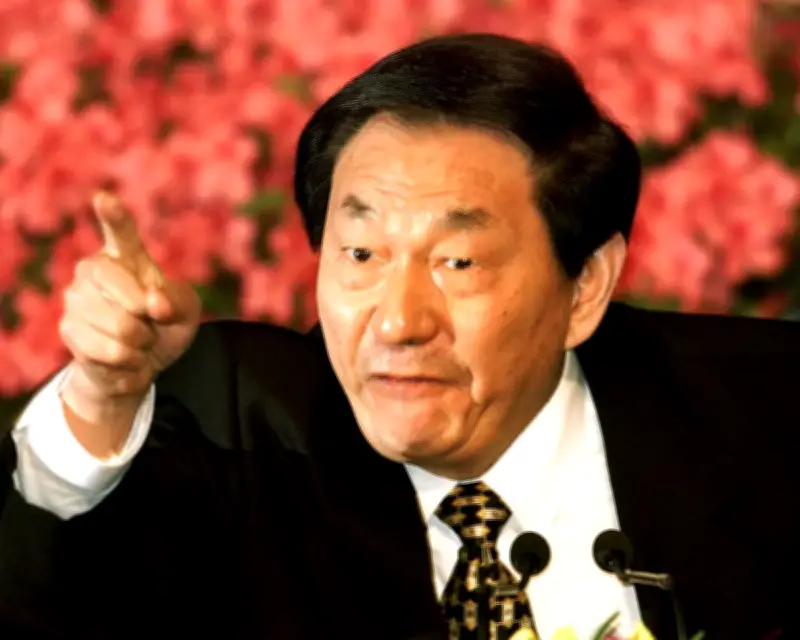
Zhu Rongji, the former premier of the People's Republic of China, has died at the age of 97. He was a leading economic reformer who played a pivotal role in transforming China into a global manufacturing powerhouse and securing its entry into the World Trade Organization (WTO).
Early Life and Political Rise
Born on October 23, 1928, in Changsha, the capital of Hunan province, Zhu was orphaned at a young age and raised by his father's two brothers. He joined the Communist Party in 1949 and graduated in electrical engineering from Qinghua University in Beijing in 1951.
His early career was marked by turbulence. Working as an engineer in the state development and planning commission, he was branded a "rightist" for criticizing Maoist policies during the Hundred Flowers campaign of 1956-57 and was sent to the countryside to teach. After a brief rehabilitation in 1962, he was again purged during the Cultural Revolution and sent to a "7 May school"—essentially a re-education camp—where he remained until 1975.
Economic Reforms and WTO Accession
Zhu was summoned to Beijing in 1991, following Jiang Zemin, to take charge of the economy as vice premier and governor of the People's Bank of China (1993-95). He implemented tough reforms to address inefficiencies in the state-owned sector and modernize infrastructure, declaring by the decade's end that China had become "the factory of the world."
His most significant achievement was securing China's WTO entry, which was finalized in 2001 after years of negotiations. The deal with the US, initially expected to be signed in 1999, was delayed by President Bill Clinton due to domestic political issues. Zhu reportedly expressed frustration with Washington's "incompetence and lack of foresight" but ultimately succeeded.
Legacy and Controversies
Zhu was known for his blunt style and harsh stance on corruption, once sacking a provincial governor on the spot. He famously said in 1998, "I have prepared 100 coffins here – 99 for corrupt officials and one for myself," earning him the nickname "the Boss."
However, his reforms came at a cost. Up to 60 million workers were laid off as the state sector was restructured, leading to social unrest. Despite these challenges, Zhu remained committed to the Communist Party and opposed political reforms, viewing Mikhail Gorbachev with contempt for his role in the Soviet Union's collapse.
Zhu retired in 2003 and was succeeded by his protégé, Wen Jiabao. He spent his later years largely out of politics, making his last public appearance at the 2017 party congress. He is survived by his wife, Lao An, and two children.




