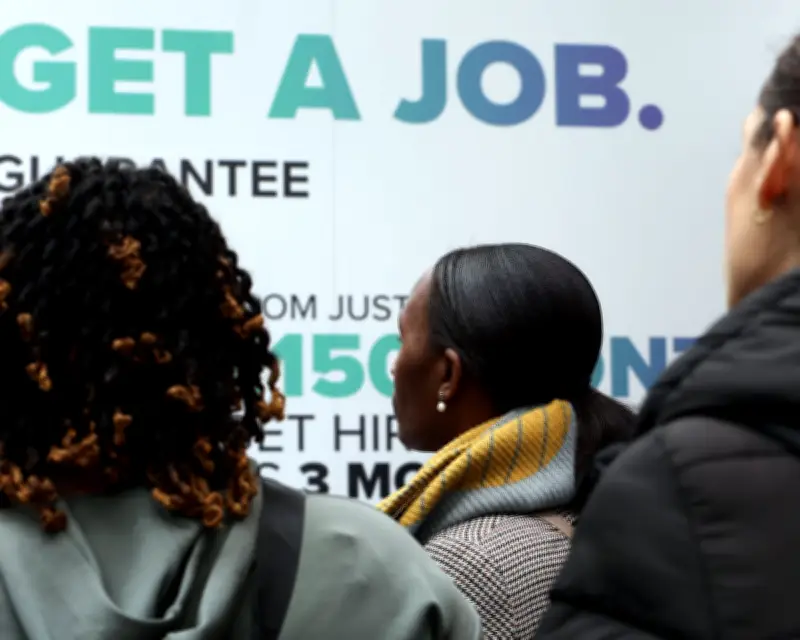
A recent report has revealed that young people in England are increasingly losing faith in their futures, with record numbers expressing fear of long-term unemployment. The Institute for Public Policy Research (IPPR) analyzed survey data, including from the Office for National Statistics, and found that 16- to 21-year-olds are less confident about being successful than they were a decade ago.
Declining Confidence Across Demographics
The IPPR report highlights that younger people are less convinced than older generations that hard work will be rewarded. Only one in four 16- to 29-year-olds agreed with the statement that 'everyone has a fair chance to go as far as their talent and hard work will take them.' This compares with 35% of 50- to 69-year-olds and more than 40% of those aged over 70.
'Confidence is falling across England, across social groups, and across genders,' the report states. This widespread decline in optimism is not limited to a specific demographic but is a broad trend affecting young people from all backgrounds.

Rising NEET Numbers
Policymakers have become increasingly concerned about the challenges facing young people. The number of 16- to 24-year-olds not in education, employment, or training (NEET) recently exceeded 1 million for the first time in a decade. Former Labour minister Alan Milburn is currently reviewing how to reverse this rise, with his findings expected later this year. In an interim report, he warned that Britain risks a 'lost generation' and could see a 25% increase in NEETs to 1.25 million by 2030 if action is not taken.
Economic Implications
The IPPR argues that falling confidence in future opportunities is not just socially problematic but can also have a detrimental impact on the economy. It disincentivises young people from studying, working hard, and building savings. Ellie Harris, IPPR’s head of children and young people, stated: 'Young people are telling us clearly that the deal no longer adds up. For too many, the promise that hard work will lead to security and opportunity no longer feels credible.'
Survey Data Highlights
The Understanding Society survey asked 16- to 21-year-olds to rate their chances of future success. The proportion who chose 20% or less was just 2% in 2015-17 but tripled to 6% by 2023-25. Meanwhile, the share who believed they had an 80%-plus chance of suffering long-term unemployment in their lifetime more than tripled to 7% over the same period.
Possible Causes
The IPPR identifies several possible causes for this shift, including the effects of austerity, the reshaping of the online information environment by personalised algorithms, and deteriorating mental health among young people. The thinktank suggests that young people may be 'drawing reasonable conclusions from the conditions around them,' such as rising youth unemployment and high housing costs.
Mental Health Concerns
The report estimates that as many as four in 10 women and three in 10 men aged 16 to 24 have poor mental health. Among those affected, only 24% believe they have a good chance of succeeding in life, compared with 48% of their peers. Separately, Prime Minister Keir Starmer is expected to announce restrictions on social media for under-16s amid fears about its impact on children's mental health.
Government Response
A government spokesperson said: 'We recognise too many young people have been locked out of opportunity. That’s why we are bringing forward a £2.5bn youth employment support package to help almost 1 million young people either earn or learn. We are also expanding youth hubs to every corner of Great Britain to provide crucial skills, job and housing support for the future generation.'
The IPPR’s research is part of a wider project called State of a Generation, sponsored by the charities Youth Futures Foundation and Big Change, and by the fast food chain McDonald’s.