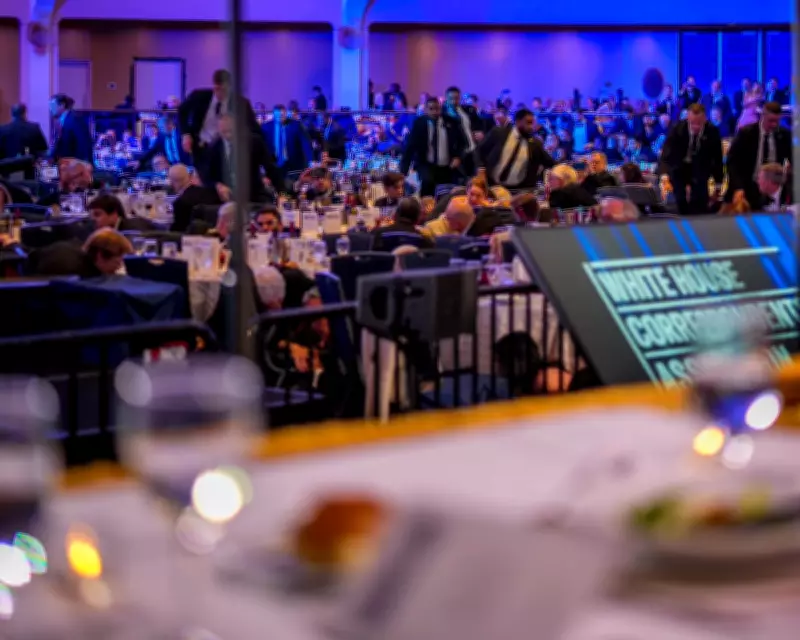
Secret Service agents responding to a shooting incident at the White House correspondents' dinner at the Washington Hilton on Saturday have raised questions over security at the event. The Secret Service director says security succeeded in stopping the shooter before he could do further harm, but others disagree.
Security Under Scrutiny
The shooting at the White House correspondents' gala has prompted questions over security, with some asking how a shooter was able to get close to where Donald Trump and many other senior administration officials were gathered. Many others praised the actions of law enforcement that swiftly stopped the attack.
As details about the shooting at the Washington Hilton continued to surface, the alleged shooter, Cole Tomas Allen, 31, mocked an "insane" lack of security at the Washington dinner in a manifesto reportedly sent to his family 10 minutes before his assault started.

"I walk in with multiple weapons and not a single person there considers the possibility that I could be a threat," the suspect said in the alleged manifesto first obtained by the New York Post, which expressed hostility to Trump and his administration. Allen, a Caltech graduate, wrote, "this level of incompetence is insane, and I very sincerely hope it's corrected by the time this country gets actually competent leadership again."
Political Reactions
Concerned Republican lawmakers have floated the creation of a House committee to investigate the shooting and security around the event, Politico reported Monday, citing three anonymous sources. The outlet said the House oversight and homeland security committees, and the Senate judiciary committee, have requested briefings from the Secret Service.
"There needs to be wholesale change," Mike Lawler, a Republican New York congressman who was at the dinner, told Politico. "This nutjob could have walked into any of the other events before the dinner and caused mass casualties."
The acting attorney general, Todd Blanche, earlier confirmed to NBC's Meet the Press that law enforcement believes the suspect was targeting administration officials "likely including the president" based on a preliminary assessment. The attack came less than two years since Trump was the target of an assassination attempt in Butler, Pennsylvania, and a subsequent attempt at a golf course in Florida.
Security Measures Praised and Questioned
Sean Curran, the Secret Service director, insisted late Saturday that security measures in place at the White House Correspondents' Association dinner had been successful in detaining the suspect before he could do further harm. The attacker was successfully brought to the ground, with the only injury to attendees being one law enforcement officer hit by a bullet but spared serious harm by a bullet-proof vest.
"It shows that our multi-layered protection works," Curran said. Others agreed. "We express our deepest gratitude to the US Secret Service and all law enforcement personnel who ensured the safety of everyone in the ballroom and beyond. Their actions protected thousands of guests, and we wish a full and speedy recovery to the officer who was injured in the line of duty," said Weijia Jiang, the WHCA president.
Trump said in an interview with Fox News that the shooter "never even came close to getting by the doors or getting through the doors." But security at the event was coming under scrutiny. "We're still understanding the security protocols that led to him being able to have firearms in that hotel," Blanche said during an interview with CBS's Face the Nation on Sunday.
Security Protocols
The Washington Hilton, the location of the 2,300-seat dinner, was closed to the public beginning at 2 p.m. Saturday, six hours before the dinner began. Guests were required to pass through several additional checks to enter the room, including showing tickets to association volunteers and hotel staff, and passing through airport-style metal detectors. The Secret Service maintained another perimeter around Trump that included a buffer separating him and others seated at the head table and armored plates hidden under the table where he was seated. Heavily armed counter-assault agents were posted to the left and right of the top table, behind curtains.

However, the measures, while effective in ensuring Trump was safe, did not prevent the dinner from being cancelled after security protocols were breached as the attacker sought to gain access to the room. According to the Associated Press, the Secret Service has long used the annual dinner to put some agents through their paces, in part because it was studied after the shooting of Ronald Reagan there by John Hinckley Jr. on March 30, 1981.
The hotel built extensive security modifications specifically to accommodate the president, including a secured garage designed to fit the presidential limo, which leads to a dedicated elevator and staircase to a secured suite. But hotels, while privately owned, function as "public accommodations," meaning they remain open to other guests staying there, apparently allowing the attacker to access the hotel with his weapons.
Political Fallout
Trump has already used Saturday's attack as further justification for the 1,000-seat ballroom currently under construction adjacent to the White House but which is under a series of legal challenges. "It's not a particularly secure building," Trump said of the Hilton. He maintained that a ballroom inside the White House perimeter with bullet-proof glass and protection from drone attacks was essential. But a judge has said national security "is not a blank check" and does not exempt the ballroom from planning approval.
Following the shooting, political factions settled into familiar arguments for why the foiled assassination attempt justified furthering their respective political objectives. For Republicans, that meant the ballroom, funding the Secret Service during the ongoing partial government shutdown, and renewing surveillance authorizations under the Foreign Intelligence Surveillance Act, due to expire next week. Blanche rejected the idea that Amtrak should now install security screening to prevent weapons being transported across state borders, as the suspect appears to have done as he traveled across the US by train to Washington.