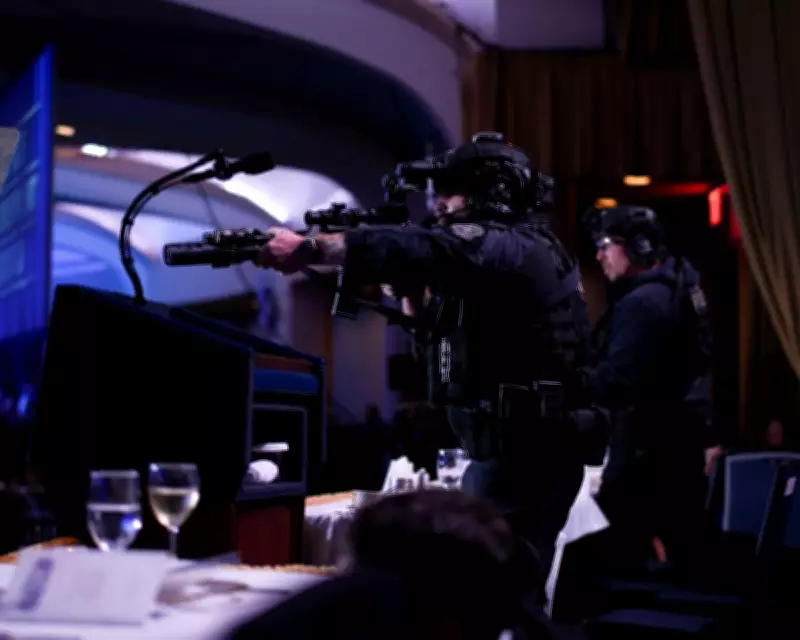
The annual White House Correspondents' Association dinner descended into chaos on Saturday night when gunfire erupted, forcing the evacuation of President Donald Trump and other senior officials. The incident has raised serious questions about security protocols and reignited debates over political violence in the United States.
Chaos at the Washington Hilton
Around 8:30 p.m., shots were heard inside the Washington Hilton ballroom, where roughly 2,000 guests had gathered for the traditional media event. Witnesses described scenes of panic as attendees, including journalists in formal attire, dove under tables. Secret Service agents swiftly surrounded the president and his cabinet members, escorting them to safety. Trump and First Lady Melania Trump were unharmed.
The Guardian's Washington bureau chief, David Smith, who was present, likened the experience to a Hollywood thriller. He reported seeing men in tuxedos and women in dresses scrambling for cover as agents shouted orders. The suspect, identified as Cole Tomas Allen, 31, of Torrance, California, attempted to breach a security checkpoint near the ballroom. He was carrying multiple weapons, including a shotgun, a handgun, and knives. Law enforcement intercepted him before he reached the main event, but he managed to fire, striking a Secret Service officer whose ballistic vest prevented serious injury. Allen was subdued and taken into custody.

Suspect and Motive
Allen has no prior criminal record in Los Angeles County, according to records. Interim Washington Police Chief Jeffery Carroll confirmed that Allen was a guest at the hotel and that authorities had secured his room for investigation. Acting U.S. Attorney General Todd Blanche stated that preliminary evidence suggests Allen was targeting members of the Trump administration. Investigators are analyzing a manifesto reportedly written by the suspect, which was published by the New York Post and deemed authentic by an official familiar with the matter. The manifesto listed targets ranked by priority, with administration officials at the top. About 10 minutes before the shooting, Allen sent writings detailing grievances against the administration to his family, White House officials told the Associated Press.
Trump's Reaction and Aftermath
President Trump used the incident to advocate for a secure ballroom on White House grounds, posting on Truth Social that such a facility has been demanded for 150 years. In an interview with CBS's Norah O'Donnell on 60 Minutes, Trump claimed he was not worried and that his curiosity may have slowed Secret Service efforts. He urged the dinner to be rescheduled within 30 days, stating, 'I don't want to see it be cancelled. I think it's really bad for a crazy person to be able to cancel something like this.' The dinner has been postponed but is expected to be rescheduled.
Broader Implications
The shooting has renewed scrutiny of White House security and the climate of political violence in America. The White House Correspondents' Association dinner, a tradition dating back to the 1920s, typically features self-deprecating remarks from the president and a comedy roast. This year's entertainment was to be magician Oz Pearlman. The most infamous prior incident occurred in 2011 when Barack Obama mocked Trump over birtherism, an event many link to Trump's 2016 presidential run.
As investigations continue, the nation grapples with the implications of yet another violent episode targeting political figures. The suspect remains in custody, and authorities are working to determine if any co-conspirators were involved.