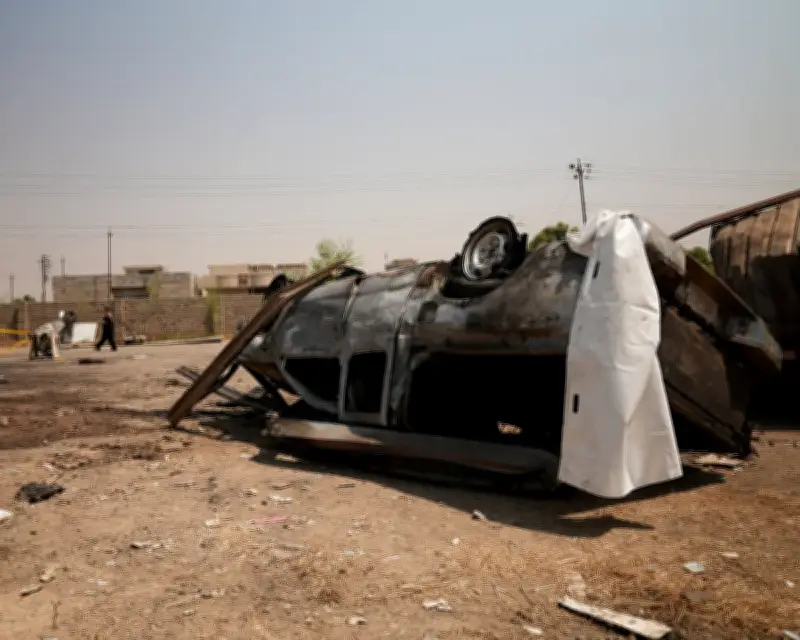
US-Saudi airstrikes on a Popular Mobilisation Forces (PMF) base in Mosul, Iraq, on Wednesday killed at least 20 fighters, pushing the region into what analysts describe as "uncharted territory." The strikes, which Riyadh publicly joined, mark a significant escalation in the ongoing conflict between the United States and Iran, adding a new dimension to the war.
The attack followed a brief lull in direct US strikes on Iranian targets, but Iran responded by launching missiles at US military installations in Jordan, its first such attack since the pause. President Donald Trump stated the US would "be hitting [Iran] hard," despite claiming coordination with the Iraqi government, which condemned the strikes as a violation of sovereignty.
Iraqi government condemns strikes
The Iraqi presidency called the air raids on the PMF, also known as al-Hashd al-Shaabi, a "blatant violation of Iraq's sovereignty, targeting its official institutions." The PMF is a network of Shia-majority factions established in 2014 to fight the Islamic State, overseen by Iranian General Qassem Suleimani, who was killed by a US strike in 2020. Iraqi Prime Minister Ali al-Zaidi cancelled a planned meeting with Saudi Crown Prince Mohammed bin Salman in Jeddah following the strikes.
Iran-backed militia Harakat Hezbollah al-Nujaba warned that Washington's and Riyadh's interests and security would face consequences. Mourners in Mosul shouted Shia sectarian slogans and "Death to America!" as they carried the bodies of slain fighters.
Regional implications and Saudi involvement
Iraq, heavily affected by the closure of the Strait of Hormuz through which most of its oil is exported, has struggled to prevent the war from spilling over its borders. While Saudi Arabia had reportedly been involved in secretive strikes on Iran, Riyadh's overt involvement marks a new turning point. This comes after Yemen's Iran-backed Houthi rebels announced a blockade of Saudi ports at the Red Sea entrance.
Sanam Vakil, director of the Middle East and North Africa programme at Chatham House, noted, "Everyone is trying to make sense of something that is increasingly senseless. There is no longer any plausible deniability because everyone knows how the relationships are intertwined." Vakil suggested Tehran's unpredictability aims to pressure Trump "either into confrontation or concession" to maintain control over the Strait of Hormuz.
Analysts warn of unpredictable responses
H A Hellyer, senior associate fellow at the Royal United Services Institute, said, "From the point of view of the Saudis, there is a feeling that the Iranians are doing what they are doing because they feel that the Gulf Arab states won't move up the escalatory ladder. The Saudis want to make it clear that assessment is wrong." However, he warned that while the Saudis may have rationalized the attack as precisely calculated, the response could be impossible to anticipate, placing the region in "uncharted territory."