
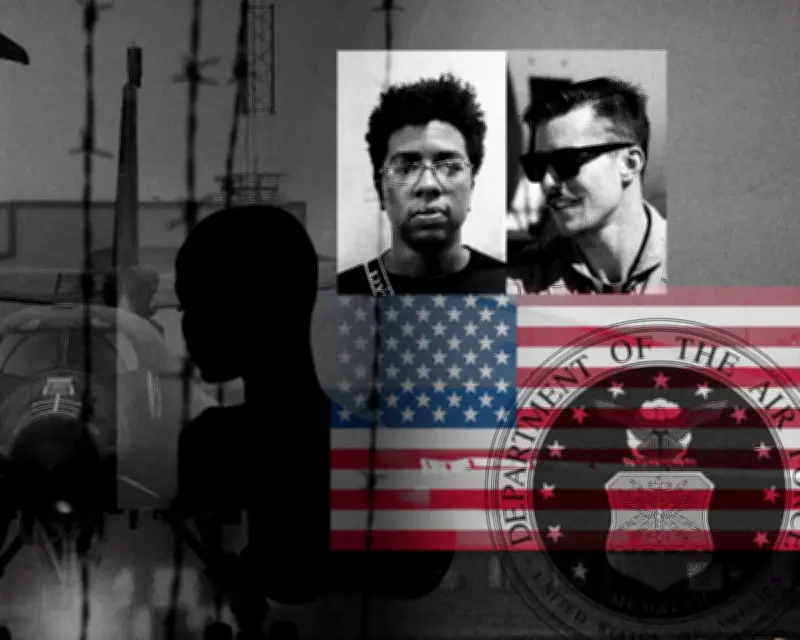
A Guardian investigation has uncovered how US military personnel accused of raping and sexually assaulting women in the UK have avoided British justice, instead being tried in secret court martials on sealed bases where sentences are often lighter than under UK law.
Secret trials on US bases
For the past six months, the Guardian's investigations team has examined the secretive world of US military bases in Britain. The bases, such as Lakenheath in Suffolk, are closed to the public and function as slices of Americana, complete with shopping malls and Taco Bell. In April, reporters Harry Davies and Rob Evans became the first British journalists known to attend a court martial on a US base.
They observed the trial of Jacob Wulfson, a fighter pilot accused of sexually assaulting British academic Sarah Steele. Steele alleged Wulfson drugged, strangled, and penetrated her without consent. An all-male panel of eight US air force officers heard the case. Steele endured six hours of grueling questioning, with Wulfson's lawyer claiming she fabricated the allegations for money and abused prescription drugs.
Lighter sentences under US military law
Under British law, Wulfson would likely have faced a rape trial. Instead, he was acquitted of drug and sexual offenses but convicted of strangling an intimate partner. The panel gave him a formal reprimand, six months' confinement at Lakenheath, and dismissal from the air force. The jury was allowed to consider Wulfson's combat record, with former colleagues testifying about his military adventures in Afghanistan. Harry Davies noted, “The irony was that a man’s track record in killing people was being used as mitigation for a sentence for committing a violent crime.”
Without the Guardian's presence, the only public record of his trial would have been a brief entry on an obscure US air force webpage.
Pattern of US jurisdiction
The reporters identified multiple cases where US service members in the UK were convicted by US courts martial of sexual assault, paedophilia, indecent exposure, and violent attacks, often involving British victims committed while off duty. In three particularly disturbing cases, the US military took jurisdiction from UK police: one airman allegedly exposed himself to a 16-year-old girl and four women in Cambridgeshire; another was accused of rape by two women; and a third faced accusations of raping sleeping women in England. None were convicted of rape.
“We began to realise that this had been going on for a very long time,” Davies said. “There seemed to be quite a lot of cases where people in the UK have been harmed by visiting US military, who come here for a few years, and then move on.”
Legal framework and police role
The presence of US bases is governed by a 1951 agreement stipulating that the US prosecutes its own personnel for offenses committed on duty or against other US forces. For other cases, UK police should decide whether to prosecute. However, police have often ceded control to the US military. One alleged rape victim was advised by an ISVA that the CPS might not prosecute and that US military court would provide quicker resolution. Victims in England and Wales wait an average of 417 days for rape cases to be heard.
Davies noted the US military has been “aggressively” expanding its jurisdiction, with different police forces interpreting rules inconsistently. Following the investigation, ministers and police chiefs have pledged to examine why UK police have handed cases to the US military.
Impact and response
The investigation has generated significant reader correspondence and government attention. Davies, who has also exposed ties between Israeli military and big tech and Mossad's efforts to pressure the ICC, said this story has resonated widely. The Guardian continues to devote resources to such investigative journalism, which relies on public support.




