
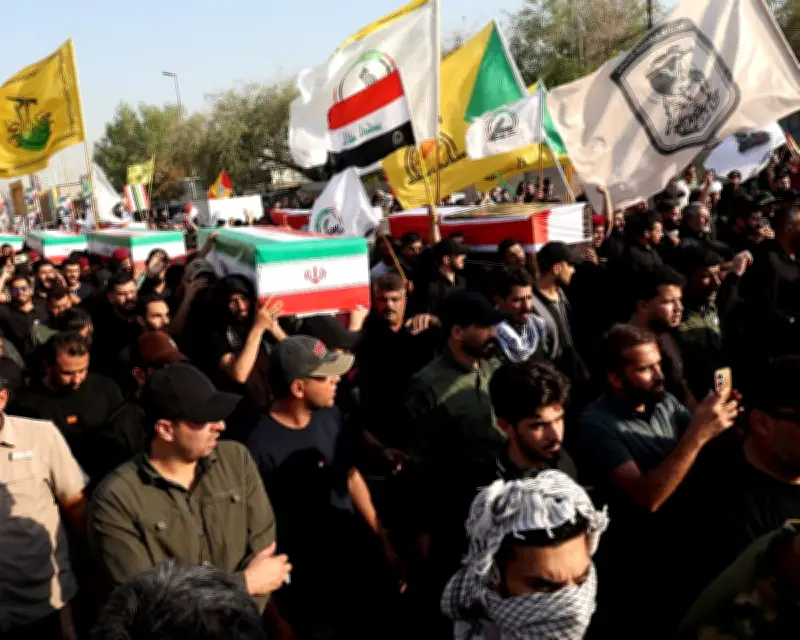
The US war against Iran is spiraling out of control, with Saudi Arabia joining American airstrikes in Iraq and reportedly planning an offensive on Yemen's Houthi militia. The conflict has expanded across the Middle East, with attacks in at least five countries, threatening to disrupt energy supplies and potentially triggering a global recession.
Saudi Airstrikes in Iraq
On Wednesday, Saudi Arabia announced it had joined the US in airstrikes inside Iraq against the Iranian-backed Popular Mobilization Forces (PMF), killing at least 20 fighters. Saudi officials had blamed Iraqi-based militias for drone attacks on Saudi oil facilities on 27 July and warned of retaliation if Iraq did not restrain the groups. The PMF is a network of mostly Shia militias created with Tehran's support in 2014 to fight Islamic State.
Trump claimed the US and Saudi militaries coordinated with Iraq before the strikes, but Iraqi leaders denied any prior knowledge. This denial highlights that many regional leaders don't want to be associated with Trump's expanding war. The attacks threaten to undermine Iraq's fragile power balance, as it struggles to maintain good relations with both sides.
Historical Context and Escalation
After the 2003 US invasion of Iraq, Washington helped install a Shia-led government, opening the door for Iran's influence and powerful militias. Iran's efforts were overseen by Qassem Suleimani, assassinated by a US drone strike in January 2020 on Trump's orders, along with PMF deputy chief Abu Mahdi al-Muhandis. This fueled animosity and set the stage for the current war.
Beyond Iraq, the US and Saudi Arabia risk expanding the war. The kingdom is reportedly planning a major offensive against the Houthi militia, which controls large areas of Yemen. After Trump's war began in late February, Iran effectively shut the strait of Hormuz, through which a fifth of the world's oil and liquid gas supplies passed daily. Some producers, especially Saudi Arabia, shifted exports to the Red Sea, but the Houthis can disrupt shipping there.
Houthi Blockade and Impact
On 20 July, the Houthis declared a blockade on Saudi vessels in the Red Sea, retaliating for a Saudi air and naval blockade on Yemen. They have since attacked several ships, forcing Saudi Arabia to reroute nearly half of its oil exports around Africa. On 25 July, the Houthis claimed to have struck "sensitive" oil infrastructure in Saudi Arabia, disrupting the Yanbu export hub. The Saudis retaliated with airstrikes in Yemen.
Saudi Arabia's GDP decreased by nearly 5% in the second quarter of 2026 compared to last year. Saudi leaders blame Iran for the Houthi escalation and have vowed to form an international maritime coalition. On Thursday, the Saudi defense ministry announced 14 states, including Turkey, Pakistan, Egypt, and Sudan, had agreed to join. But it's unclear how this differs from the EU's Operation Aspides.
Risk of Reopening Yemen Wounds
Saudi Arabia's crown prince, Mohammed bin Salman, has tried to avoid direct confrontation with Iran, but the conflict with the Houthis risks reopening a painful chapter. In 2015, Saudi Arabia led a coalition to intervene in Yemen's civil war, aiming to dislodge the Houthis from Sana'a. By the end of 2021, the UN estimated the conflict had killed 377,000 people, nearly 60% of whom died from indirect causes like food shortages and cholera.
Despite thousands of airstrikes over seven years, the Houthis retained control of the capital. A UN-brokered ceasefire in 2022 held, but negotiations for a permanent peace deal stalled after the Houthis began attacking ships in 2023. Today, the tenuous ceasefire is in danger of collapsing, another casualty of Trump's disastrous war against Iran.




