US Hockey Champions Greeted at State of the Union Amid Political Spotlight
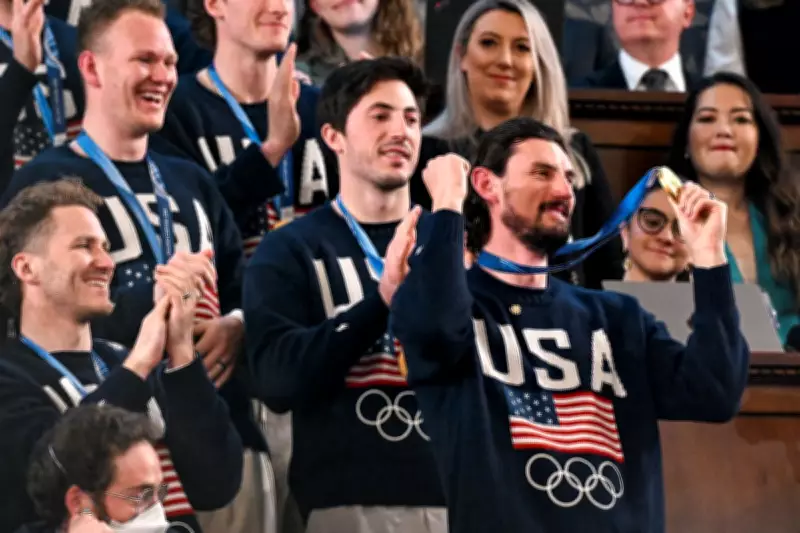
During Tuesday's State of the Union address, President Donald Trump welcomed members of the newly crowned US men's national ice hockey team to the House gallery, sparking chants of "U-S-A, U-S-A!" from the assembled lawmakers. The Olympic champions, who had defeated Canada in the Winter Olympics final just days earlier, received a warm bipartisan applause, yet their presence served as a potent political symbol in Trump's America.
Presidential Honors and Political Props
Trump announced that Team USA's goaltender, Connor Hellebuyck, would receive the prestigious Presidential Medal of Freedom, declaring, "What special champions you are." However, the president strategically framed their introduction within his broader narrative of national success, stating, "Our country is winning again. To prove that point, here with us tonight is a group of winners who just made the entire nation proud." This moment underscored how athletes are increasingly utilized as political props in today's polarized climate.
The team's entanglement with Trump began immediately after their victory in Milan, when a widely circulated video showed players listening as the president extended a White House invitation. Trump notably added, "I must tell you, we're going to have to bring the women's team," prompting laughter from many players that was widely interpreted as derisive. Scorer Jack Hughes later addressed the backlash, saying, "People are so negative out there. Everything is so political. We're athletes. When you get the chance to go to the White House and meet the president, we're proud to be Americans, and that's so patriotic."

The Inevitable Collision of Sports and Politics
Hughes's observation that "everything is so political" rings particularly true under Trump's presidency. While sports and politics have long intersected, these collisions have intensified, revolving around central questions of loyalty and national identity. From debates over who is American enough to perform at the Super Bowl to partisan scrutiny of athlete participation, sports have become a battleground for defining allegiance in the Trump era.
Trump's recent fascination with hockey reveals deeper geopolitical tensions. Last winter, as the US faced Canada in the NHL's Four Nations tournament, Trump mused about annexing Canada as America's 51st state. Following Canada's tariff deal with China, he warned that China would "take over Canada" and "end ice hockey." Weeks later, during a social media rant about the Gordie Howe International Bridge, Trump speculated China would "eliminate ALL Ice Hockey being played in Canada and permanently eliminate The Stanley Cup."
Hierarchy, Leverage, and International Relations
These comments transcended mere trade disputes, reflecting Trump's focus on hierarchy and deference. They followed Canadian Prime Minister Mark Carney's perceived upstaging of Trump at Davos, after which Trump withdrew Carney's invitation to join the Board of Peace. In Trump's worldview, hockey—as Canada's national game—becomes leverage, something to threaten when international relations don't align with his preferences.
Visible Divisions and Strategic Absences
Despite the appearance of unity in the House gallery, divisions within the hockey community were apparent. Several players, including four from Minnesota where Trump implemented harsh immigration policies, were absent from the event. While none explicitly condemned the president, their absence spoke volumes. More strikingly, the entire US women's national ice hockey team, also gold medalists, declined their White House invitation—a move executed gracefully but understood as a political statement. Trump mentioned in his speech that the women would visit "soon," but no official confirmation has followed.
Trump's treatment of athletes varies significantly based on perceived loyalty. Earlier in the Games, when US freestyle skier Hunter Hess stated that wearing the flag didn't mean he represented "everything that's going on in the US," Trump rebuked him online as "a real Loser" who "shouldn't have tried out for the Team." This incident highlights the expectation that athletes must demonstrate unwavering loyalty both to America and to Trump's vision of it.

The Unavoidable Political Arena for Athletes
While athletes like Hughes may wish for simplicity—a separation between sports and politics—that division has never existed in practice. Today, more than ever, athletes are expected to take their place within a hierarchy, proving their loyalty to both nation and leader. The US hockey team's State of the Union appearance exemplifies how sports have become another arena where political allegiance is performed, tested, and scrutinized in Trump's America.