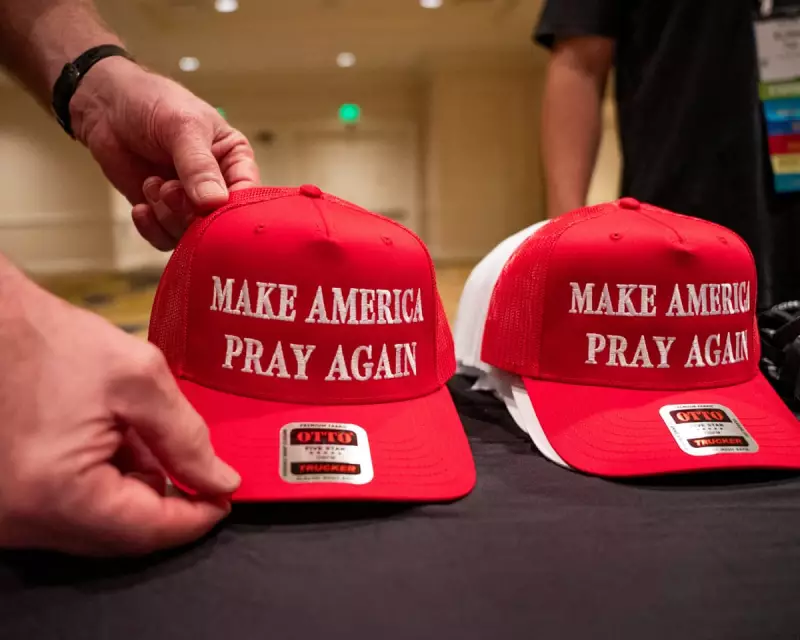
While prominent Christian figures are gaining influence within right-wing circles in Britain, new research indicates the broader evangelical community's political allegiances are far more fragmented and distinct from the US model.
A Different Landscape: UK vs US Evangelical Politics
The powerful fusion of evangelical Christianity and right-wing politics has long been a defining force in the United States, forming a steadfast base for Donald Trump. However, a fresh poll conducted by the UK's Evangelical Alliance (EA) suggests Britain is not following the same path. The survey of nearly 1,500 evangelicals shows Labour leading with 26% support, while Reform UK and the Liberal Democrats are tied on 20%. The Conservatives trail at 18%, with the Greens on 12%.
This stands in stark contrast to the US, where around three-quarters of evangelicals approved of Trump's presidency. In Britain, evangelicals constitute a much smaller portion of the population—roughly a tenth of the US figure—and their voting intentions reveal a more complex picture.

Prominent Faces and Policy Influence
Despite the diverse voting base, devout Christians are certainly visible in certain political spheres. At Reform UK events, the party's head of policy, MP Danny Kruger, and senior adviser James Orr, a Cambridge academic, are notable figures. Both are outspoken on social issues like abortion and family values.
They also sit on the advisory board of the right-wing thinktank the Alliance for Responsible Citizenship, led by the strongly religious Conservative peer Philippa Stroud. Another member is Paul Marshall, the hedge fund millionaire who owns GB News and The Spectator, and is a devout Christian.
James Orr has links to the US religious-right, having hosted Vice-President JD Vance at his home and being involved with the National Conservatism movement. However, these connections remain exceptions rather than the rule.
Faith Across the Spectrum and Emerging Trends
Evangelical belief in Parliament is not confined to the right. It exists across parties, including in cross-party prayer groups. Figures like Kruger are balanced by others such as Tim Farron, the former Liberal Democrat leader, and Labour MP Rachael Maskell, who is vocal about her faith shaping her stance on poverty and social justice.
Danny Webster, head of advocacy at the EA, explains the nuance: "Sometimes with evangelicals there can be a dissonance between opinions, especially on social issues, and how people vote... So the opinions on economic issues like poverty can win as social issues don't have an outlet." The poll reflected this, showing support for more generous welfare alongside significant concern about plans to legalise assisted dying.
A newer, more marginal trend mirrors American-style religious nationalism. Far-right agitator Tommy Robinson now frames himself in explicitly Christian terms, often in opposition to Islam. Similarly, Nick Tenconi of Turning Point UK mixes calls for the country to "return to Christ" with anti-Islam and anti-migrant messaging. In October, a group called King's Army, allied with Turning Point, marched through London's LGBT+ community centre in Soho.
Yet, this remains a niche phenomenon. Friends of Paul Marshall insist he is "strongly opposed to Christian nationalism and any kind of politicisation of faith." One Christian MP on the right noted that beyond specific issues like assisted dying, there is little cohesive evangelical lobby, concluding: "And here, religion is not really a vote winner."