From Peace President to Operation Epic Fury: Trump's Road to War
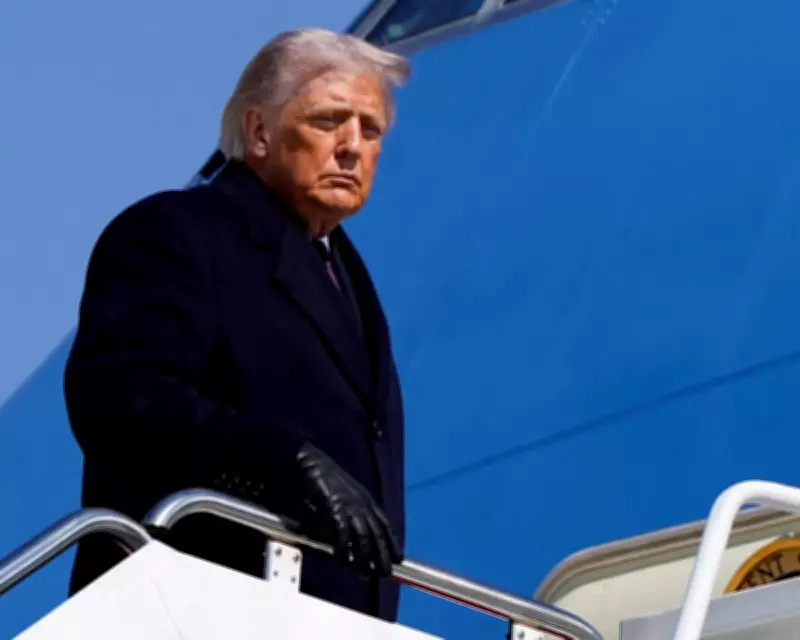
Donald Trump ordered the launch of the war on Iran last Friday afternoon while aboard Air Force One, as the presidential plane descended toward Corpus Christi, Texas. Trump was en route to deliver a speech titled American Energy Dominance and had spent the three-hour flight discussing options in Iran with Texas Republican politicians, including hawkish senators John Cornyn and Ted Cruz.
The Flight and the Prelude to Conflict
Also present on the plane during the countdown to Operation Epic Fury was veteran film star Dennis Quaid. At one point, Cruz filmed Quaid sitting next to Trump and persuaded the actor to reprise his role as Ronald Reagan from a 2024 biopic, framing the encounter as "two great American presidents." Speaking as Reagan, Quaid declared Trump was "like me on steroids," symbolically passing the flame from the patron saint of Republican hawks to their current hero.
Not mentioned was Quaid's earlier role as a slapstick version of George W. Bush in the 2006 film American Dreamz, portraying a clueless president manipulated into war. The shadow of Bush and the regional conflicts he ignited loomed over the past week's events, though comparisons were largely unacknowledged or rejected by the White House.
Trump's Transformation and Military Aspirations
Trump had campaigned as a leader who would end America's "forever wars" initiated by Bush in Afghanistan and Iraq. His Maga movement was built on antipathy to foreign entanglement, and he spent much of 2025 lobbying for the Nobel Peace Prize. However, within months, the "peace president" became the first U.S. leader since Bush to lead a regime-change war against a major adversary.
Factors behind this transformation include Trump's susceptibility to persuasion by foreign strongmen, his showman's knack for distraction, a stubborn adversary, and the momentum of a vast military machine. In reality, Trump's opposition to war was only partial; he opposed large-scale infantry conflicts but was willing to use overwhelming air power to punish enemies. He risked all-out war with Iran in his first term by assassinating General Qassem Suleimani in January 2020 and bombed Iran's nuclear sites in Operation Midnight Hammer last June.
Key Events Leading to War
A pivotal moment was the successful kidnapping of Venezuelan leader Nicolás Maduro on January 3 this year, a made-for-television success that boosted Trump's military confidence. This operation diverted attention from domestic pressures, such as the Jeffrey Epstein files, where Trump is mentioned over 38,000 times, though he denies any wrongdoing.
Israeli Prime Minister Benjamin Netanyahu played a crucial role in swaying Trump toward regime change in Iran. During a visit to Mar-a-Lago in late December, Netanyahu sought U.S. approval for strikes on Iranian missile sites, which later expanded into a joint onslaught to overthrow the Islamic Republic. Protests in Iran over economic conditions further influenced intelligence assessments, with the CIA and Mossad becoming more confident the regime could be toppled.
Saudi Crown Prince Mohammed bin Salman also privately urged Trump to attack Iran in February, while publicly advocating for peace. By the time Netanyahu met Trump at the White House on February 11, regime change had become the preferred option, with joint U.S.-Israeli military planning already underway.
Diplomatic Efforts and Military Buildup
Publicly, Trump insisted on a diplomatic solution to Iran's nuclear and missile programs, with negotiators Steve Witkoff and Jared Kushner meeting Iranian diplomats three times in February. However, the gaps were too wide, and by the Geneva meeting on February 26, the U.S. had amassed the largest military force in the Middle East since the Iraq invasion. Trump demanded Iran's surrender, with Witkoff questioning why they hadn't capitulated.
The scale of joint planning with Israel, including AI-assisted targeting, created its own momentum. U.S. Secretary of State Marco Rubio claimed Washington was aware of an impending Israeli attack that would force pre-emptive U.S. strikes, though Trump denied this version. The strikes were delayed multiple times, ultimately scheduled after intelligence indicated Iran's supreme leader, Ayatollah Ali Khamenei, would be at his compound.
The Launch of Operation Epic Fury
Trump gave the order at 3:38 PM from Air Force One, stating, "Operation Epic Fury is approved. No aborts. Good luck." Upon landing in Corpus Christi, he evaded questions, later flying to Mar-a-Lago where defense officials awaited in an improvised situation room. As partygoers attended a fundraiser, Trump excused himself, saying, "I gotta go to work."
The operation began at 1:15 AM Florida time, with over 30 Israeli missiles and more than 100 U.S. aircraft striking Khamenei's compound, killing him and senior officials. General Dan Caine described it as a "massive, overwhelming attack across all domains of warfare." Trump framed the assault as an opportunity for the Iranian people to overthrow the regime, though the administration has since scaled back regime-change rhetoric.
Trump now emphasizes his steadfastness in war, boasting of a "virtually unlimited supply" of weapons and stating, "Wars can be fought 'forever' and very successfully," marking a complete reversal from his earlier anti-war stance.