Trump's Prayer Breakfast Address Blends Politics and Faith
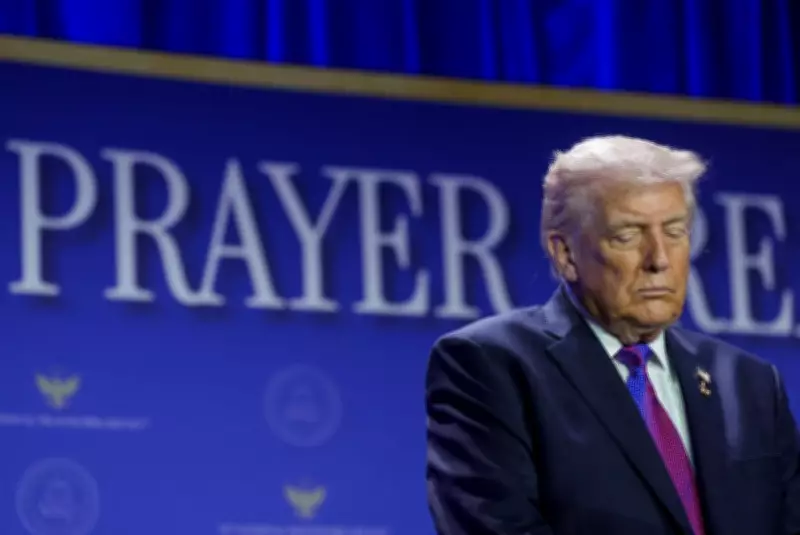
Donald Trump delivered a characteristically unconventional speech at the National Prayer Breakfast in Washington DC on 5 February 2026, transforming the traditionally solemn religious gathering into what many observers described as a political rally. The event, held in the cavernous ballroom of the Washington Hilton hotel, saw the former president wearing a dark suit and purple tie as he addressed attendees with his trademark rhetorical style.
A Political Performance in a Religious Setting
The National Prayer Breakfast has historically featured speakers ranging from Mother Teresa to Bono, but Trump's appearance marked a distinct departure from the event's usual tone. Rather than focusing on spiritual reflection, the former president embarked on what critics described as a "greatest hits" tour of his political talking points, barely touching on themes of prayer or religious devotion.
In a somewhat slurry delivery, Trump launched into familiar territory, attacking what he called "transgender insanity" and criticising wind farms for their impact on bird populations. He revisited his interest in Greenland, describing it as "the biggest piece of ice in the world," and boasted about the military, claiming service members "all look like Tom Cruise only bigger."
Insults and Political Rivalries
The speech included characteristic insults directed at political opponents. Trump dismissed Republican representative Thomas Massie as a "moron" and wrestled with his preferred nickname for President Joe Biden, debating between "Sleepy Joe" and "Crooked Joe." He described Barack Obama as "divisive" while simultaneously questioning how "a person of faith can vote for a Democrat."
Trump repeated his unfounded claim that the 2020 election was "rigged" and celebrated his 2024 victory, stating: "I had to win it. I needed it for my own ego. I would have had a bad ego for the rest of my life. Now I really have a big ego. Beating these lunatics was incredible."
International Guests and Awkward Moments
The former president welcomed two special guests to the event, though not without some awkwardness. He praised Nayib Bukele, president of El Salvador, describing him as "one of my favourite people" and "a great ally," while noting that Bukele "operates rather large prisons."
Trump then attempted to introduce "the president of the Congo," but clearly couldn't remember Félix Tshisekedi's name. After a pause, he simply asked the Congolese leader to stand, telling him: "You're a brave man," while apparently remaining unaware of his guest's identity.
The Religious Right's Complex Relationship with Trump
The event highlighted the continuing alliance between Trump and the religious right, despite his acknowledged distance from traditional Christian practices. Trump recalled how, during his initial presidential campaign, southern Baptist pastor Robert Jeffress had offered a frank assessment: "He may not be as good with the Bible as some of them. He may not have read the Bible as much as some of them. In fact, he may not have ever read the Bible, but he will be a much stronger messenger for us."
Trump added: "You know, I didn't want to admit anything, but that was very interesting and I think we've gotten more done than anybody could have ever gotten done." This exchange encapsulates what analysts describe as a "devil's pact" between Republicans and rightwing evangelicals, who see Trump as a modern-day Cyrus the Great - an instrument of divine purpose despite personal shortcomings.
Trump's Personal Theology
The former president offered glimpses into his personal beliefs during the speech. He mused: "Religion - you have to believe in something. You have to believe that what we're doing, there's a reason for it. There has to be a reason for it. We're all working and we're doing, we're behaving. I mean, I behave because I'm afraid not to, OK, because I don't want to get in trouble."
Trump also shared personal anecdotes, including his sleeping habits during presidential travel: "I don't sleep on planes. I don't like sleeping on planes. You know, I like looking out the window watching for missiles and enemies, actually."
A Messianic Self-Image
Despite his acknowledged lack of biblical knowledge, Trump appears to have developed a messianic self-image. He concluded with a characteristically confident assessment of his spiritual prospects: "I really think I probably should make it. I mean, I'm not a perfect candidate but I did a hell of a lot of good for perfect people."
The National Prayer Breakfast speech demonstrated how Trump continues to command loyalty from religious conservatives while operating outside traditional religious frameworks, maintaining his unique position at the intersection of American politics and faith.