
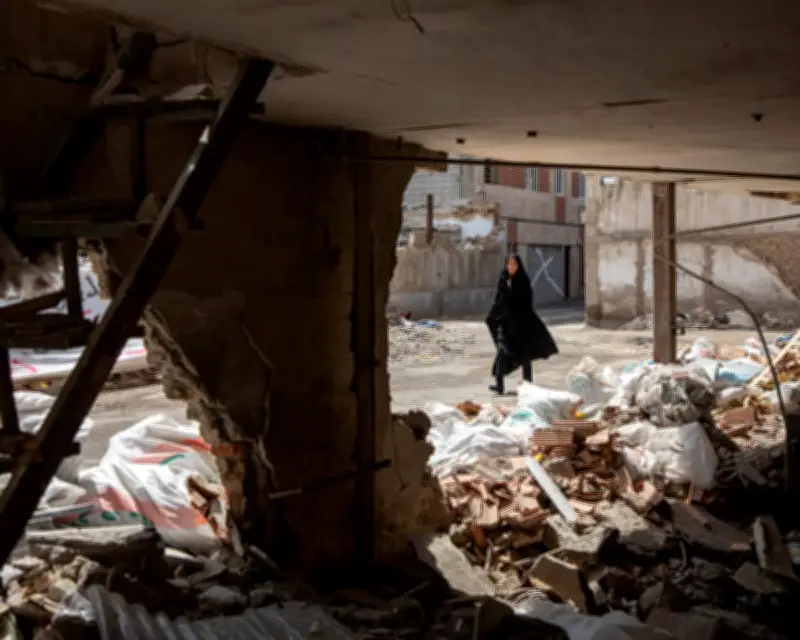
Five years after the chaotic US withdrawal from Afghanistan, the United States is repeating the same catastrophic mistakes in Iran. President Donald Trump's "little excursion" against Iran has escalated into a sixth month of conflict, with no end in sight, echoing the "forever war" pattern that defined Afghanistan and Iraq. This new war, analysts warn, threatens to become another quagmire, with devastating consequences for the region and the world.
The Afghanistan Lesson Ignored
The US-led invasion of Afghanistan, launched after the 9/11 attacks, cost over 2,400 US and 450 British troops their lives, along with tens of thousands of civilians. The Taliban, initially routed, returned to power in 2021, reinstating repressive rule. The war, which cost roughly $1 trillion, was based on a flawed premise: that Afghanistan would otherwise become a safe haven for terrorism. As Carter Malkasian, a National War College professor and former adviser in Afghanistan, noted, "Nothing of the sort occurred. Over the past five years, not a single act of terrorism against the US was carried out by a group based in Afghanistan."
Malkasian's warning is stark: "The greatest danger is not that a terrorist safe haven might once again emerge in Afghanistan. A graver threat comes from the risk of collective forgetting." This collective forgetting seems to have taken hold, as the US now finds itself embroiled in another conflict with no clear exit strategy.
Iraq: A Repeat of False Premises
The Iraq war, launched in 2003, was justified by false claims about weapons of mass destruction and links to al-Qaida. The occupation led to an insurgency and contributed to a broader "global war on terror." According to Brown University's Costs of War project, an estimated 940,000 people were killed in direct post-9/11 violence in Iraq, Afghanistan, Syria, Yemen, and Pakistan between 2001 and 2023, with up to 3.8 million dying indirectly.
In Iran, similar exaggerations are at play. Trump and Israeli Prime Minister Benjamin Netanyahu have "greatly and knowingly exaggerated the immediacy and existential nature of the Iranian threat," according to Simon Tisdall, a Guardian foreign affairs commentator. Iran possesses no nuclear weapons, and there is zero firm evidence it is actively seeking them, yet the US has launched a war based on perceived threats.
The Forever War Dynamics
The concept of a "forever war" is not new. It was first coined during the Vietnam War, which was fought under the discredited "domino theory" and driven by US exceptionalism and global hegemony. Today, Trump's policies reflect similar motives, from his hostility toward Venezuela and Cuba to his attempts to monetize conflicts in Ukraine and Gaza.
The lack of effective UN mediation, the hollowing out of US diplomacy under Secretary of State Marco Rubio, and a refusal to accept military reality all contribute to turning conflicts into quagmires. Trump's ego, too, plays a role. He seems "rather kill thousands more civilians, risk committing war crimes, set the Middle East ablaze and destroy Republicans' electoral chances than admit he was wrong over Iran."
The Human and Moral Toll
The war's pointlessness is fundamentally immoral, Tisdall argues. "War without end is the death of hope." As Trump twists and turns, alternating between talk of negotiations and massive violence, the situation worsens. Iranian hardliners, careless of their people's suffering, relish his dilemma and escalate regional attacks, including drone and missile strikes that spook the global economy.
Neither military escalation nor a desperate deal is likely to work. This Iranian catastrophe is already defining Trump's presidency, leaving a "bloody stain" that will last forever. The lesson of Afghanistan—that exaggerated threats lead to endless, costly wars—remains unlearned, and the world is paying the price.




