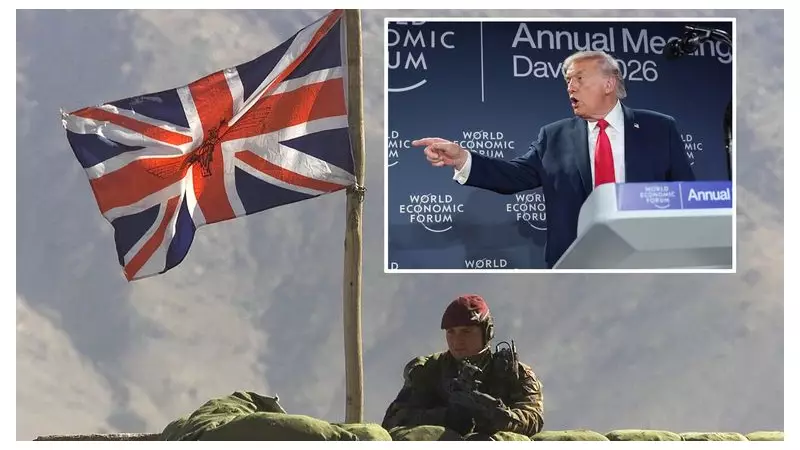
Former US President Donald Trump has ignited a firestorm of criticism from the British government, military veterans, and grieving families following controversial remarks about NATO allies' involvement in the Afghanistan conflict. During an interview with Fox News at the Davos summit, Trump asserted that troops from alliance nations, including the United Kingdom, remained "a little off the frontlines" during the war.
Downing Street Delivers Forceful Rebuttal
The Prime Minister's official spokesman issued a sharp response, stating unequivocally that Trump was "wrong" to diminish the contributions of NATO and British forces. The spokesman highlighted the 457 British service personnel who lost their lives in Afghanistan, alongside "many hundreds" more who sustained serious injuries, emphasising that UK troops participated in "sustained combat operations" alongside American counterparts.
"We are incredibly proud of our armed forces and their service and sacrifice will never be forgotten," the spokesman declared, underscoring the government's unwavering support for veterans and their families.

Families of Veterans Express Profound Anger
The reaction from military families has been particularly visceral. Diane Dernie, whose son Ben Parkinson survived catastrophic injuries after his vehicle struck a mine in 2006, described Trump's comments as "the ultimate insult." Parkinson, widely regarded as the most severely injured British soldier to survive the conflict, had both legs amputated and suffered brain damage and spinal injuries.
"I can assure you, the Taliban didn't plant IEDs miles and miles back from the front line," Dernie stated passionately. She called on political leaders to robustly defend the armed forces and refute Trump's assertions, noting her son's ongoing struggles nearly two decades later.
Political Figures Unite in Condemnation
Across the political spectrum, MPs and ministers have voiced their outrage. Defence Secretary John Healey reminded the public that NATO's Article 5 collective defence clause was invoked only once—following the 9/11 attacks to support the United States. "Those British troops should be remembered for who they were: heroes who gave their lives in service of our nation," Healey affirmed.
Social Care Minister Stephen Kinnock echoed this sentiment, labelling Trump's remarks "plainly wrong" and praising the valour of British forces. Conservative Party leader Kemi Badenoch denounced the comments as "complete nonsense" that risk undermining the NATO alliance, while Liberal Democrat leader Sir Ed Davey pointedly noted Trump's own history of avoiding military service.
Veterans and Experts Counter False Narratives
Defence Minister Al Carns, a former commando awarded the Military Cross for gallantry after five tours in Afghanistan, dismissed Trump's claims as "ridiculous." "Many courageous and honourable service personnel from many nations fought on the front line. Many fought way beyond it," Carns asserted, highlighting the deep bonds forged in conflict.
Tory MP Ben Obese-Jecty, who served as a captain in Afghanistan, expressed sadness at seeing the nation's sacrifice "held so cheaply" by the US president. He recounted firsthand experiences in Sangin, where British and American forces endured severe casualties together.
Former UK ambassador to Afghanistan Sir Nicholas Kay added his voice to the chorus of criticism, noting that Trump "is not known for his accuracy with facts" and fails to appreciate NATO's value appropriately.
The Stark Human Cost of the Conflict
The Afghanistan war exacted a heavy toll on coalition forces. The United Kingdom suffered the second-highest number of military deaths, with 457 fatalities, while the United States recorded 2,461 losses. Overall, America's allies accounted for 1,160 deaths—approximately one-third of total coalition casualties.
These statistics underscore the profound sacrifices made by international troops who answered the call to support the US-led mission. The memories of battles in places like Sangin, Musa Qala, and Nad Ali remain etched in the minds of survivors and the families of those who never returned home.

As the controversy continues to reverberate, the unified response from British officials, veterans, and military families serves as a powerful testament to the enduring legacy of those who served—and the unwavering commitment to honour their contributions.