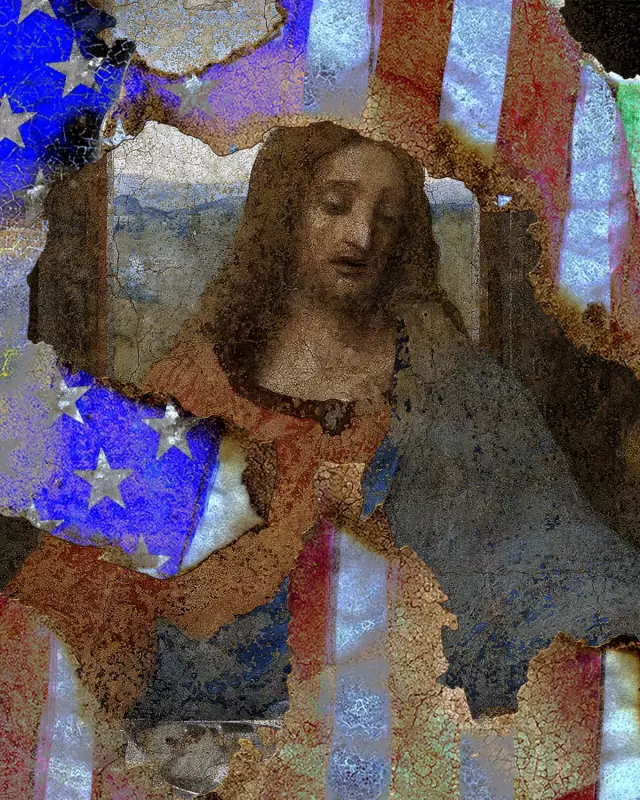
The political landscape of America under Donald Trump bears a striking resemblance to the transformation many Christians have witnessed within their own faith communities over recent decades. As the former president displays increasingly authoritarian tendencies, those raised in mainline Protestant traditions recognise a familiar pattern: the distortion of foundational principles into their exact opposite.
The political and religious parallel
Trump's most revealing moments came earlier this autumn when he unveiled plans for a gilded ballroom twice the size of the White House, then began unilaterally demolishing the East Wing to construct it. Shortly afterward, he posted an AI video depicting himself as 'King Trump' piloting a fighter jet that bombed American cities with graphically rendered human faeces.
While these actions may not represent his most dangerous policies - his cuts to USAID have caused an estimated 600,000 deaths and his fossil fuel policies may kill another 1.3 million according to recent studies - they serve as definitional moments. No previous president, not Richard Nixon nor Andrew Jackson, would have dared destroy sections of the White House for personal glorification or boasted about defecating on citizens.
Speaker of the House Mike Johnson's response to the controversial video was telling. When questioned, he didn't deny seeing it but instead praised Trump as 'probably the most effective person who's ever used social media'.
The religious transformation
For those raised in mainline Protestant denominations - Methodists, Lutherans, Presbyterians, Congregationalists, Episcopalians - this political transformation feels hauntingly familiar. We have watched over decades as rightwing evangelical churches turned the Jesus we grew up with into his exact opposite.
The figure of radical love who blessed the poor and preached turning the other cheek has been reshaped into a symbol of hate who blesses the very cruelties he originally condemned. The message has shifted from 'the meek shall inherit the Earth' to 'the meek shall die of cholera'.
This religious transformation has occurred gradually over decades rather than months, but the disorientation feels similarly profound. What particularly stings is the failure to effectively fight back, resulting in the surrender of control over the concept of Jesus itself.
The demographic shift has been dramatic. In 1958, when President Dwight Eisenhower laid the cornerstone for the National Council of Churches building in Manhattan, 52% of Americans belonged to mainline denominations. These churches, marked by civic normality and progressive biblical interpretation, actively supported the civil rights movement - Dr Martin Luther King's March on Washington was planned from the Methodist national headquarters.
Today, these denominations represent barely a sixth of the population, their churches aged and declining. The most publicly powerful forms of Christianity now are wildly different megachurches and TV ministries, as distant from traditional Protestantism as Donald Trump is from Eisenhower.
The new face of American Christianity
Paula White-Cain, who leads the newly created White House Faith Office, held a livestreamed prayer service after the 2020 election calling on 'angelic reinforcement' from Africa and South America to swing the election away from Joe Biden. Doug Wilson, the self-taught pastor who co-founded Pete Hegseth's denomination, has argued against women's voting rights and describes sex in aggressively hierarchical terms.
While Christianity has always involved angels and struggled with women's roles, the distinctive feature of this newly dominant version is its compatibility with political cruelty directly contradictory to the older interpretation. They share the same forms - homage to Jesus and biblical quotations - just as Trump inhabits the same White House, but the essence has been transformed.
The Jesus I grew up with was born to homeless parents in a garage, his family fleeing to another country to escape secret police. He worked as a carpenter, preached love for the poor through concrete action, taught turning the other cheek as educational resistance, and suggested giving your sweater to someone who steals your coat. This subversive figure was executed by imperial power but his message spread through communities attempting to emulate his behaviour.
Today, we see figures like Allie Beth Stuckey, whose father serves as senior adviser to the Heritage Foundation, describing empathy as toxic and unbiblical while supporting immigration policies she claims are scriptural based on Nehemiah's walls. This represents classic prooftexting - using isolated verses to support predetermined beliefs while ignoring Jesus's clear, repeated instructions to welcome strangers.
The Greek term 'philoxenia' used in the New Testament means love of strangers - the exact opposite of the xenophobia demonstrated by JD Vance and Trump with their claims about immigrants eating cats and dogs.
Resistance and hope
There are signs of resistance emerging. In Texas, Democratic Senate candidate James Talarico has gained traction by explicitly championing retro Christianity, declaring that Christian nationalists have 'turned this humble rabbi into a gun-toting, gay-bashing, science-denying, money-loving, fear mongering fascist.'
Pope Leo XIV has also shown promising signs. Despite American Catholicism's recent conservative tilt, the new pope - shaped by decades in Peru away from America's culture wars - has explicitly criticised immigration authorities for brutal treatment and denial of communion. He reminds us that when God judges humans, 'We're going to be asked how did you receive the foreigner?'
The struggle to reclaim both Christianity and American democracy requires referencing what makes each distinctive and beautiful. For Christianity, this means the example of Jesus; for America, the best of its historical ideals. Neither requires ignoring past failures but combines humility with belief - a combination serious American Christians should find familiar.
The movement building in streets across America, with American flags at demonstrations and appeals to historical ideals, mirrors the necessary religious resistance. Having lost control of the cross, we must not surrender the flag as well.