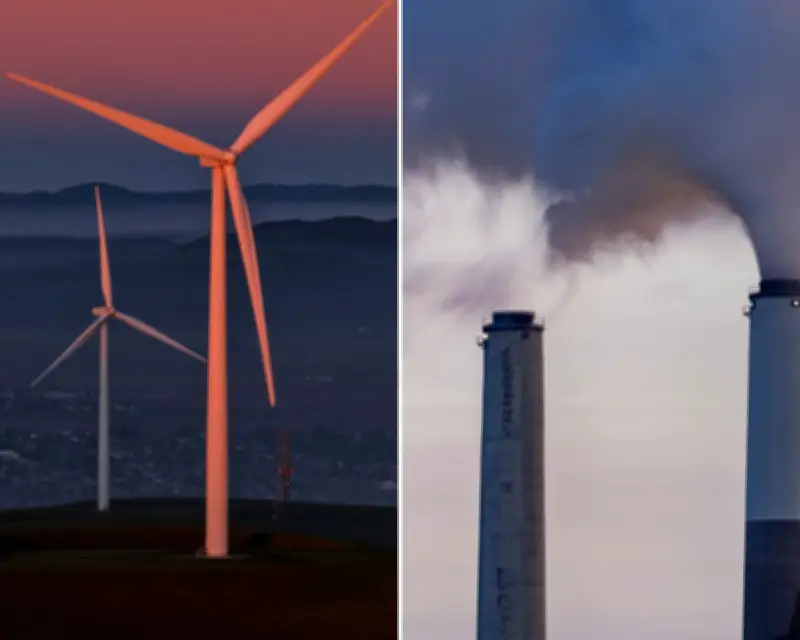
The Trump administration has directly spent $2.7bn of taxpayer money on its crusade against wind power while pouring $1.125bn into boosting coal, which critics say is pushing up Americans' bills. They say the moves are evidence that the president aims to serve fossil-fuel companies, which donated record sums to his presidential campaign, rather than the working-class Americans to whom he pledged to lower energy bills and other costs.
Billions spent to cancel wind projects and prop up coal
The Department of the Interior has, since March, struck four deals with energy companies, paying them to cancel a total of eight offshore wind projects and pledge to invest in fossil-fuel power. The first such agreement was announced in March with the French energy company TotalEnergies, sparking a lawsuit from seven Democratic-controlled states that alleged it was an illegal use of taxpayer money. The latest deal with Duke Energy was announced late last month.
In September, the Department of Energy announced it would spend $625m to “expand and extend the life of” coal-fired power plants, allocating $350m to “modernize” coal plants, $175m to fund coal projects powering rural communities, and $50m to upgrade wastewater management systems to extend coal plants’ lifespans. Last month, the agency also set aside up to $500m from the Defense Production Act to “expand and reinvigorate” the capacity of 13 coal plants, and to help build a coal export terminal in Oakland, California. A week later, the department announced an additional $3.6m to “refurbish or retrofit” nine existing coal plants.
Critics: Taxpayers pay twice – for subsidies and higher bills
“Trump is getting Americans coming and going,” said Jay Inslee, the former governor of Washington state and a Trump detractor. “He’s forcing higher power bills on them by blocking clean energy, then he’s fattening the wallets of his cronies – all with billions of our tax dollars.”
There is no precedent for the federal government directly paying developers to relinquish legally acquired offshore wind leases, said Jenny Rowland-Shea, senior director for conservation policy at the liberal thinktank the Center for American Progress. “They are trying to snuff out an entire form of energy,” she said. “And it’s at a time when the United States needs more energy … as people’s rates are going up for electricity, as we see datacenters gobbling up more energy.”
Coal is the most carbon-dense fossil fuel, making it a major contributor to the climate crisis. It is also harmful to public health, with one 2023 study estimating that as many as 460,000 deaths in the US from 1999 to 2020 were attributable to tiny particles of air pollution from coal plants alone. Coal plants are also more expensive to build and run than renewable alternatives, experts warn.
Administration defends actions, critics call it a 'mugging'
In an email, an energy department spokesperson, Ben Dietderich, said the administration is “proud” of its efforts to boost coal. “Before President Trump ended the Green New Scam, taxpayers paid the bill for trillions of dollars of so-called green energy subsidies,” Dietderich wrote, saying this resulted in the “premature shutdown” of fossil fuel plants, higher energy costs and increased blackout risk. “It’s worth noting that states with their own anti-coal and gas policies experienced the highest price increases during that time period,” he said.
A White House spokesperson, Taylor Rogers, said officials were “not spending taxpayer dollars on these deals”. “The administration is returning the money that companies bid on offshore wind projects that are unable to be built due to national security concerns, and those companies are voluntarily redirecting those returned bid amounts to energy projects that will provide affordable, reliable, and secure energy for American families and businesses,” she said. “The reality is that the Biden administration lured companies into these projects with the promise of millions of taxpayer dollars in subsidies to make these offshore wind projects viable.”
But money from energy leases on public lands and waters goes into public accounts, said Rowland-Shea. “They can use the word return, but they are paying the companies not to produce this energy or to give taxpayers what was promised,” she said. The Biden administration indeed made subsidies available for offshore wind, but fossil fuels have long been subsidized by federal administrations, she noted.
Economic impact: Coal costs more than renewables
A 2025 analysis from research firm Grid Strategies suggests that if all 35,000 megawatts of large fossil power plants scheduled to retire by 2028 were kept running, this would cost ratepayers at least $3.12bn by the end of 2028. Yet 99% of domestic coal-fired power plants cost more to run than it would cost to replace them with renewable power sources, a 2023 report from the research organization Energy Innovation found. Generating power with coal in 2024 cost 28% more than the same amount would have cost in 2021, Energy Innovation found last year.
“These coal plants that are being supported by the government are coal plants that were going to close down because they couldn’t keep themselves open on their own,” said Gabrielle Levy, spokesperson for green advocacy group Climate Action Campaign. “So we’re paying as taxpayers to keep economically unviable plants open, and meanwhile those are doing immeasurable harm to the local environment, to people’s health, and to the climate, which costs us more, too.”
Inslee said the Trump administration’s actions amounted to a “mugging”. “We pay more, Republicans rubber-stamp it, and Trump’s donors walk off with the bag,” he said.