
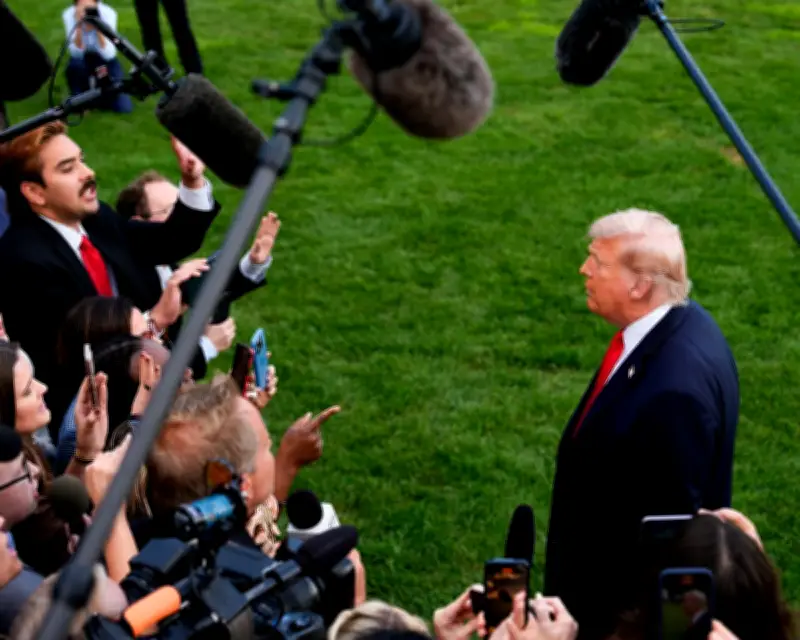
President Donald Trump is redefining the role of the presidency by simultaneously serving as his own chief commentator, offering a continuous stream of analysis and opinion on a wide range of issues. From crime and immigration to the Iran war and his administration's scandals, Trump frequently steps back from decision-making to provide a running voiceover, often using phrases like "people are saying" and "I hear" rather than "I have decided." This approach has become particularly pronounced as challenges mount, positioning him as a narrator of his own presidency.
A President in the Commentary Box
Trump's background as a reality TV host may explain his instinct to fill silence with commentary. He constantly assigns motives, identifies heroes and villains, and tells his audience what to think. For instance, on the algae-afflicted Lincoln Memorial reflecting pool, Trump took to Truth Social to paint a fictitious picture of vandalism, claiming the material was being cut with a knife or box cutter. Later, he criticized US attorney Jeanine Pirro for "choking" and "folding like an umbrella" in dropping charges against a former Olympian accused of vandalizing the pool.
During an Oval Office tirade, Trump exaggerated accusations against his favorite targets, claiming that Biden spent $58 million and that Obama's plan to use Potomac water was "putrid" and a "disaster." These off-the-cuff remarks are typical of his approach, blending fact with fiction to craft a narrative that suits his agenda.
From Epstein Files to Attorney General Nominee
When pressure mounted over his administration's handling of the Jeffrey Epstein files, Trump did not maintain a dignified silence. Instead, he inserted himself into the news cycle, attacking critics, dismissing the matters, and sympathizing with people who "innocently met" the convicted paedophile. Similarly, when his attorney general nominee Todd Blanche agreed to abandon Trump's controversial $1.8bn "anti-weaponisation fund" to secure Republican support, Trump made clear it was not his decision but still offered his thoughts.
"All I know is that Todd Blanche is great," Trump told reporters, sounding like a guest analyst lamenting a policy he had no power over. Yet he insisted that his supporters should receive compensation from the justice department, saying, "These people were treated horribly, and this fund could have given them some solace." He added, "I don't participate in that fund, but I thought it would be very fair for people that spent years in prison."
Postmodern Punditry and the Paradox of Power
Trump's informal exchanges with reporters in the Oval Office and on Air Force One are exercises in postmodern punditry. He frequently breaks the fourth wall by interrupting questions to "correct" the premise, insulting reporters or their networks, and offering alternative interpretations of the day's news. This behavior reflects a paradox: while Trump has boasted of being the most powerful person to ever walk the earth, his constant commentaries reveal a sense of impotence when facing actions by Iran, the courts, or his own government departments.
When supreme court justices ruled against him on tariffs, Trump lamented, "They were appointed by me, and yet have hurt our Country so badly!" This admission, reminiscent of the Vicomte de Valmont in Les Liaisons Dangereuses ("It's beyond my control"), underscores his tendency to commentate rather than act.
What Lies Ahead for the Commentator-in-Chief
As Trump continues to tease an unconstitutional third term, he will likely commentate on his own succession, leaving potential contenders like JD Vance and Marco Rubio facing the unenviable prospect of the president delivering snap verdicts on their every move. Whether Trump transitions to a full-time media role, as host on Fox & Friends or a crank caller on C-Span, his words will continue to flow. However, it remains uncertain if they will still be good for ratings.




