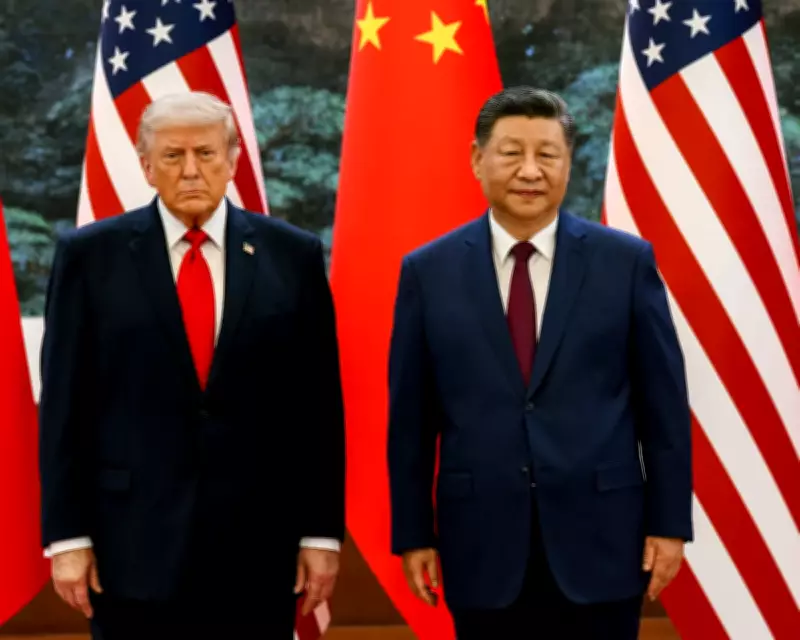
For anxious Taiwan, Trump’s silence after his meeting with Chinese President Xi Jinping was the best possible outcome. The island breathed a sigh of relief as fears receded that the US could jettison its longstanding support for the self-ruled democracy.
Before this week’s summit between the Chinese and US presidents, Taiwan had been cast as the anxious bystander. Observers suggested that Taipei feared the unpredictable and transactional Donald Trump might overturn Washington’s longstanding support for the island, which Beijing claims as a breakaway province, during the talks. However, while the US president hailed his “great” meeting with Xi, he took an uncustomarily muted approach as he sidestepped questions on Taiwan. A White House readout of the meeting published later also omitted mention of the country.
Xi’s Firm Warning
Shortly before the meeting, Xi took a firm tone, declaring that “Taiwan independence” and peace in the Taiwan Strait were “incompatible.” Xi warned that if the Taiwan issue is not handled properly, the two countries could “collide or even conflict,” pushing the entire Sino-US relationship into a very dangerous situation. Wen-Ti Sung, a non-resident fellow with the Atlantic Council’s Global China Hub, said Xi’s tone was “surprisingly firm for summit diplomacy,” intended to signal to Trump that the “Taiwan issue remains the reddest of red lines” for Beijing. Xi’s message was “get Taiwan right and we are friends; get Taiwan wrong and we might become foes before you know it,” Sung said.

Taiwan’s Response
Taiwan’s ministry of foreign affairs issued a swift retort to Xi, stating that “the Republic of China and the People’s Republic of China are not subordinate to one another.” But beyond this customary sparring, Taipei will be quietly pleased at the meeting’s outcome, according to William Yang, a senior analyst focusing on China for the Crisis Group. While Trump and Xi were to meet again on Friday, Yang believed that would focus on trade and investment deals, and Taipei may have already breathed a “sigh of relief.” Yang said: “[Taipei] would welcome Taiwan being mentioned as little as possible. They’d rather have Taiwan not mentioned than Taiwan mentioned in a way that marks a departure from longstanding US policy.”
Arms Sales and Strategic Ambiguity
Before Trump’s arrival in Beijing, Xi had been expected to press him on arms sales to Taipei. Beijing regards Taiwan as a breakaway province and refuses to renounce the use of force to take it. Washington acknowledges China’s claim without endorsing it and maintains a policy of strategic ambiguity, saying it could—but may not—intervene to protect Taiwan if invaded. The US supplies Taiwan with means to defend itself through arms sales. Before the meeting, China’s Taiwan affairs office reiterated its opposition to these sales, condemning Washington’s “military ties with China’s Taiwan region.” In December, the Trump administration angered Beijing by announcing an $11bn weapons package for Taiwan. Another package worth about $14bn has reportedly been awaiting Trump’s signoff for months, with a bipartisan group of US senators urging him to move forward with it.
Taiwan’s Defense Budget
The president now faces added impetus to do so after Taiwan’s parliament ended a months-long impasse when opposition parties passed a much-reduced $25bn defense budget financing those purchases. Before Trump’s meeting with Xi, commentators speculated that the US president’s need for Beijing’s support to end his intractable war with Iran could set the stage for a “grand bargain” in which he made concessions on US support for Taiwan. But the tenor of Xi’s statement suggests the Chinese leader “may not want to place Taiwan within that framework,” said Alexander Huang, chair of the Taiwan-based thinktank the Council on Strategic and Wargaming Studies. Huang said: “Xi did not openly ask Trump to say or commit something on Taiwan. This is because Xi believes the Taiwan question should be handled strictly between [Taipei and Beijing]. Openly asking Trump for specific words or actions would give the impression that Taiwan is a bargaining chip up for trade.”