
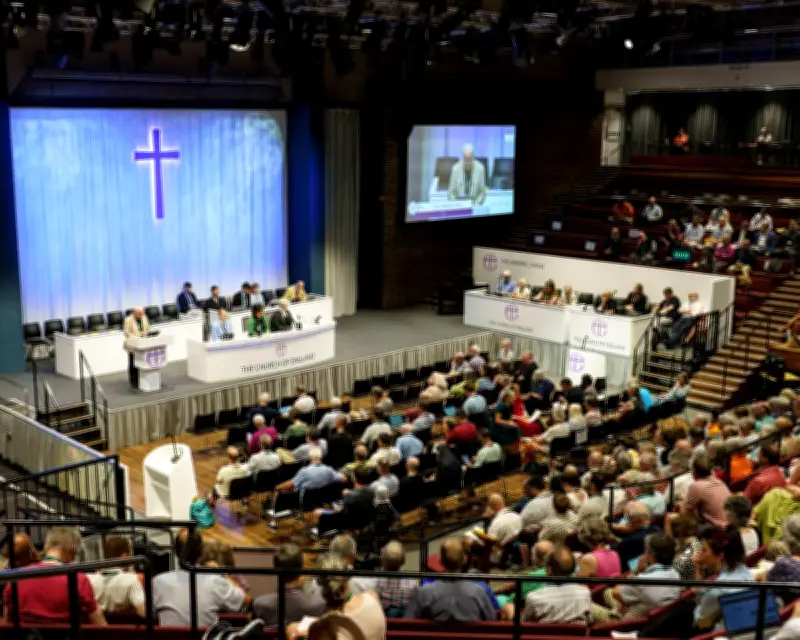
The Church of England's General Synod voted overwhelmingly last week to hear a document that describes Israel's actions in Gaza as a 'genocidal war' and a 'colonial enterprise'. The motion, passed by bishops, clergy, and laity, marks a significant shift in the church's engagement with Palestinian Christians, but has drawn warnings from Jewish groups that it risks straining Christian-Jewish dialogue.
Palestinian Christian Priest Describes Vote as 'Surreal'
Father Fadi Diab, a prominent Palestinian Anglican priest from Ramallah who co-wrote the document at the centre of the debate, described the moment as 'surreal'. 'It was very moving and very emotional,' he said. 'I think members of synod wanted to say: We hear your voices, we feel your pain, and we want to stand with you in your struggle.'
The document, titled Kairos Palestine II (A Moment of Truth: Faith in a Time of Genocide), was published last year by Palestinian Christian leaders across denominations. It calls for an urgent global Christian response to the war in Gaza and Israel's occupation of the West Bank, using terms such as genocide, apartheid, and settler colonialism.
Motion Amended from 'Receive' to 'Hear'
Originally drafted to ask synod to 'receive' the report, the motion was amended during the debate so members instead agreed to 'hear' it. The Archbishop of Canterbury, Sarah Mullally, acknowledged concerns raised by Jewish organisations and explained that hearing Palestinian Christians' experiences did not mean endorsing every aspect of the report. 'It does mean that we listen with compassion, and stand in solidarity with them amidst the many injustices they face,' she said.
Before the debate, the Board of Deputies of British Jews urged synod to reject the report, releasing a briefing that said it 'directly undermines the struggle against antisemitism'. The UK's chief rabbi, Sir Ephraim Mirvis, and the co-chairs of Progressive Judaism also warned it risked harming Christian-Jewish relations.
Jewish Leaders Voice Concerns
Rabbi Charley Baginsky, a co-chair of Progressive Judaism, said the document contained 'an entrenchment of antisemitic tropes' and 'wiped out the experiences of what it means for Jews and Israelis to be in relationship with the land'. However, she welcomed the church's continued engagement, adding: 'As always, the challenge for all of us in faith relationships is: how do we stay in the room and hear things that are difficult?'
Georgina Bye, co-director of the Council of Christians and Jews (CCJ), expressed concern about the 'lack of nuance' in some terms used in the document, but said she was grateful for the amendment from 'receive' to 'hear'. 'Ultimately, Kairos II is presenting a perspective,' she said. 'If we really want to understand and grapple with something as complex as what's going on in the Middle East, we have to expose ourselves to lots of different perspectives.'
Church Leaders Defend Engagement
Richard Sewell, the Residentiary Canon of St George's Cathedral in Jerusalem, described the report as 'a cry for help from our brothers and sisters in Palestine and Israel'. He insisted the Church of England had a duty to hear the suffering church's voice directly. 'People ask: Why are you raising these painful issues which are going to cause so much distress? Because our brothers and sisters in the Diocese of Jerusalem are pleading with the wider church to engage with them,' he said.
The debate marked one of Mullally's first significant interventions as leader of the church. Weeks earlier, she visited Diab's congregation in Birzeit in the occupied West Bank. During the synod debate, she said she had seen settlements expanding 'at unprecedented rates' and that Palestine was 'on the brink of disappearing'. 'Against this desperate backdrop we are called to a new and active solidarity,' she said.
Palestinian Christians Defend Language
Diab said Kairos II was born out of 'the existential threats facing the Christian community' caused by the war in Gaza and decades of military occupation. He defended the language in the report, including the terms genocide and apartheid, saying they reflected the findings of human rights organisations. 'The reality is that the state of Israel continues to confiscate occupied Palestinian land and build settlements on it. We are not inventing words. We are describing what is happening on the ground,' he said.
Diab urged more people to visit the occupied territories. 'Many simply do not know what is happening. We know many people whose views changed after visiting because once you experience crossing checkpoints, once you experience humiliation, you begin to understand what it means to live under military occupation for nearly 60 years,' he added.




