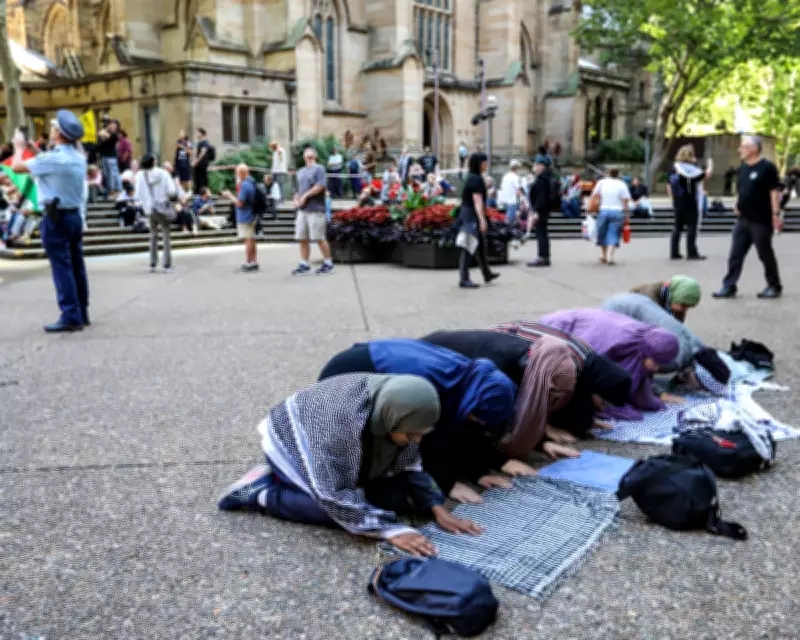
Sydney Prayer Incident Exposes Tensions Between State Power and Religious Vulnerability
Disturbing footage from Sydney's central business district this week captured a scene that has resonated deeply within Australia's Muslim community and beyond. The video shows New South Wales police officers physically handling a group of men who were engaged in prayer, dragging and shoving them while they maintained their ritual posture. The men's response was notably disciplined—they continued their prayers without retaliation, fists raised, or chaos, demonstrating a quiet commitment to a sacred practice that cannot be easily abandoned once initiated.
The Profound Significance of Prostration in Islamic Worship
For observant Muslims, the moment of prostration—where the forehead touches the ground—represents the closest symbolic proximity to God. This posture embodies complete vulnerability, with the body lowered, ego surrendered, and the external world shut out. Ritual prayer is considered the very foundation of Islam, making the Sydney footage profoundly confronting for many Muslim Australians. Interrupting someone in this most defenseless position transcends mere physical relocation; it constitutes an intrusion upon an intimate act of spiritual surrender.
Private Apologies Versus Public Accountability
NSW Police Commissioner Mal Lanyon confirmed that he contacted senior Muslim community leaders privately, offering apologies for any offense caused by the disruption of prayers. However, Premier Chris Minns declined to issue a public apology, defending the police response as appropriate given what he described as a tense and fast-moving situation. This divergence highlights a critical issue: when incidents occur in full public view and impact extends beyond a small group of representatives, private outreach alone proves insufficient. A public incident warrants public acknowledgment.

A public apology is not about political maneuvering or humiliation—it is fundamentally about recognition. The images were witnessed by families at home, young Muslims grappling with their sense of belonging, and a community questioning whether their dignity is equally protected. Public acknowledgment affirms their rightful place in the national narrative and demonstrates that state power can be corrected as well as asserted.
Contextualizing the Incident Within Broader Societal Patterns
For many Muslim Australians, the Sydney images did not emerge in a vacuum. They landed within a community shaped by two decades of heightened securitization: expanded surveillance measures, loyalty tests, and a persistent framing of Muslim civic life through a security lens. Following the horrific terror attack at Bondi Beach on December 14, Muslim Australians again experienced the familiar surge of collective suspicion. In this context, the physical handling of men at prayer transcends mere operational detail—it resonates and ricochets through a community already navigating complex social dynamics.
The Accumulation of Resentment and the Need for Leadership
Resentment within marginalized communities is not merely theatrical outrage; it represents sedimented experience that accumulates over time. It builds in classrooms where children are unexpectedly asked to explain geopolitics, in workplaces where "jokes" about terrorism pass as casual banter, and when grief expressed by Muslims is framed as volatility rather than legitimate emotion. Political leaders sometimes speak as though solidarity is finite, suggesting that recognizing Islamophobia might diminish concern about antisemitism—a logic that dangerously invites competition of grief and fragments the public into rival claimants for empathy and legal protection.
Refusing to apologize may offer short-term political advantages, signaling toughness and resoluteness. However, toughness without introspection proves brittle. Long-term community trust depends on demonstrating that state authority can acknowledge and correct its missteps, not just assert its power.
Pathways Toward Meaningful Resolution and Broader Reckoning
A serious response to this incident requires several concrete actions:

- An independent inquiry empowered to examine operational choices, command structures, and proportional use of force during the Sydney prayer disruption.
- Transparency as the minimum condition for rebuilding legitimacy and community trust.
- Meaningful engagement with Muslim community leaders and grassroots organizers—moving beyond curated photo opportunities or closed-door apologies to select representatives.
The fundamental question should not be how to manage community anger, but how to address the underlying conditions that produce it. As a saying attributed to the Prophet Muhammad reminds us: "The strong person is not the one who overpowers others, but the one who controls himself in anger."
Finally, Australia must undertake a broader reckoning with Islamophobia that operates not only as interpersonal prejudice but as a policy lens, media reflex, and security grammar that casts Muslim civic presence as conditional. Multiculturalism cannot be sustained as mere celebration of cuisine and costume while sidestepping genuine accountability. Australia prides itself on being a successful multicultural society—that reputation depends on consistent application of principles and rule of law for all citizens.