Starmer's 'Keep Calm' Trump Diplomacy Faces Mounting Public Disapproval
Recent opinion polls indicate a significant rise in public disapproval regarding Prime Minister Keir Starmer's handling of relations with former US President Donald Trump. This growing scepticism emerges as Starmer pursues a measured, pragmatic diplomatic strategy that prioritises private influence over public confrontation.
The Powell Doctrine: Private Diplomacy Over Public Posturing
Jonathan Powell, Starmer's national security adviser and former chief of staff to Tony Blair, outlines two distinct approaches in his political treatise The New Machiavelli. The first involves public criticism and posturing, exemplified by French diplomatic style. The second, which Powell advocates and Starmer appears to favour, emphasises private diplomacy and relationship-building to cultivate genuine influence.
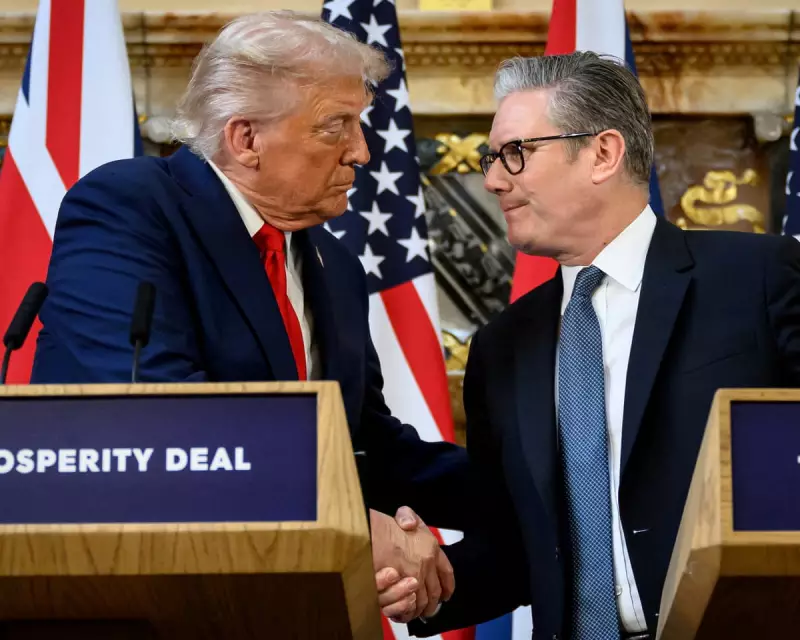
This philosophical alignment explains Starmer's recent declaration at a Downing Street press conference, where he emphasised seeking "pragmatic, sensible and sustained" solutions through "calm discussion" rather than engaging in what he termed "gesture politics" that might damage the crucial UK-US relationship.

Trump's Unpredictable Actions Test Starmer's Strategy
Within twenty-four hours of Starmer's carefully calibrated address, Trump launched an extraordinary broadside against the UK's Chagos Islands agreement, which he had previously endorsed. Simultaneously, the former president shared an AI-generated image on his Truth Social platform depicting European leaders including Starmer in the Oval Office, presenting them with a map showing Greenland, Canada, and Venezuela under the US flag.
Starmer maintains that "being pragmatic does not mean being passive" and asserts that mature alliances involve "addressing differences directly and respectfully." However, his entire approach faces intensified scrutiny as Trump's unpredictable behaviour continues.
Political Opposition and Cabinet Support
Liberal Democrat leader Ed Davey has described Trump as "a bully" and "an international gangster," arguing that "the only way to deal with a bully is to stand up to them." Privately, some Labour figures reportedly share this sentiment.
Nevertheless, Starmer's cabinet ministers have largely rallied behind his strategy. Chief Secretary Darren Jones defended the approach, stating that "private, proper diplomacy" had proven effective on issues including tariffs and Ukraine support, despite acknowledging the "noisy" and "challenging" nature of current geopolitical discussions.
Scotland Secretary Douglas Alexander offered a cultural analogy, suggesting he would "rather have Keir Starmer in charge right now than Richard Curtis," referencing the filmmaker behind Love Actually and implying that cinematic diplomacy makes poor real-world policy.
Internal Government Tensions and Future Reassessment
Even among cabinet ministers who support Starmer's approach, there exists recognition of its domestic political difficulty. One minister acknowledged private horror at Trump's actions but questioned the value of public condemnation, suggesting the need to "see how this all unfolds."
Another government source indicated that while the public desires strong UK-US relations, "if Trump gets even more unpredictable we will have to reassess." Some ministers speculate that any attempt by Trump to forcibly claim Greenland would represent a "gamechanger" requiring strategic recalibration.
Damage Control and Diplomatic Reassurance
Amid the turbulence, US House Speaker Mike Johnson visited London, telling Parliament he had spoken "at length" with Trump and aimed to "help calm the waters." Meanwhile, at the World Economic Forum in Davos, US Commerce Secretary Howard Lutnick assured UK Chancellor Rachel Reeves of American affection, to which she reciprocated the sentiment.

As European leaders condemn what they term Trump's "new colonialism," Starmer's pragmatic approach faces its sternest test. The prime minister bets on influence through private diplomacy, but with public disapproval mounting and Trump's unpredictability continuing, this strategy may yet face fundamental reassessment in the coming months.