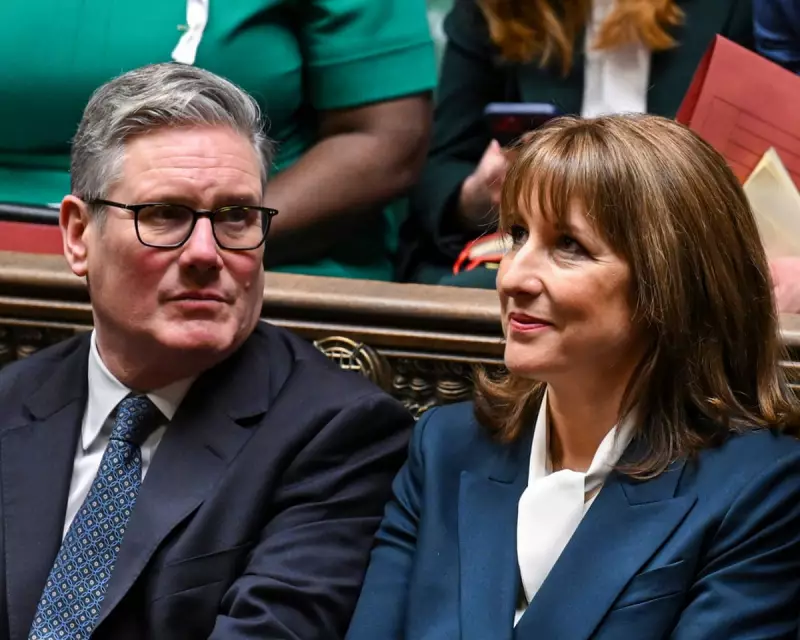
Prime Minister Battles to Change Conversation After Budget Fallout
Keir Starmer is launching a personal fightback this week as he attempts to shift attention away from the ongoing controversy surrounding Chancellor Rachel Reeves's budget decisions and toward the government's broader economic vision.
The Prime Minister will deliver a significant speech on Monday designed to draw a line under the political storm that has engulfed his Chancellor since last week's fiscal announcement. At the heart of the controversy are Conservative accusations that Reeves misled the public about her reasons for implementing record-breaking tax increases.
Interlinked Political Futures
Political insiders confirm that the fates of Starmer and Reeves are deeply connected, with allies suggesting that if one were to fall from grace, the other would likely follow. This explains why Conservative attacks have focused intensely on the Chancellor's personal ethics rather than just her policy decisions.

In his Guardian article published ahead of Monday's address, Starmer defended the budget choices, stating: "At the budget last week, we made the right choices for Britain, cutting the cost of energy with £150 off bills, protecting the NHS and tackling the scourge of child poverty by removing the two-child limit."
The Prime Minister will characterise his government's programme - which includes welfare reform and deregulation measures - as a "big, bold long-term plan" rather than a collection of short-term solutions.
OBR Forecasts at Centre of Political Storm
The immediate trigger for the political confrontation stems from conflicting interpretations of Office for Budget Responsibility forecasts. Conservatives have alleged that Reeves used reduced productivity predictions as justification for tax rises while downplaying more positive elements of the OBR's assessment.
While the OBR did indeed downgrade its productivity outlook, it simultaneously upgraded forecasts for wages and tax receipts - improvements that ultimately left the Treasury with a surplus rather than the expected deficit.
Further controversy emerged regarding the timing of Treasury briefings. Conservative leader Kemi Badenoch has accused Reeves's allies of attempting to manipulate financial markets through selective disclosure about decisions on income tax rates.
The situation became sufficiently contentious that Richard Hughes, head of the OBR, felt compelled to write to the Treasury select committee to clarify the timeline of events. This intervention came as a direct response to Treasury briefings on November 14th that aimed to calm investor concerns about abandoned income tax increase plans.
Chancellor Defends Fiscal Decisions
Appearing on BBC One's Sunday with Laura Kuenssberg, Rachel Reeves maintained that her tax decisions were necessary to create a buffer against unexpected costs and protect the government's fiscal rules. Her supporters argue that without the OBR's productivity downgrade, her financial position would have been considerably more comfortable.
However, the political challenge extends beyond immediate budget controversies. Recent polling from More in Common reveals that only 16% of voters believe the Chancellor is performing well - virtually unchanged from pre-budget figures.
This suggests that public opinion about the government's economic management may already be hardening, presenting a significant obstacle for Starmer and Reeves as they attempt to regain political momentum.
Long-Term Strategy Versus Immediate Political Pressures
Starmer's Monday speech represents a calculated gamble that voters will eventually recognise the benefits of increased public spending and business deregulation. He will argue that his economic programme should be judged at the end of the parliamentary term rather than in its immediate aftermath.
Yet with citizens increasingly restless for tangible improvements in their daily lives, the Prime Minister may discover that time is a luxury his government cannot afford. The success of his reframing effort will determine whether the budget controversy becomes a temporary setback or a lasting political liability.