
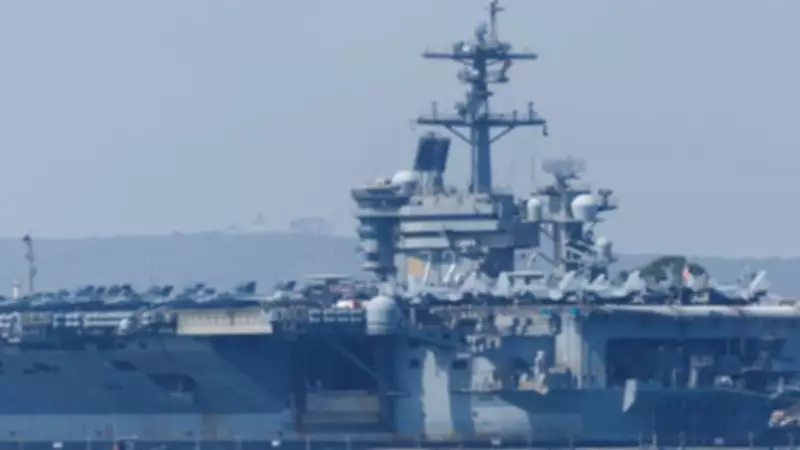
A United States fighter jet has been scrambled to shoot down an Iranian drone that was flying aggressively towards an American aircraft carrier in the Arabian Sea, according to statements from the US military. The incident, which occurred approximately 500 miles from Iran's southern coast, has heightened tensions between the two nations as they prepare for crucial diplomatic talks scheduled later this week.
Drone Intercepted with Unclear Intent
US military spokesperson Captain Tim Hawkins confirmed that a Shahed-139 drone operated by Iran approached the USS Abraham Lincoln, part of a large naval armada deployed in the region, with what was described as "unclear intent." Despite de-escalatory measures taken by US forces operating in international waters, the drone continued to advance towards the vessel.
In response, an F-35C fighter jet was launched from the aircraft carrier and successfully intercepted and destroyed the unmanned aerial vehicle. Captain Hawkins emphasised that no US personnel were harmed, and no equipment sustained damage during the engagement, which underscores the defensive nature of the action taken by American forces.
Iran Disputes US Account of Events
Reports emerging from Iran have contested the US version of the incident. Media sources, including the semi-official Fars news agency, have claimed that the Iranian drone was merely completing a routine surveillance mission in international waters, suggesting a different narrative to the aggressive approach alleged by Washington.
This disagreement highlights the ongoing friction and mistrust between the United States and Iran, which have been long-time adversaries in the volatile Middle East region. The conflicting accounts may complicate efforts to de-escalate tensions through diplomatic channels.
Further Escalation in the Strait of Hormuz
In a separate but related incident hours later, Iranian forces, including a drone and two boats carrying Islamic Revolutionary Guard Corps personnel, harassed a US-flagged merchant vessel, the Stena Imperative, in the Strait of Hormuz. The Iranian assets approached the tanker at high speeds and threatened to board and seize it, according to Captain Hawkins.
The destroyer USS McFaul responded promptly, escorting the Stena Imperative with defensive air support from the US Air Force. This intervention ensured the merchant vessel's safe passage, demonstrating the US military's commitment to protecting international shipping lanes and maintaining security in key maritime corridors.
Diplomatic Talks Proceed Amid Rising Tensions
White House Press Secretary Karoline Leavitt confirmed the drone shooting on Fox News and stated that talks with Tehran, scheduled for later this week in Turkey, will still proceed as planned. This decision indicates a willingness from both sides to engage in dialogue despite the recent military confrontation.
The talks are centred on efforts by US President Donald Trump to negotiate a deal over Iran's nuclear programme, a longstanding point of contention. President Trump remarked on Monday that his administration has "talks going on with Iran," but refrained from specifying any thresholds for potential military action against the country.
Iran's Supreme Leader, Ayatollah Ali Khamenei, has previously warned that any US military action could lead to a regional war, adding a layer of urgency to the diplomatic efforts. Meanwhile, Iran's President Masoud Pezeshkian has directed the country's foreign minister to pursue "fair and equitable negotiations" with the United States, signalling a potential openness to dialogue from Tehran.
Background of Domestic Unrest in Iran
The drone incident occurs against a backdrop of significant domestic turmoil within Iran. The Iranian government has spent weeks suppressing protests that began in late December against economic instability, which later evolved into broader challenges to the Islamic Republic's authority.
Human rights organisations and medical professionals estimate that between 33,000 and 50,000 people may have died in the violence, although Tehran has officially admitted to 3,117 fatalities, claiming the majority were security forces and civilians rather than protesters. In early January, President Trump pledged to "rescue" Iranians from their government's crackdown, further straining bilateral relations.
As tensions simmer in the Arabian Sea and the Strait of Hormuz, the upcoming talks in Turkey represent a critical juncture for US-Iran relations. The international community will be closely monitoring whether diplomacy can prevail over military posturing in this highly charged geopolitical landscape.




