
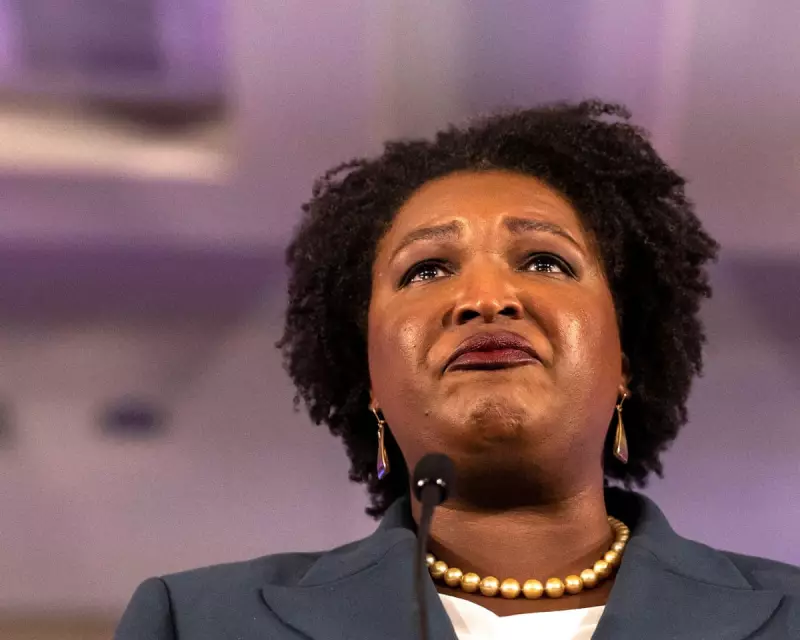
Stacey Abrams Transforms 10 Steps Into Major Anti-Authoritarianism Coalition
Stacey Abrams, the prominent former Georgia gubernatorial candidate, is set to make a significant announcement on Thursday regarding the expansion of her political initiative. The campaign she launched last year to combat authoritarianism in the United States has evolved into a substantial coalition, attracting dozens of new partner organisations that collectively represent millions of voters across the nation.
From Political Campaign to National Movement
Abrams, a Yale-educated lawyer who previously served as minority leader in the Georgia House of Representatives, made history in 2018 as the first Black woman to secure a major party nomination for a gubernatorial race. Following her second electoral defeat to Brian Kemp in 2022, she stepped back from the political spotlight, accepting a teaching position at Howard University in 2023. However, her commitment to democratic principles remained undiminished.
In response to growing concerns about democratic backsliding, particularly following Donald Trump's re-election campaign, Abrams established the 10 Steps initiative. This organisation was specifically designed to coordinate and mobilise opposition against what she perceives as authoritarian policies emerging from certain political quarters.
"We know that there are people who are angry, who are afraid, who are uncertain," Abrams explained. "They recognise that there's a problem, but now they need to take action. The challenge has been that while there are numerous individuals and groups working on these issues, finding them can be difficult, and understanding how to contribute effectively presents its own obstacles."
Building Infrastructure for Democratic Defence
Abrams positions the expanded coalition as serving dual purposes: acting as a "wayfinder" to help people navigate the political landscape, and functioning as a "force multiplier" to amplify collective impact. She emphasises that before activists can contemplate dramatic acts of resistance, substantial groundwork must be established.
"A general strike represents one potential tool," Abrams noted, "but we must remember that such actions form part of a broader strategy. I don't want us to become so fixated on cinematic moments that we neglect the essential infrastructure pieces. What makes this authoritarian rise particularly insidious is how it latches onto existing systems we've grown accustomed to. We weren't prepared to see them weakened."
She pointed to concerning developments during government shutdowns, where vulnerable populations including children, elderly citizens, and disabled individuals faced reduced access to essential services as political leverage.
Diverse Coalition Partners Join Forces
The newly formed coalition brings together organisations with varying public profiles. Alongside established activist groups like Democracy Forward, Indivisible, MoveOn, and Run for Something, Abrams has successfully recruited numerous civic organisations with lower national visibility but significant grassroots influence.
These include New Disabled South, Red Wine and Blue, UnidosUS Action Fund, and Gen-Z for Change, each bringing unique perspectives and constituencies to the collective effort.
Cheyenne Hunt, executive director of Gen-Z for Change, expressed her organisation's commitment: "Generation Z rejects the notion that we must passively observe our country's descent into authoritarianism. We refuse to be bystanders while our democracy faces assault in broad daylight. We're proud to join the 10 Steps campaign alongside numerous partners, empowering young people with the tools to reclaim the democracy and America we were promised."
The Ten Steps Framework
Abrams originally developed the 10 Steps campaign to highlight specific authoritarian tactics and provide organisational frameworks for resistance. Her analysis identifies ten methods authoritarians typically employ to consolidate power, including attacking independent media, normalising political violence, and systematically weakening governmental institutions.
According to Abrams' assessment, the United States currently contends with at least nine of these concerning developments. "We exist within an authoritarian regime," she asserts. "This represents what political scientists term competitive authoritarianism. Our nation has been downgraded on international democracy indices, and we no longer consistently abide by the rule of law as a fundamental premise."
Importantly, Abrams' framework also outlines ten corresponding steps to counter authoritarianism, with organising and mobilising representing two crucial components. "This campaign aims to unite organisations addressing diverse issues," she explained, "enabling us to construct national infrastructure not merely for resistance, but for reclamation. This must be rooted in local communities, because what occurs at the highest levels only sustains itself if we collectively decide there are no alternatives."
The expansion of 10 Steps into a broad coalition marks a significant development in progressive organising, creating structured opposition to perceived authoritarian trends while attempting to bridge gaps between established organisations and emerging grassroots movements.




