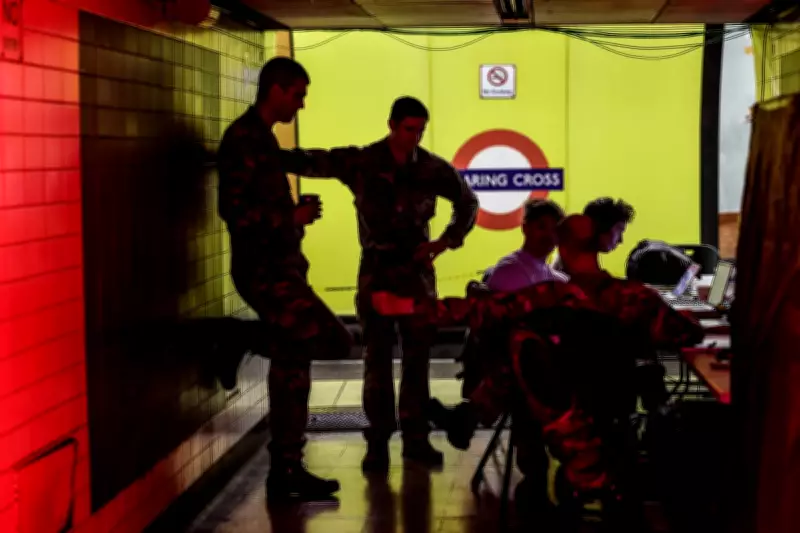
Secret Nato Bunker Exercise in Charing Cross Station
Deep in Charing Cross underground station, in the disused terminus of the Jubilee line, a secret Nato command bunker has this week been discreetly at work. Dozens of mostly British soldiers were engaged in a war game defending Estonia from a Russian invasion in 2030, unbeknownst to commuters and tourists bustling above.
The secret chambers are behind two sets of normally locked, metal double doors. A red glow at the bottom of the escalator beyond is the first sign of troops below; next are mocked up newspaper covers pasted over ageing adverts. A British Nato force has deployed to Estonia they blare, in response to a Russian massing of troops on the border.
Scenario Set in 2030 to Highlight Russian Threat
“The scenario you are about to see is very deliberately set in 2030 because that is where we see the threat from Russia to be at its most acute,” says Lt Gen Mike Elviss, commander of the Allied Rapid Reaction Corps, in a video briefing. If the war ends in Ukraine it is the point at which, military analysts estimate, a remilitarised Russia could be ready to attack Europe again.

The aim, ostensibly, is to show Moscow that for all Donald Trump’s bluster, Nato is ready, operationally at least, to defend its most exposed members on the Baltic. But a more important audience is a mile or so down the road in Westminster, where the Ministry of Defence has been locked in a funding battle with the Treasury for months.
British Army Drone Shortage: 80-90% Gap
Remodelling the British army, it is said, will cost billions in investment, particularly on drones. It is estimated that it will cost £50m a year to get the arms industry building the required volumes of simple one-way attack drones, so familiar in Ukraine, and £500m a year to develop more sophisticated models, such as armed driverless vehicles.
If there was a full-scale war in eastern Europe tomorrow, it is understood the British military would run out of drones in less than a week, able only to launch a few hundred a day. On this thinking, the British army is between 80 and 90% short of the drones it thinks it needs – for reconnaissance, air defence or attack.
Exercise Arrcade Strike: A Glimpse of Future Capability
The exercise, Arrcade Strike, is meant to show “the strategic reserve corps that you could have by 2030,” said Elviss. Three junior defence ministers are among those who visited the secret bunker on Wednesday, though the secretary of state John Healey, was tied up on official business and has been visiting Estonia, where the bulk of the UK 4th brigade is now deployed, as part of a related exercise.
Chairs, computers and screens crowd the underground hall, spilling on to a platform: a temporary Ukraine-style bunker, ready for a simulated war influenced not just by the war in Ukraine but also the recent US attack on Iran. In theory, the command centre can house 500 people, transmitting 10 terabytes of data a day, equivalent to three months of Netflix.
Virtual Reality and AI in the Bunker
What follows is carefully choreographed. To explain the mission, journalists attending are invited to put on virtual reality headsets, supplied by US technology company Anduril (US vice-president JD Vance is an investor), which display a 3D model of the battle plan. In this glossy, computerised vision of war, the first waves of drones are lost but the Russian positions quickly located and eliminated.
The operation is spelt out explicitly: a Nato force would use thousands of drones or more to lead a counterattack against Russian forces, revealing and knocking out enemy air defence, other positions and headquarters with the help of fighter jets and artillery all the way to St Petersburg from the border. It is not meant to be subtle; the rehearsals are conducted “because the adversary is watching,” Elviss said.

AI-Powered Decision-Making and Deep Strike Capability
One intention is to visualise the British army’s project Asgard, a digital communication system that uses artificial intelligence (Hivemind, from US firm Shield AI is referenced) on the battlefield, linking any surveillance node to any weapon. The key purpose of artificial intelligence, is to speed up decision-making, including target acquisition, from 72 hours to two hours, following the lead of the Israeli and US militaries.
A virtual target is identified, although it is not shown how. The exercise includes a new deep strike unit able to hit targets 90 miles away with M270 artillery; meaning it could bomb Leicester if the rocket launcher was in Charing Cross.
Three bombing options are offered from a drop down menu, chosen with the help of artificial intelligence for the attack, based on weapons available. An icon is selected, a new screen loads, and towards the bottom, a red flashing fire button appears.
Nato’s Military Chief Praises British Efforts
It falls to Nato’s military chief, Gen Alexus Grynkewich, an American, to applaud the British efforts “to transform into an AI-fuelled command post,” in a video message. If the artificial intelligence has made a mistake during Arrcade Strike, it is not something anybody appears aware of, though in any event this is a demonstration.
Defence Budget Increase Expected
This is war in 2026 as well as 2030: a high-speed, hi-tech means of dealing death from a distance from the relative safety of deep underground. Meanwhile, over at the Ministry of Defence, the early hints are that next month, several billion more will be found to increase the defence budget to close an £18bn funding gap – and begin paying for the British army of the near future.