
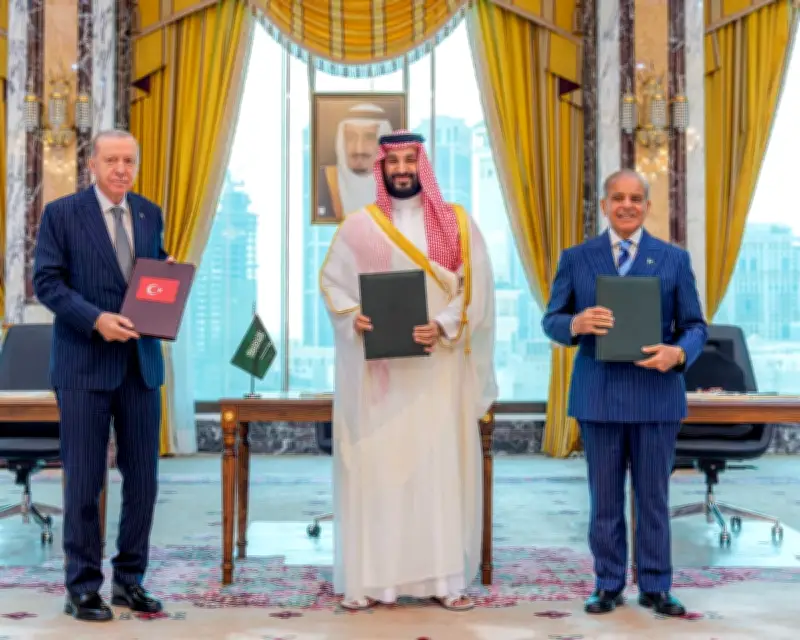
Saudi Arabia, Pakistan and Turkey have signed a mutual defence agreement in Mecca, placing three of the Muslim world's most influential states into a Nato-style pact, as Riyadh confronts escalating attacks from Iran-aligned Houthis in Yemen. The agreement stipulates that an attack on one country will be deemed an attack on all, though conditions attached to this collective defence pledge remain unclear.
Deadly Houthi attacks test the new pact
On Thursday, the Houthis killed at least 58 Yemeni government troops in missile and drone attacks, according to a military source, marking one of the deadliest days in the conflict for years. A separate attack into southern Saudi Arabia, bordering Yemen, injured 11 civilians. The first test of the tripartite pact, long in preparation, may come in Yemen.
On Friday, a Houthi drone strike killed three more members of Yemen's government in an attack on a military camp in Marib, with ten missiles and seven explosive drones fired. The Houthis said they were reacting to what appeared to be a large Saudi-led military buildup.
Regional tensions escalate amid US-Israel conflict with Iran
The three Sunni Muslim-led countries are concerned by increasing regional jeopardy after the US-Israeli war on the Shia government in Iran, with Donald Trump unable to contain the conflict. It is disputed whether the Houthi group is acting on Iran's instruction, or instead, as it insists, trying to lift what it regards as a Saudi blockade of Houthi-controlled territory inside Yemen.
The present conflict broke out when an Iranian plane flew to the Houthi-controlled capital, Sana'a, supposedly to transport a Yemen delegation to the funeral of the former Iranian supreme leader Ali Khamenei. Saudi intelligence claimed the plane was carrying Iranian weaponry for the Houthis.
Saudi Arabia's naval coalition and military buildup
Riyadh has already developed a 10-nation naval coalition intended to protect commercial shipping from Houthi attacks in the Red Sea and the Bab-el-Mandeb strait. The Houthis insist they are firing only on Saudi-linked shipping, and there is no immediate sign that the naval coalition is deterring them.
Saudi intelligence sources say they are picking up reports not just of increased Houthi hostility but likely attacks on Saudi interests by Iranian-backed militia inside Iraq. Saudi Arabia has been working to persuade Trump not to launch massive attacks into Iran.
Saudi response and civilian casualties
In a separate attack early on Friday, a Saudi official accused the Houthis of indiscriminately shelling civilian areas in Saudi Arabia, injuring 11 civilians, including a four-year-old child. Maj Gen Turki al-Maliki, spokesperson for the Saudi-led military coalition supporting Yemen's government, said the coalition would continue taking all necessary measures to protect civilians.
The attack was in southern Najran province, injuring seven Saudis, one Yemeni, two Egyptians and one Pakistani national, al-Maliki said. Neither the Houthis nor Iran immediately commented on Friday's attack.
Long-running conflict and Saudi preparations for offensive
Saudi Arabia and the Houthis have been vying for control of Yemen for more than a decade, but over the past month an uneasy status quo has unravelled, with the Houthis mounting attacks against Saudi Aramco oil facilities. The Houthi movement, which controls Sana'a and much of Yemen's Red Sea coastline, declared a naval blockade of Saudi Arabia in the Red Sea last month.
Saudi Arabia has been leading a military coalition supporting Yemen's government against the Houthis since 2015. Yemen, already battered by more than a decade of war, has increasingly been drawn into the regional confrontation centred on Iran. The Houthis abandoned a largely successful 2022 truce with the Saudi-backed government.
Yemeni sources said recently they believed Saudi Arabia was preparing for a major military offensive against the Houthis by sea and possibly by land in central Yemen, in a move to break their chokehold on Saudi oil exports through the southern Red Sea.
Yemen's government restructuring and regional diplomacy
Separately, after the implosion of the separatist Southern Transitional Council (STC) in the south of Yemen in January, Saudi Arabia took greater responsibility for funding and organising the UN-recognised government in Yemen. The STC leadership overreached in December, trying to take control of the whole of the south, but were beaten back by a surprisingly fierce Saudi reaction.
Saudi Arabia has subsequently reconstructed Yemen's government, excluding southern separatists, but the government is struggling to provide services, and the latent support for separatism in the south remains. The bulk of the STC leadership is in exile or under a form of arrest in Riyadh.
Iran and Oman have said negotiations on an agreement over the strait of Hormuz are in the “final stage” of drafting. The agreement is expected to be contingent on the US lifting its blockade on Iran's ports. The strait is crucial to global shipping and energy supplies; before the war, which began with US and Israeli strikes on Iran in February, about one-fifth of the world's traded oil and fossil gas passed through the waterway at the mouth of the Persian Gulf.




