
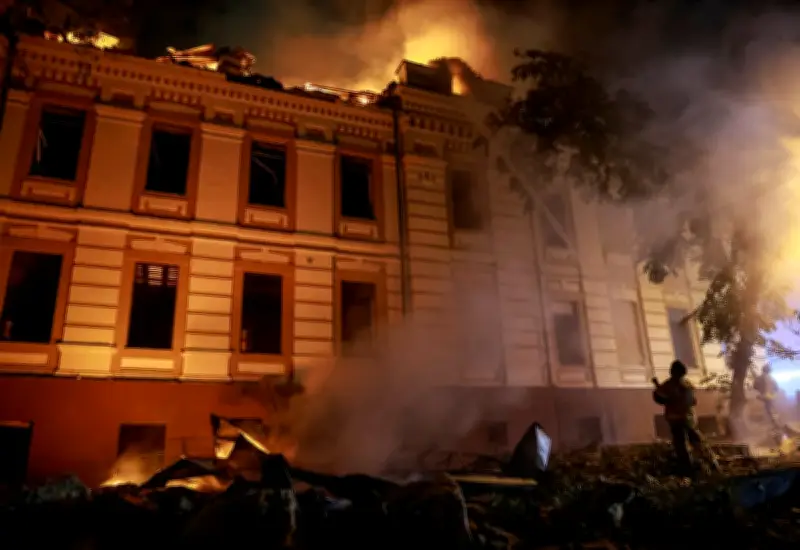
Russia has carried out one of its biggest ballistic missile attacks on Kyiv and other Ukrainian cities, launching a five-hour assault that left at least six people dead and dozens injured, and caused fires and damage across the capital.
Details of the Attack
Ukrainian officials said the capital had been hit with about 40 Iskander-M and hypersonic Zircon missiles. Residents heard an air raid siren sound at 1:30 a.m. There was the sound of air defences, followed minutes later by a series of booms and explosions. Houses in Kyiv's historic centre shook, and car alarms blared, as dozens of missiles arrived in less than an hour. A second air raid siren sounded at 6:30 a.m., with more impacts reported.
A three-storey building caught fire in the central Shevchenkivsky district. Rescuers dug out several people trapped inside and recovered a body. Four other areas were hit, with fires reported at office and residential buildings and a dormitory. Residents sheltering inside Lukyanivska metro station posted footage after the ceiling in the ground-floor vestibule collapsed due to a massive blast wave. The station is temporarily closed.
Casualties and Damage
“According to preliminary information, one person was, sadly, killed as a result of the attack,” the city military administration said on Telegram. Kyiv’s mayor, Vitali Klitschko, said seven people were wounded. A Russian attack on a postal facility near Kharkiv later on Sunday killed three people and wounded at least 20, according to the regional administration. Russian guided missiles also hit Kherson and Sumy, local authorities and Ukraine’s emergency service reported, with each strike leaving at least one person dead.
Kyiv’s military said it had shot down 18 missiles in Sunday’s attack, which was aimed primarily at the Ukrainian capital. It added that 108 out of 125 drones had also been downed.
Witness Accounts
“The missiles just kept coming one after another, the explosions were powerful, it was horrible,” 47-year-old Kyiv resident Ganna Zagorodnia told the AFP news agency. “I thought that life was just about to end.” A resident who identified himself as Vlad told Reuters he had been inside his apartment when a blast tore off his balcony door, which hit him on the head. “My grandmother lives with me, and she can’t walk. How could I run away and leave her behind?” he said.
Political and Military Context
Russia has been firing drones and missiles at Kyiv and other Ukrainian cities almost daily since its full-scale 2022 invasion. Ukrainian President Volodymyr Zelenskyy said last week that Washington and Kyiv had reached a political agreement on licences to make Patriot interceptors, adding that he hoped production could begin by the end of the year. Ukraine’s own stocks of interceptors appear to have dwindled. “Protection against ballistic missiles is our constant and top priority right now,” Zelenskyy said on X on Sunday. “Interceptors are needed every day.”
The attacks come amid big anti-government protests in Kyiv after Zelenskyy’s decision to sack the country’s popular defence minister, Mykhailo Fedorov. Demonstrators want Fedorov reinstated and Commander-in-Chief Col Gen Oleksandr Syrskyi sacked instead.
Response and Aftermath
Rescue workers pulled four people from a burning home in Sviatoshynsky district and rescued residents from a burning three-storey building in Shevchenkivsky district. A fire in a non-residential building was also contained. One person was later found dead. Firefighters also responded to blazes in the Solomyansky, Desniansky and Dnipro districts.
Ukraine also launched attacks on Russia, sending attack drones to destroy e-commerce warehouses in the Moscow and Tambov regions, killing eight people and causing major fires. “In response to Russian strikes on our civilian infrastructure and on our cities and communities, two major logistics facilities were hit – in the Moscow and Tambov regions,” Zelenskyy said. He alleged the centres had been used “to supply sanctioned components for drone production and navigation equipment”.
June was the deadliest month for civilians in Ukraine since April 2022, with at least 293 people killed, according to the UN. Talks on ending Europe’s bloodiest conflict since the second world war remain frozen, while fighting at the front is effectively at a standstill.




