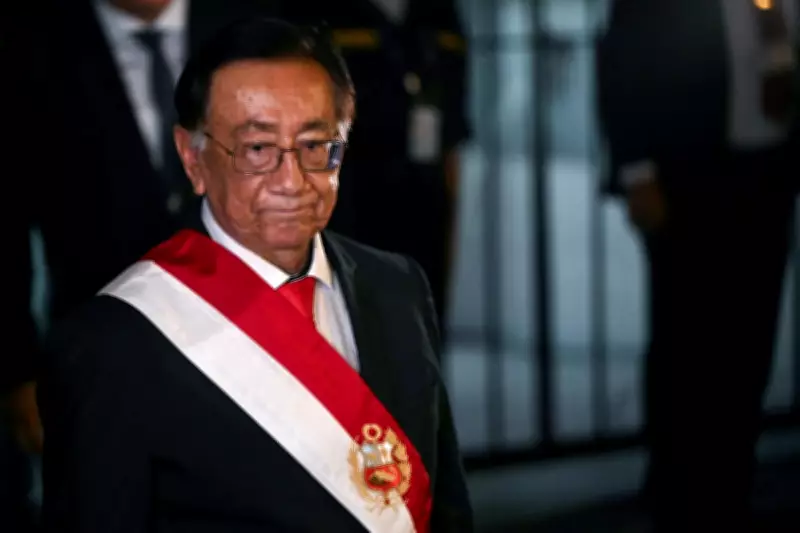
Peru's congress has elected José María Balcázar, an octogenarian leftist lawmaker with a controversial history of defending child marriage, as the nation's new interim president. This surprise move comes ahead of general elections scheduled for April, marking the country's ninth presidential change since 2016 and highlighting an era of profound political instability.
A Surprise Election in a Time of Crisis
On Wednesday, lawmakers voted to install Balcázar after a four-hour session where none of the four initial candidates secured a simple majority. In a second round of voting, Balcázar defeated the favored conservative candidate, María del Carmen Alva, following the removal of his predecessor, José Jerí, just one day earlier. Jerí was ousted after a scandal involving secretive meetings with Chinese businessmen, having served only four months in office.
Balcázar, a member of the leftist Peru Libre party, was immediately sworn in as Peru's head of congress. His election has ignited fierce reactions across the political spectrum, with right-wing parties engaging in finger-pointing and recriminations, while sectors of the Peruvian left have offered praise. This transition underscores the unprecedented volatility in Peruvian leadership, with the country now seeing its eighth president in as many years.

Controversial Remarks Dominate the News
However, it is Balcázar's past statements on child marriage and sexual relations that have dominated Peruvian news coverage since his unexpected election. In 2023, as a former regional high court judge, he sparked widespread controversy by being the sole lawmaker to criticize and vote against a measure to ban child marriage. He argued that such bans should only apply to individuals under the age of 14.
"From the age of 14 onwards, there should be no impediment; everyone has sexual relations, [male] teachers with pupils, female teachers with pupils, and between pupils too. That's fine," Balcázar told journalists after the congressional vote. He later claimed his remarks were taken out of context, but the damage to his reputation was already done.
In another instance, while serving as chair of the congressional education committee, Balcázar stated that it is common for teachers to have sex with their students, even suggesting that such relationships could be "beneficial" for the minor. Peru's women's ministry strongly condemned these comments in a statement, accusing him of justifying "sexual violence against school-age children and adolescents, a painful and despicable situation that profoundly affects their overall wellbeing and fundamental rights."
Legal and Political Background
Balcázar's controversial history extends beyond his remarks. He has been investigated for allegedly embezzling funds during his tenure as head of the bar association in his native region of Lambayeque. In 2022, he was expelled from the association following a disciplinary hearing, adding to the scrutiny surrounding his career.
Politically, Balcázar has expressed intentions to release jailed former leftist leader Pedro Castillo, who was sentenced by Peru's supreme court in November to over 11 years in prison. Castillo was convicted for attempting to disband congress and rule by decree in December 2022, a move that further polarized the nation.
As Peru braces for general elections in April, Balcázar's interim presidency is set against a backdrop of deep-seated political divisions and ongoing debates over social issues. His election not only reflects the country's turbulent political landscape but also raises critical questions about leadership and accountability in a time of crisis.