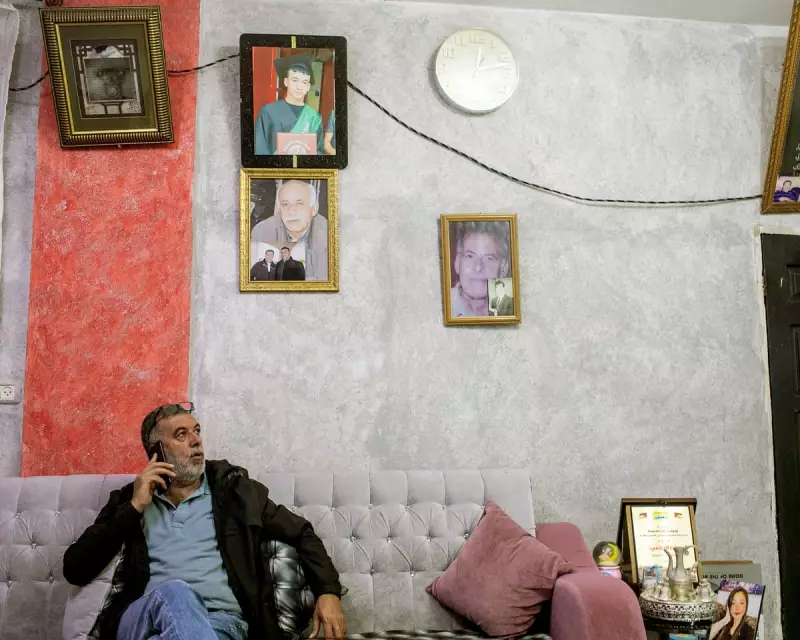
The golden dome of the al-Aqsa mosque shimmered under the autumn sun as Zohair Rajabi gazed from his balcony towards the ancient skyline of Jerusalem. Below, Christian pilgrims disembarked from buses and Jewish worshippers congregated near the Western Wall. Yet, just metres from his home, new Israeli flags fluttered, marking buildings from which his neighbours had recently been expelled by police. After more than two decades of resistance, Rajabi knows his time in Batn al-Hawa, a Palestinian neighbourhood in occupied East Jerusalem, is almost certainly over.
A Family Home on the Brink
"Yes, I have lost. I have been defeated," said the 55-year-old father. "I am not only waiting for my home to be taken but for every home here to be taken." Rajabi has spent his entire life in the sprawling four-storey house, built on land purchased by his grandfather in 1965. The building shelters his extended family, including his mother, brothers, and many children. Two relatives live with severe disabilities.
All 52 members of the household face being uprooted if Israeli courts reject a final legal appeal—an outcome widely anticipated in Batn al-Hawa. "We know what the decision will be … but we are going to fight anyway," Rajabi stated, estimating his family may be forced to find new accommodation within a month.

The Legal Battle and Settler Ambitions
This neighbourhood has long been in the crosshairs of right-wing Israeli organisations dedicated to cementing Israeli control over parts of Jerusalem seized in the 1967 war. One key group is Ateret Cohanim, which describes its mission as reclaiming urban land to restore Jewish life in historic Jerusalem.
The organisation's legal argument hinges on a historical claim: that much of Batn al-Hawa sits on the site of a late 19th-century village established under Ottoman rule for impoverished Yemeni Jews. That community was evacuated by British authorities in the 1930s. Lawyers for a reactivated trust representing that historical community have successfully argued in Israeli courts that its prior ownership trumps later purchases by Palestinian families. A 1970 Israeli law further enables Jewish claims to properties in East Jerusalem.
Daniel Luria, a spokesperson for Ateret Cohanim, which has already settled nearly 40 Jewish families in the area, was unsympathetic. "I sympathise but … they are illegal squatters in properties from which Jews were driven out in the 1930s," he said, comparing the residents' resistance to "Custer's last stand."
An Accelerated Crisis Amid War
In recent months, a sudden wave of evictions has followed a series of Israeli court rulings. According to the Jerusalem NGO Ir Amim, Rajabi's family is among 34 households—totalling around 175 people—facing "imminent displacement and settler takeover of their homes." If executed, this would constitute the largest coordinated expulsion and settler takeover in occupied East Jerusalem since 1967.
Rajabi draws a direct line to the conflict in Gaza. "The war is a big factor," he asserted. "If there was no war, maybe you would see only one eviction every 10 years instead of five in 15 months. The war has created an atmosphere where you can push this through … An atmosphere of hate."
This atmosphere is reinforced by Israel's most right-wing government in history, which includes ministers fervently committed to expanding Jewish settlements. Finance Minister Bezalel Smotrich has publicly advocated for Israel to annex most of the occupied West Bank—a proposal Luria of Ateret Cohanim said he supported "one thousand percent."
Back in Batn al-Hawa, the human toll is palpable. Rajabi's 15-year-old daughter, Dahreen, fears losing her home and community. "Every stone here is a memory for me," she said, worried the family will be split apart. "But I'm taking my cat with me whatever happens." With a painting of the al-Aqsa mosque on his wall and uncertainty ahead, Rajabi summarises a widespread dread: "The government and the settlers want us out of Jerusalem."