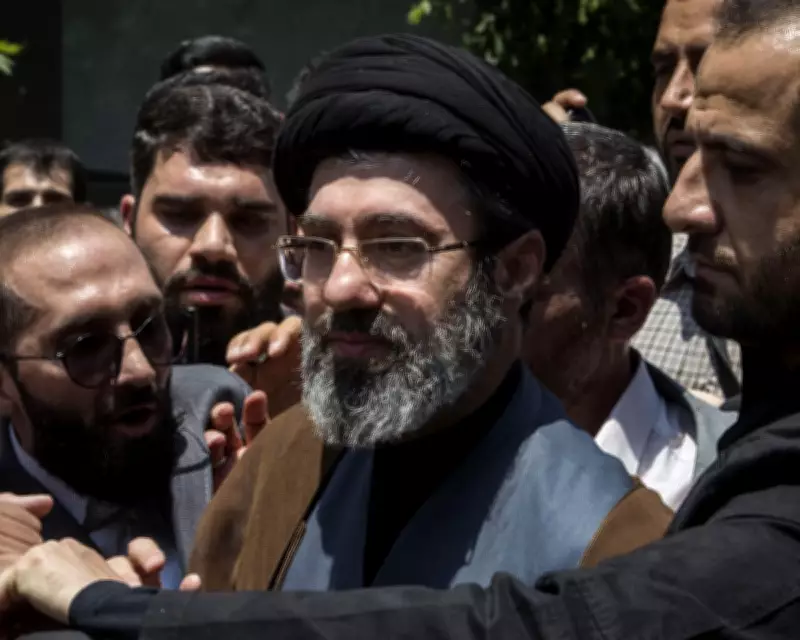
Iran's Supreme Leadership Passes from Father to Son in Historic First
In a landmark decision that reshapes Iran's political landscape, Mojtaba Khamenei has been officially chosen as the country's new supreme leader, succeeding his late father Ayatollah Ali Khamenei. This unprecedented move represents the first time since the 1979 Islamic Revolution that Iran's highest authority has transferred directly from father to son, marking a significant departure from the republic's founding principles against hereditary rule.
International Reactions and Escalating Tensions
The appointment has immediately drawn sharp criticism from Western powers, particularly the United States. Former President Donald Trump had previously identified Mojtaba Khamenei as the most likely successor and explicitly declared such an outcome "unacceptable." On Sunday, Trump reiterated his position, warning that Iran's next supreme leader would "not last long" without Washington's approval and insisting that the United States should have a say in Iran's future political direction.
Meanwhile, the Israeli military issued a statement in Farsi on social media platform X, vowing to pursue every successor of Ali Khamenei and anyone involved in the appointment process. This declaration comes amid escalating regional violence, with Iran threatening to attack oil facilities in neighboring countries following Israeli strikes on energy sites in and around Tehran that blanketed the city in black smoke.

A Controversial Figure Emerges from the Shadows
Mojtaba Khamenei, 56, represents a unique figure in Iranian leadership. Unlike most prominent political figures in the Islamic Republic, he has never held elected office or occupied formal senior government positions. Instead, he has operated largely behind the scenes, cultivating influence within his father's inner circle and building relationships with conservative clerics and elements of the Islamic Revolutionary Guards Corps (IRGC).
Born in 1969 in Mashhad, Khamenei was raised within the political and clerical establishment that emerged after the revolution. He studied theology in Qom's seminaries and reportedly participated in the final stages of the Iran-Iraq war. His name first entered public discourse during the disputed 2009 presidential election, when reformist figures accused him of supporting the security crackdown that followed mass protests.
Symbolic Significance and Internal Debate
For many analysts, Mojtaba Khamenei's appointment serves as a symbolic gesture designed to project regime strength and determination in the face of Western pressure. To his supporters, he represents continuity with the ideological line established by Ayatollah Ruhollah Khomeini and maintained by his father during his 37-year rule.
However, the succession raises profound questions about power concentration and the emergence of dynastic rule in a state founded explicitly to overthrow hereditary monarchy. This development is likely to ignite intense debate within Iran about the nature of the Islamic Republic's political system and its future direction.
Regional Escalation and Economic Implications
The leadership transition occurs amid heightened regional conflict with significant global economic implications. An IRGC spokesperson warned on Sunday that oil prices could exceed $200 per barrel if attacks on Iranian energy infrastructure continue. The United States has sought to calm markets by pledging not to target Iran's oil facilities.
A fresh wave of Iranian strikes hit Gulf states on Sunday, with Saudi Arabia, the United Arab Emirates, Qatar, Bahrain, and Kuwait all reporting attacks. Saudi Arabia intercepted 15 drones, while strikes in Bahrain caused material damage to a critical desalination plant. In Al-Kharj, Saudi Arabia, a projectile struck a residential area, killing two people and injuring twelve others.
The appointment of Mojtaba Khamenei as supreme leader represents not just a personal succession but a potential turning point for Iran's political identity and its relations with the international community. As the country navigates this historic transition, the world watches closely to see how this dynastic shift will affect regional stability and global energy markets.