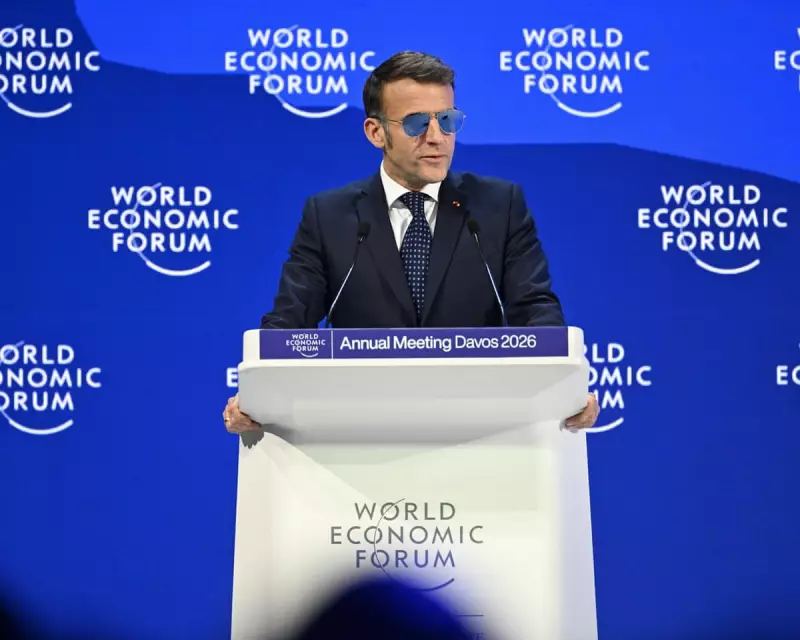
European Leaders Unite Against Trump's 'New Colonialism' in Greenland Standoff
European leaders have delivered a forceful condemnation of Donald Trump's "new colonialism" as the crisis over Greenland intensifies, with the US president declaring there is "no going back" on his goal of controlling the vast Arctic territory. The escalating row has plunged transatlantic relations into fresh turmoil, prompting warnings that Europe faces a critical crossroads.
Macron's Sunglasses Statement at Davos
French President Emmanuel Macron, wearing sunglasses due to what he described as a mild eye condition, used his platform at the World Economic Forum in Davos to deliver a blistering critique of Trump's approach. Addressing the gathering in Switzerland, Macron stated he preferred "respect to bullies" and the "rule of law to brutality," emphasising that now was "not a time for new imperialism or new colonialism."
The French leader specifically criticised what he termed the "useless aggressivity" of Trump's pledge to levy tariffs on European countries that oppose a US takeover of Greenland. Macron argued that the United States was seeking to "weaken and subordinate Europe" by demanding "maximum concessions" and imposing tariffs that were "fundamentally unacceptable – even more so when they are used as leverage against territorial sovereignty."

European Commission President Issues Stern Warning
European Commission President Ursula von der Leyen described Trump's threat to impose a 10% tariff on imports from Denmark, Norway, Sweden, France, Germany, the UK, the Netherlands and Finland as "a mistake." In a pointed reference to broken agreements, she noted that the EU and US had "agreed to a trade deal last July, and in politics, as in business, a deal is a deal. When friends shake hands, it must mean something."
Von der Leyen added that Europeans "consider the people of the US not just our allies, but our friends," but warned against plunging relations into "a downward spiral." She stated that the EU's response, if necessary, would be "unflinching, united and proportional."
Belgian Prime Minister Warns of Crossroads Moment
Belgium's Prime Minister Bart De Wever delivered perhaps the most dramatic assessment, declaring that Europe was "at a crossroads" with "so many red lines being crossed" by Trump that the continent must stand up for itself or "lose its dignity … The most precious thing you can have in a democracy."
De Wever stated he would "like to confirm that [the US] is an ally, but they have to behave like an ally," suggesting that eighty years of Atlanticism could be coming to an end. He made the extraordinary observation that "a Nato country is threatening another Nato country with military invasion."
Trump's Unwavering Position on Greenland
Donald Trump has intensified his push for Greenland in recent weeks, stating the US would take control of the Arctic island "one way or the other" and declaring: "Now it is time, and it will be done!!!" The US president posted on social media that during a call with Nato Secretary General Mark Rutte, he had "expressed … very plainly, Greenland is imperative for National and World Security. There can be no going back."
Trump shared an AI-generated image showing himself, US Vice-President JD Vance, and Secretary of State Marco Rubio planting a US flag next to a sign reading: "Greenland, US territory est. 2026." Another image depicted a map with Canada and Greenland as part of the United States.
UK's Cautious Response and International Reactions
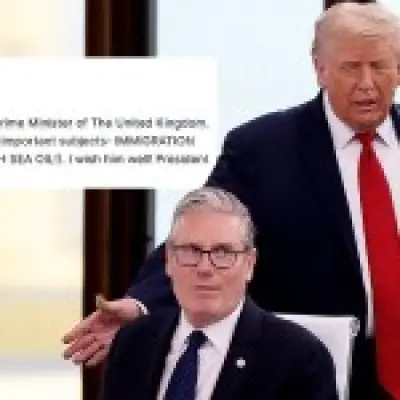
UK Prime Minister Keir Starmer's response to Trump's Greenland threats has been more measured than those of his French and Canadian counterparts, though it represents a slight shift from his usually deeply cautious approach towards the US president. Starmer told his cabinet that US tariffs were "the wrong thing to do," while his government continues with plans to cede the Chagos islands to Mauritius – a move Trump has criticised as "an act of great stupidity."
Canadian Prime Minister Mark Carney, speaking at Davos, told the gathering that the world's "middle powers" need to work together to build a better world order. He stated that "it seems that every day we are reminded that we live in an era of great power rivalry. That the rules-based order is fading," adding that "nostalgia is not a strategy."

Potential Retaliatory Measures and Military Implications
The European Union is considering retaliatory measures that could include a package of tariffs on €93 billion (£80 billion) of US imports that has been suspended for six months. Another option is the bloc's "anti-coercion instrument" (ACI), which has never been used but would limit US access to public tenders, investments, banking activities and restrict trade in services.
Senior MEPs on the European Parliament's international trade committee are expected to announce the formal suspension of ratification of the EU-US trade deal sealed in July, according to a European Parliament source.
Greenland's Prime Minister Jens-Frederik Nielsen stated in the capital Nuuk that while it was "unlikely" military force would be used, "it could be." He noted that "Greenland is part of Nato, and if there is an escalation, it will have consequences for the outside world." Danish Prime Minister Mette Frederiksen warned that "the worst may still be ahead of us," while emphasising that her country had "never sought conflict" but had "consistently sought cooperation."
Arctic Security and Military Developments
European leaders are considering establishing a more permanent military presence in the high north to help guarantee security in the Arctic region, according to Swedish Defence Minister Pål Jonson. This development comes as the Danish public broadcaster TV2 reported that 58 Danish troops had landed in Greenland to join about 60 others dispatched earlier for a multinational military exercise, Operation Arctic Endurance.
Von der Leyen revealed in her speech that the EU was working on a package for Arctic security based on Greenlandic and Danish sovereignty, a significant investment surge in Greenland, and cooperation with the United States in the region.
Attempts to De-escalate and Broader Implications
US Treasury Secretary Scott Bessent urged partners to "take a deep breath" and let tensions over Greenland "play out," describing European "hysteria" as unjustified. He expressed confidence that "the leaders will not escalate and that this will work out in a manner that ends up in a very good place for all."
The spiralling dispute has plunged trade relations between the European Union and the United States into fresh chaos and risks unravelling the Nato transatlantic alliance that has guaranteed western security for decades. As European leaders gather in Davos with Trump expected to address the forum, the Greenland crisis represents one of the most serious tests of transatlantic relations in recent memory.