
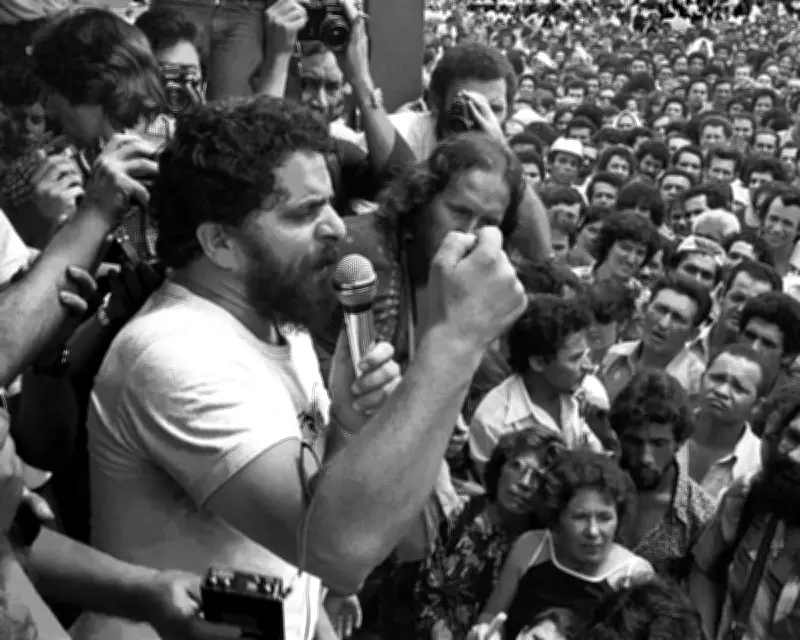
Brazil's President Luiz Inácio Lula da Silva is set to return to the Vila Euclides stadium in São Bernardo do Campo, the symbolic birthplace of his political career, to launch his seventh and final presidential campaign. The event, scheduled for Sunday, is expected to draw thousands of Workers' Party (PT) supporters to the football ground where Lula, now 80, first rose to prominence as a union leader during the metalworkers' strikes of 1979 and 1980.
Historic Strikes and the Birth of a Leader
The strikes, which took place in the industrial city of São Bernardo do Campo, were a bold act of defiance against Brazil's military dictatorship, which had ruled since 1964. Tens of thousands of metalworkers crammed onto the football pitch daily to demand higher wages, and their actions are credited with helping pave the way for Brazil's return to democracy in 1985. Photographer Jesus Carlos, who documented the events with his 24mm lens, recalled, "You weren't just documenting a fact – you were documenting history." Carlos, a former Communist party activist now aged 75, added, "I was a photographer – but before being a photographer I was a leftie. So I was fully aware what all it meant … [and] that the whole situation would be really important for the future."
Lula, then a 33-year-old union chief with a bushy beard and a heavy smoking habit, became a household name and a global icon as a result of the strikes. The New York Times hailed him as "the continent's leading working-class hero" and "a Brazilian equivalent of Poland's Lech Walesa." In 1980, Lula helped found the Workers' Party, which became one of Latin America's biggest leftwing political movements. After three unsuccessful attempts, he was elected Brazil's first working-class president in 2002, re-elected in 2006, and won a historic third term in 2022, defeating far-right incumbent Jair Bolsonaro.
Return to the Cradle of Change
The invitation to Sunday's event reads, "Vila Euclides is more than a stadium. It's a symbol of democracy. A cradle of change," urging activists to travel to "where it all began." João de Deus Martinez, an 85-year-old former metalworker who knew Lula during the strikes, recalled Lula's magnetism on the podium: "There was no one who could beat him up there on the podium … He had this magnetism. People cried [when he spoke] – tears of hope."
This year's election is expected to be tight, much like 2022 when Lula beat Bolsonaro by a narrow margin. Bolsonaro is barred from running after receiving a 27-year jail sentence for plotting to stop Lula taking power. His senator son, Flávio Bolsonaro, will stand in his place, with polls giving Lula a modest lead. John D French, Lula's American biographer, commented, "I don't think it's going to be a walkaway." French, who has charted Lula's trajectory since 1980, described the strikes as "a unique effervescence" of disgruntlement against worker exploitation and the "ignorant military men" who seized power in 1964. He noted, "Nobody knew what was going to happen, which is what made it dramatic, because there were a number of moments when it could have turned into a massacre."
Changing Political Landscape
The ABC Paulista region, of which São Bernardo is part, has changed dramatically since the 1970s. Once known as the "red belt," much of the region backed Bolsonaro in 2018. Today, only one of the seven cities in the ABC has a PT mayor, and São Paulo state is governed by Tarcísio de Freitas, a close Bolsonaro ally. Ademir Medici, a former newspaper editor who interviewed Lula for the regional Diário do Grande ABC, claimed, "If Lula turned up on Marechal Deodoro [São Bernardo's main street] he'd be booed." Dalila Teles Veras, a PT-voting poet and cultural activist, lamented the rightward drift: "Today, the sons of those [1979] union leaders are grown men who subscribe to fascist ideas. How do you switch sides just like that? I keep thinking about those old workers. What if they were still around? They'd die of heartbreak, no doubt."
Despite the challenges, Veras, 80, remains faithful to Lula, calling him the "kind of leader [who] only comes along once every 100 years or more – if that." She fears Brazil is facing its "most dangerous year" due to Donald Trump's efforts to swing the election in favor of Flávio Bolsonaro, including tariffs on Brazilian imports and revoking the visa of Brazil's US ambassador. Martinez, though frustrated that Lula has not nurtured an heir, vowed to vote for him again, saying, "I can't betray my way of thinking. He showed us the path." As Lula prepares to address the crowd at Vila Euclides, the event underscores the enduring legacy of the strikes that changed Brazil's history and the final chapter of a storied political career.




