
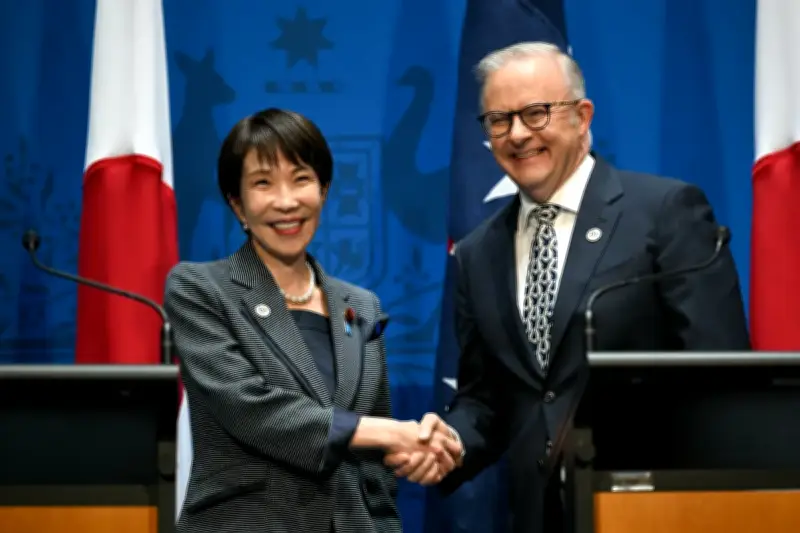
Japan's ambassador to Australia, Kazuhiro Suzuki, on Wednesday issued a statement downplaying Prime Minister Anthony Albanese's comments about a gift of melons from Japanese leader Sanae Takaichi, saying Tokyo had been reassured by the Australian government that Albanese "did not make the comments in the way that has been reported." The statement came as the Coalition continued to push for a federal police investigation into the alleged leaking of a diplomatic cable to The Australian newspaper.
Ambassador's Statement and Political Fallout
Suzuki's statement on Wednesday afternoon marked Japan's first official public comment on the issue, which has been dubbed "melon-gate" in Parliament House. The controversy stems from an interview Albanese gave to the comedy podcast Bush Deep in early July, where he discussed Takaichi's gift of Japanese melons, appearing to make hand gestures in front of his chest while saying "she brought two, as you do." The podcast host, Nikki Osborne, joked: "She came in looking like Pamela Anderson."
The Coalition, led by opposition leader Angus Taylor, has demanded Albanese apologise, with Taylor claiming the prime minister had "stuffed up." Senior shadow ministers Ted O'Brien and James Paterson have called on the Australian Federal Police (AFP) to investigate the apparent leaking of a diplomatic cable to The Australian, suggesting officers check whether the prime minister's office was involved. The AFP has been contacted for comment but has not confirmed whether it will investigate.
Diplomatic Cable and Coalition's Shift
The diplomatic cable, reportedly sent in July days after the podcast, contained Japan's government saying there had been "sensationalised reporting in the Australian media" and that Tokyo believed there was no "ill intention" in Albanese's actions. Following its publication, the Coalition shifted focus to questioning how the document became public, calling its publication an "apparent unlawful disclosure of confidential correspondence from the government of Japan."
Paterson said: "This is a serious matter. It is important that our closest allies have confidence of when they share confidential correspondence with us that it will not find its way in the media." However, when asked whether the cable proved Japan was not worried about Albanese's actions, O'Brien responded: "I won't be commenting on how Tokyo interprets this entire saga."
Labor's Defense and Japan's Reassurance
Labor ministers lined up to defend Albanese on Wednesday. Housing minister Clare O'Neil called the Coalition's AFP referral a "silly political stunt," claiming the opposition had "completely lost the plot." Education minister Jason Clare called it "rubbish," adding: "The fact that the Liberal party seem to be distracted by this, I think, shows they're not fit to govern here."
Albanese himself shrugged off the Coalition's concerns, saying the AFP was independent and would investigate whatever it deemed appropriate. In parliament, he stated: "We take our relationships seriously, including our regular engagement with Japan. And that is why we will always put the national interest first and we continue to do so." He also noted that Takaichi was "a good friend of Australia" and "a welcome guest here."
Suzuki's statement also noted that Takaichi had visited Australia in May, shortly before the interview, and had been hosted for dinner by Albanese "in a very relaxed atmosphere, and we believe it helped build a personal trust relationship between the two leaders." The melon comments resurfaced as a political issue after The Australian ran a comment piece on Monday from former Japanese ambassador Shingo Yamagami, who left his post in 2023, claiming Albanese had insulted Takaichi. Japan's government had refrained from public comments until Wednesday, when Suzuki released the statement that did not raise any further issue with Albanese's conduct.




