
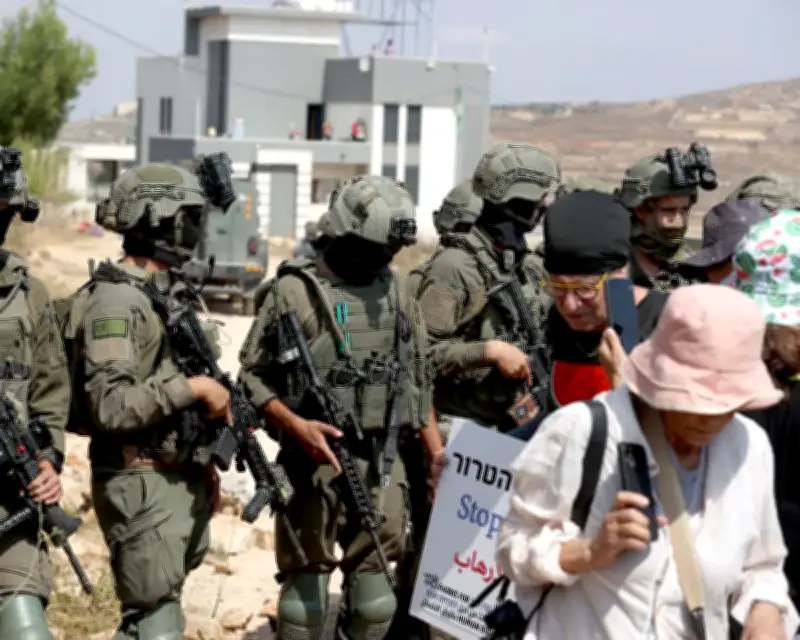
Israel's defence minister, Israel Katz, has ordered the military to draw up plans to transfer law enforcement powers for Israeli settlers in the occupied West Bank to the police, a move that Palestine's vice-president, Hussein al-Sheikh, has condemned as a "flagrant violation of international law" and a step towards full Israeli annexation. The announcement came amid domestic and international criticism of the army's failure to tackle militants besieging three Palestinian families in the village of Qusra, where a settler siege has entered its sixth day.
Plan Draws Immediate Condemnation
Al-Sheikh called for international intervention to enforce international law and stop a move that would "entrench the illegitimate annexation of Palestinian land." The plan, if implemented, would shift responsibility for policing Israeli settlers from the military to the Israel Police, a significant change in the occupied territory where military law currently applies.
Michael Sfard, a leading Israeli human rights lawyer, said the transfer could constitute a major step towards formal annexation. "The military can delegate enforcement but not responsibility [of the law]," Sfard said. "If they want to create a normative legal framework that absolves the army from responsibility and transfers it to police, that would be another brick, a very major one, of annexation."
However, Sfard noted that Israel could also legally expand police powers in the occupied West Bank under the current occupation framework, and the lack of detail in Katz's statement indicated it may have been driven more by politics than clear policy. "This is a cowardly statement made by a minister of defence who is under scrutiny, because the army that reached Syria, Iran and Lebanon and annihilated Gaza cannot evacuate a few Jewish terrorists that invaded a Palestinian home in an area under occupation for six decades," he added.
Settler Violence Intensifies in Qusra and Beyond
The plan was unveiled as the Israeli army proved unable or unwilling to remove a group of militants besieging Palestinian homes in Qusra, a village in the northern West Bank. On Friday, the commander of Israeli forces for the occupied West Bank, Gen Avi Bluth, made a second visit to Qusra. Two days earlier, he had told Palestinians the army would remove the settlers, but soldiers retreated from confrontation with the group. Instead, they forced one of the Palestinian families out of their home, saying they needed it as a base for the unsuccessful military operation.
One of the homes under siege is owned by a US citizen, and US ambassador Mike Huckabee described the Israelis besieging it as terrorists, saying he had requested the Israeli police and army act to remove them. Huckabee, who supports the settlement movement's vision of establishing a "Greater Israel" on land seized from Palestinians and neighbouring countries, said the militants in Qusra represent a "very small minority" of the settler movement.
The escalation comes amid a surge in attacks on Palestinians and construction of new settlements across the occupied West Bank, as extremists backed by the most far-right government in Israel's history intensify a campaign of ethnic cleansing ahead of national elections set for October. On Thursday, Katz celebrated the re-establishment of a settlement evacuated by Israel in 2005 under then-prime minister Ariel Sharon's disengagement plan. "Here, this is the land of Israel. Here, we are staying forever," Katz said at the ceremony in Ganim, where two dozen prefabricated homes have already been installed, and the hillside is being levelled to make space for more. On the road leading to the settlement, the army had levelled Palestinian property and used piles of rubble to block access roads for Palestinian communities.
Displacement and Violence on the Rise
State and settler violence has driven a surge in displacement of Palestinian communities in the past three years. Since October 2023, Israel has forcibly displaced 64 entire Palestinian communities and parts of 15 additional communities, affecting nearly 5,000 people, according to data from Israeli rights group B'tselem.
On Friday, Israeli gunmen opened fire at a group of unarmed Israeli and Palestinian activists as they attempted to peacefully reclaim Palestinian land seized by settlers in Beit Sahour, just outside Jerusalem. A Catholic bishop and journalists covering the event were also targeted by the attackers. Israeli settlers had put a large Star of David and Israeli flags on the roof of an old, dilapidated house, owned by Palestinians, just 500 metres from a Palestinian family home.
Mia Biran, from the group Combatants for Peace, described the incident: "They are all the time threatened by the settlers. We were about a hundred activists, our goal was to clean the area, plant some trees, to show presence and to stand with the residents who are very scared. We were on private Palestinian land." A few minutes after they started work, the group heard gunfire from the settler outpost and were forced to take cover. One gunman moved close to the group, opened fire in the air and aimed the gun at activists, in an attack videoed by the group. He was later joined by three or four others. "We screamed in Hebrew 'do not fire' and then they understood there are Israelis among the crowd," Biran said. "I called the police to tell them we are threatened by settlers, the activists who were at the roof saw there was a military Jeep all the time in the area who did nothing."
After they withdrew from the area, settlers visited the nearby Palestinian home and threatened to burn it down, she added. Settlers regularly launch arson attacks on Palestinian homes; one such attack in 2015 killed a baby and his parents, orphaning their only surviving son. The ongoing violence and the proposed policy shift signal a deepening crisis in the occupied West Bank, with international law experts and Palestinian leaders warning of irreversible consequences.




