
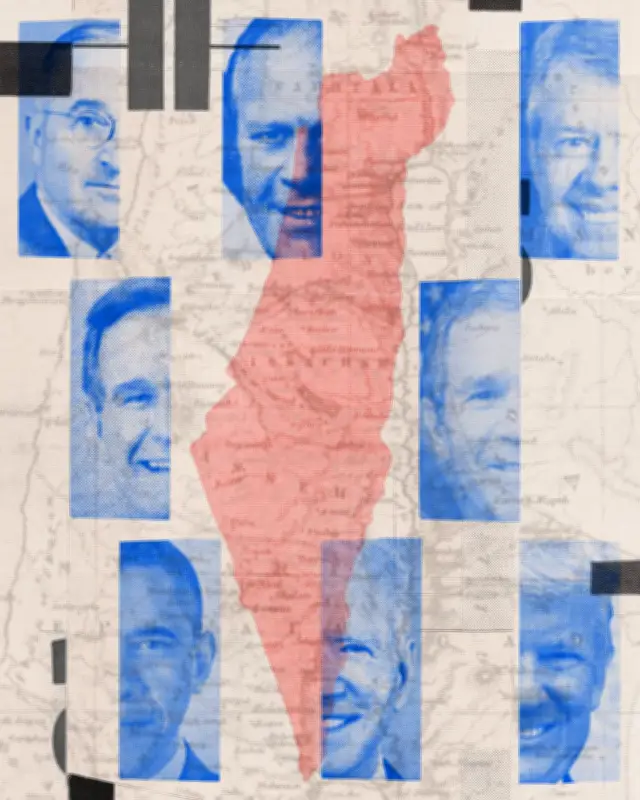
The pro-Israel lobby has swayed US presidents since Harry Truman, and its influence has only grown, culminating in Donald Trump's decision to go to war with Iran earlier this year. This pattern of presidential capitulation, driven by domestic political fears, has repeatedly undermined US interests and peace efforts in the Middle East, as detailed in the new book Israel's Lobby: America in the Grip of a Foreign Power by Eli Clifton and Ian Lustick.
Truman's 1948 Dilemma
In 1948, with war raging in Palestine, President Harry Truman faced a stark choice. On one side, Zionist lobbyists and his domestic political advisers pushed for recognition of a Jewish state. On the other, his top foreign policy and national security officials, led by Secretary of State George C. Marshall, unanimously warned against it, predicting war in the Middle East and damage to US relations with the Arab and Muslim world.
Marshall, revered as a patriotic and skilled leader, argued that recognizing Israel would be a "transparent dodge to win a few votes" and would diminish the presidency's dignity. He even declared he would not vote for Truman if he bowed to political pressure. Yet, within two days, Truman ordered US recognition of Israel, acutely aware of the power of Zionist sympathizers to sway New York's electoral votes in the upcoming election against Governor Thomas Dewey.
Ford's Reassessment and the AIPAC Letter
Twenty years later, President Gerald Ford faced a similar bind. In 1975, Ford and Secretary of State Henry Kissinger launched a "reassessment" of US Middle East policy, prompted by frustration with Israeli stonewalling. A committee of "Wise Men" unanimously recommended pressuring Israel to withdraw from the West Bank and Gaza for a comprehensive peace, in cooperation with the Soviet Union.
However, the Israel lobby, led by AIPAC, mobilized swiftly. They drafted a letter signed by 76 senators demanding that the US "stand firmly with Israel." Ford, though "mad as hell," was cowed, rejecting the Wise Men's recommendation. Instead, he returned to a step-by-step process, buying slices of the Sinai Peninsula from Israel with increased aid. The resulting US-Israeli Memorandum of Agreement, signed on 1 September 1975, included commitments that aides described as "mind-boggling" and "simply incredible." Ford later wrote bitterly about the AIPAC letter, which he felt ruined his diplomatic plans and cast a pall on his election campaign.
Carter's Surrender on Palestinian Homeland
President Jimmy Carter, who won 71% of the Jewish vote, initially pursued a comprehensive Middle East peace, including a "Palestinian homeland." The lobby immediately mobilized against him. In a 50-page memo, his senior adviser warned of serious political consequences, including losing renomination. Undeterred, Carter criticized Israeli Prime Minister Yitzhak Rabin's inflexibility and began intensive communications with Arab leaders.
But in October 1977, after a joint US-Soviet communique on a just settlement, the Israeli government and lobby reacted apoplectically. In a meeting with Israeli Foreign Minister Moshe Dayan, Carter was effectively blackmailed. According to National Security Adviser Zbigniew Brzezinski, Dayan threatened to go to "the American Jews" unless Carter assured opposition to an independent West Bank and promised economic and military aid. Carter surrendered, leading to a scaled-back "working paper" and ultimately the separate peace between Israel and Egypt, which isolated Egypt and set the stage for Israel's 1982 invasion of Lebanon and West Bank annexation.
George H.W. Bush's Frustration
President George H.W. Bush also felt the lobby's wrath. In 1991, he suspended loan guarantees to Israel to protest settlement spending, facing ferocious opposition. At a press conference, he vented: "We're up against very strong and effective, sometimes, groups that go up to [Capitol Hill]. I heard today there was something like a thousand lobbyists on the hill working the other side of the question. We've got one lonely little guy down here doing it."
Obama's Retreat and the Two-State Solution
President Barack Obama, who entered office with deep knowledge of the conflict, launched a high-profile peace initiative demanding a full Israeli settlement freeze. But a storm of outrage from Israel and the lobby, and a public feud with Prime Minister Benjamin Netanyahu, proved costly. Obama quickly reversed course, replacing peace envoy George Mitchell with lobby insider Dennis Ross, and threatened to pull $450m in aid to the Palestinians if they pursued a UN resolution against settlements.
In his memoir, A Promised Land, Obama complained about AIPAC's ability to cow politicians by invoking antisemitism accusations, noting his own vulnerability as "a Black man with a Muslim name." His UN address in 2013 shifted dramatically, focusing on Israeli victims of terrorism and opposing UN actions against Israel.
Biden's Compliance and the 2023 Gaza War
President Joe Biden, who genuinely believed in a "special relationship" with Israel, faced the ultimate test after the 7 October 2023 Hamas attacks. Despite recommendations from top advisers to act meaningfully to stop the Israeli onslaught on Gaza, Biden quashed them, mindful of the political punishment Obama suffered. When he made limited complaints about civilian casualties, the Republican Jewish Coalition slammed him for inserting "daylight" into the relationship, while AIPAC defended Israeli actions as necessary.
Washington's Warning and the Changing Political Landscape
These presidential experiences echo George Washington's Farewell Address, which warned against "passionate attachment" to a foreign country, as such factions could drive the US into dangerous commitments. Today, however, the political landscape is shifting. In the 2024 election, nearly a third of Biden's 2020 voters who didn't vote for Kamala Harris cited ending Israel's violence in Gaza as the top issue. Sixty percent of Americans now hold an unfavorable view of Israel, and record numbers of Israel critics are winning congressional primaries.
Despite these losses, Israel and its lobby continue to work to reverse Trump's campaign promises to avoid Middle East wars, pushing for closer US-Israeli military ties and spending millions to thwart critics. The authors argue that unless other groups can act freely without fear of antisemitism accusations, US Middle East policy will remain dangerously distorted. They call on Americans to unite to prevent any foreign power from exerting such influence over US policy and public debate.




