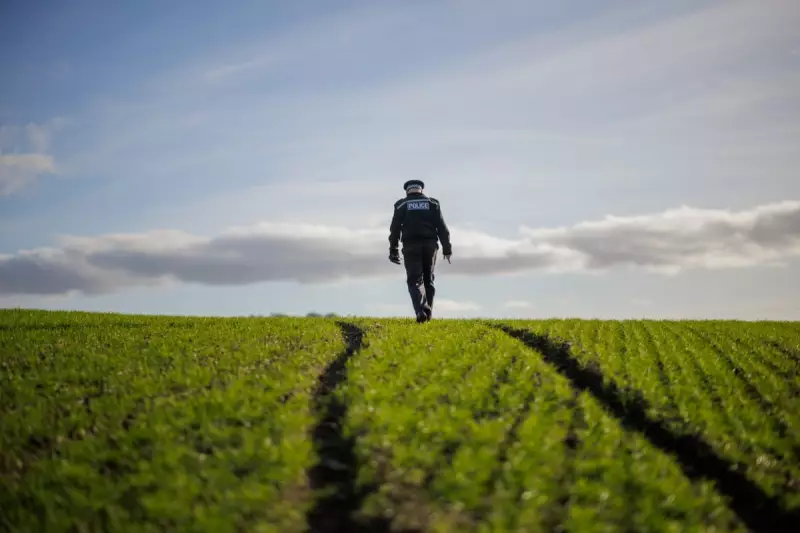
On a cold, bright afternoon in Wiltshire's Vale of Pewsey, the scene appears tranquil. Brown hares nibble in fields of winter barley. Yet, the deep tyre tracks gouged through the crop tell a different, violent story of what happens under cover of darkness.
A Rural Crime Epidemic Linked to Global Gambling
This picturesque corner of the West Country is a hotspot for hare coursing, a brutal activity where criminal gangs use dogs—typically greyhounds or lurchers—to chase down and kill hares. The crime is fuelled by illegal gambling, with bets placed on how many turns it takes a dog to make a kill. Chases are often livestreamed, allowing gamblers from across the world, including China, to participate remotely.
Wiltshire Police, a leading force in tackling this issue, report that gangs are terrorising the countryside. Inspector Andy Lemon, the tactical lead for rural crime in the county, expressed grave concern. "I fear it's only a matter of time before a farmer or landowner here is seriously injured defending their property," he warned. He urged landowners not to take matters into their own hands, but to call police instead.
The statistics are stark. Over the past year, hare coursing and poaching offences in Wiltshire rose by more than 20%. Since January 2025, police have made 30 arrests for these crimes—a staggering 500% increase compared to the whole of 2024.
Farmers Under Siege and a Conservation Irony
Despite the crackdown, many offenders evade capture. Gangs travel from across the UK to Wiltshire, attracted by vast open fields that offer little cover for hares after the autumn harvest. "This is their playground," said Inspector Lemon, who estimates hare coursing is happening somewhere in the county every single day.
Farmers are fighting back with increasingly desperate measures. One landowner in the Vale of Pewsey showed defences including concrete-filled troughs and fallen trees blocking gateways. "They smash through gates and fences. They don't care," he said. "There's big money involved... This is a crisis for us."
Another local farmer reported his land was targeted ten times in one month, leading to huge investments in ditches, fencing, CCTV, and nightly security patrols. The human cost is high, with one farm worker suffering leg and hand injuries after being knocked down by a car when confronting suspects.
Ironically, the rise in hare coursing is partly linked to successful conservation. One farmer noted that efforts to improve habitats have increased hare numbers. "I've heard of some farmers thinking of shooting hares to stop hare coursing, which is so sad," she lamented.
International Networks and a Cruel Sport
Philip Wilkinson, the Police and Crime Commissioner for Wiltshire and Swindon, is unequivocal. "We're being hammered, terrorised," said the former army officer. He is committed to a robust response, deploying armed response teams and traffic officers to catch offenders.
Wilkinson emphasises the deep links to international organised crime. Intelligence suggests those involved in coursing are often also responsible for stealing high-value farm equipment, which is smuggled to Eastern Europe. "What we're seeing is the ends of the tentacles," he explained. "If you swim upstream through those networks... you get to China and eastern Europe. It's all overlapped and linked."
The cruelty of the so-called 'sport' is condemned by animal welfare groups. David Bowles, Head of Public Affairs at the RSPCA, described the grim reality: "The end result is inevitably that the dog catches the hare and rips it to bits." The dogs themselves often suffer, with Wiltshire Council reporting an increase in abandoned lurcher-type dogs, many found underweight and injured.
Although hare coursing was banned under the Hunting Act 2004, recent legislative changes have introduced stronger sentences and powers to seize dogs. Bowles believes the concerted effort by police forces like Wiltshire and Lincolnshire, working with the RSPCA, NFU, and Countryside Alliance, is starting to show results in 2025.
Yet, as Inspector Lemon left the Vale of Pewsey, his radio crackled to life with a new report: dogs found in a car on Salisbury Plain. The daily hunt for the coursers was beginning again.