
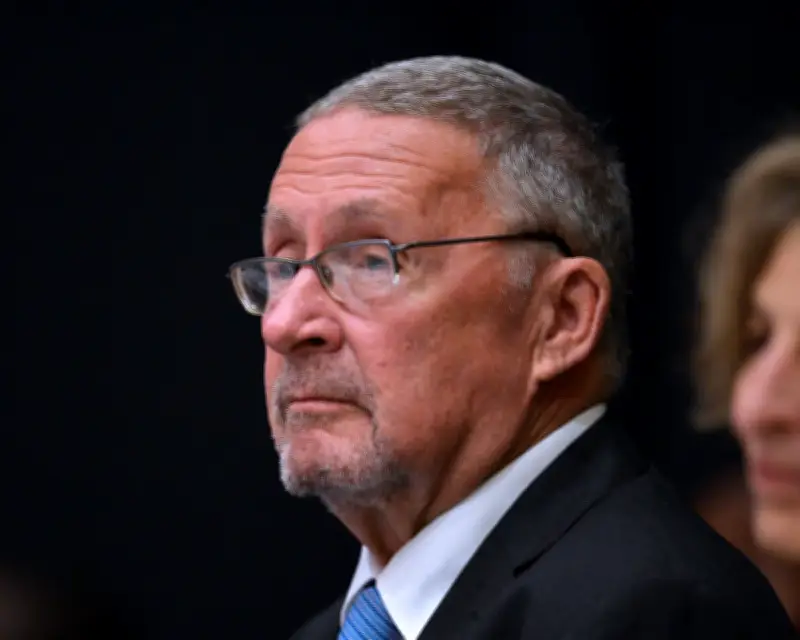
Guy Scott, the Zambian politician who made history as his country's first white head of state since independence, has died at the age of 82. Scott, who served as acting president for 90 days in 2014, passed away on 15 July 2026, leaving behind a legacy of political pragmatism and a unique sense of humour that defined his career.
A Historic Presidency
Scott's brief tenure as acting president came unexpectedly after the death of President Michael Sata in October 2014. As vice-president, Scott assumed control until a new election could be organised. However, he was barred from contesting the presidency himself because the constitution then required candidates' parents to be Zambian by birth or descent—both of his parents were born in Britain.
During his time in office, Scott faced a fractured Patriotic Front (PF) party. He briefly dismissed Edgar Lungu as secretary general for defying a ban on internal campaigning before Sata's funeral, only to reinstate him the next day. Despite demands from senior ministers for his resignation, Scott remained in office, oversaw the election, and peacefully transferred power to Lungu in January 2015.
An Improbable Partnership
Scott and Sata formed an unlikely political alliance: Scott was a Cambridge-educated economist, while Sata was a rough-edged populist known as "King Cobra." Over more than a decade, they travelled Zambia building the PF from a marginal opposition party into the movement that defeated the long-ruling Movement for Multiparty Democracy (MMD) in 2011. Sata became president and appointed Scott as vice-president, a move that drew international attention due to the rarity of white politicians at the highest levels of postcolonial African government.
Within Zambia, the reaction was largely positive. Mark Chona, a former adviser to founding president Kenneth Kaunda, said: "It shows people are colour blind and what they are looking at is performance, not colour." Scott himself noted: "There's been no hint of any resentment … I have long suspected Zambia is moving from a post-colonial to a cosmopolitan condition."
Early Political Career
Scott entered electoral politics in 1990 with the MMD, which ousted Kaunda's United National Independence Party after 27 years of rule. He won the Mpika Central parliamentary seat in the 1991 election and became minister of agriculture, food and fisheries, where he dealt with the severe regional drought of 1992 by arranging emergency maize imports through strained transport networks, helping Zambia avert a deeper food crisis.
However, he was dismissed from his post in 1993 during a cabinet purge by President Frederick Chiluba. After three years, Scott left the MMD to help form the short-lived Lima party, then joined Sata's PF in 2001. He returned to parliament for Lusaka Central in 2006 and served as Sata's principal strategist, integral to the party's 2011 election victory.
Handling Chinese Investment
As vice-president, Scott proved a capable technocrat, particularly on the sensitive issue of Chinese investment in Zambia's mining sector. During the 2011 campaign, Sata had used anti-Chinese rhetoric following a 2010 shooting at a coal mine where two Chinese managers opened fire on striking workers, injuring at least 11. When further violence erupted in 2012, Scott took a pragmatic approach, organising compulsory workshops to familiarise Chinese managers with local labour laws.
His translator at some workshops witnessed his forcefulness but also his recognition of linguistic and cultural differences. Scott's message of legal obligations was accepted, and managers' dealings with local workers improved.
Later Life and Legacy
After leaving frontline politics before the 2016 election, Scott published an idiosyncratic memoir, Adventures in Zambian Politics: A Story in Black and White (2019). In 2021, he became chief consultant to the United Party for National Development after its leader, Hakainde Hichilema, won that year's presidential election.
Born in Livingstone, Northern Rhodesia, Scott was the son of Grace, an English nurse and writer whose 1966 book The Fading Colour Bar examined racial segregation, and Alec Scott, a Glasgow-born doctor, lawyer, and newspaper publisher who supported African political advancement. Educated at Peterhouse boys' school in Southern Rhodesia, Scott graduated from Trinity Hall, Cambridge, in mathematics and economics in 1965.
He returned to newly independent Zambia, working as a planner in the finance ministry before establishing Walkover Estates, which grew wheat, strawberries, and vegetables. In the 1970s, he served as the first project manager of the Mpongwe Development Project, an agricultural pilot testing irrigated wheat cultivation. He later studied cognitive science and artificial intelligence at Sussex University, completing a master's in 1983 and a doctorate in 1986, and did research in robotics at Oxford before entering politics.
Scott's intelligence was matched by a taste for provocation. In 2013, he told the Guardian: "The South Africans are very backward in terms of historical development," and likened President Jacob Zuma to De Klerk, prompting Pretoria to summon Zambia's high commissioner. Yet his unique sense of humour made politics fun, as former colleagues and many Zambians recalled.
He is survived by his second wife, Charlotte (nee Harland), whom he married in 1994, and their daughter Thandi, plus three children from his previous marriage to Manja Crnkovic: Sasha, Hugo, and Sebastian.




