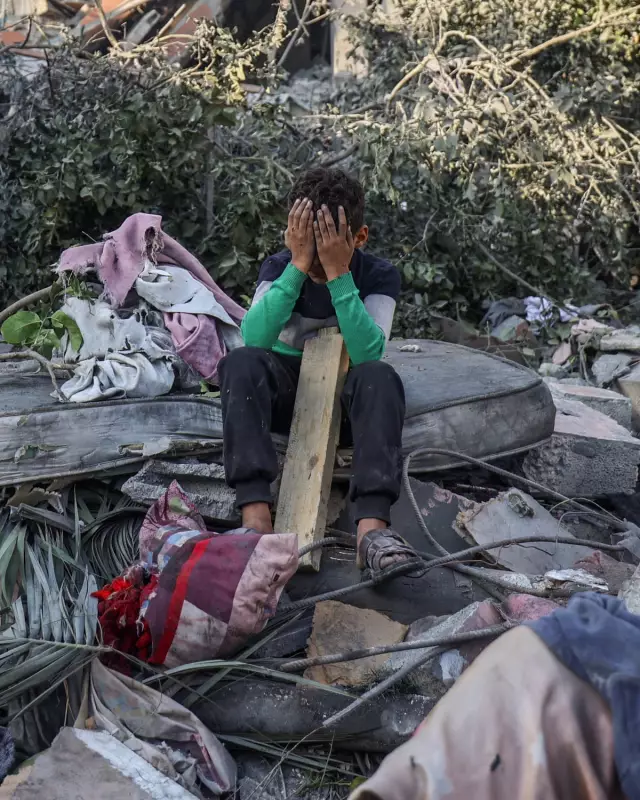
A so-called ceasefire in Gaza has failed to halt the killing or alleviate a profound humanitarian crisis, with more than 360 Palestinians, including at least 70 children, killed since the US-brokered truce was declared on 10 October.
A Mother's Grief Amid a Broken Truce
Hala Abu Assi believed her children would be safe when a ceasefire was announced. That illusion shattered on 29 November when an Israeli drone strike killed her two young sons, nine-year-old Jumaa and ten-year-old Fadi, as they searched for firewood near Khan Younis.
"After the ceasefire was announced, I felt a bit of safety and believed that nothing would harm my children any more," Abu Assi said. "But fate had another plan. They were killed at a time when bloodshed was supposed to stop."

She now focuses on keeping her two surviving daughters alive, but safety remains elusive. "I still hear explosions and gunfire," she said. "I do not feel that the war has ended."
The 'Yellow Line' and a Hardening Partition
While the daily death toll has fallen from a wartime average of 90 to around seven, this still constitutes an active conflict. Many of the killings have occurred near the "yellow line", a new boundary where Israeli forces have withdrawn under the truce.
This line now bifurcates Gaza, with Israel occupying 58% of the territory, including most of its fertile farmland. The Palestinian population is largely confined to the remaining 42%, barren coastal sand dunes described in US plans as a "red zone".
Concrete Israeli military outposts are being built along the line, signalling a potential permanent partition. On the Israeli-occupied side, neighbourhoods continue to be flattened, contrary to reconstruction commitments in the Trump-endorsed UN resolution from November.
Dire Conditions and Controversial 'Solutions'
For Gaza's 2.2 million Palestinians, conditions remain catastrophic. Nine in ten are homeless, with 81% of dwellings destroyed or severely damaged. Recent heavy rains have flooded tent camps, mixing with sewage and raising fears of cholera outbreaks.
While aid deliveries have increased slightly, they remain far below pre-war levels. Although commercial goods have reduced market prices, most Palestinians have exhausted their savings after two years without work.
Controversial US-led plans propose building "Alternative Safe Communities" (ASCs)—fenced camps of prefabricated units in the Israeli-controlled zone. These have been criticised by humanitarian groups and legal experts as potential tools of coercive displacement that may violate international law. A pilot project in Rafah would house only 25,000 people, just 1% of Gaza's population.
Stalled Diplomacy and International Complicity
The diplomatic process is stalled. Israel demands the return of all hostage bodies and Hamas's disarmament before further withdrawals. Hamas has returned all but one body and offered to discuss handing offensive weapons to a third party, but not to Israel.
European and Arab states justify their involvement in the US-Israeli Civil-Military Coordination Centre (CMCC) as a way to improve aid flows. However, observers warn that without political progress, this collaboration risks making them complicit in maintaining an inhuman status quo.
"An army that has just committed a genocide has 30, 40 other militaries now collaborating with it in its back yard," said Daniel Levy, a former Israeli negotiator.
For Palestinians like Faiq al-Sakani, living 500 metres from the "yellow line" in Gaza City, anxiety is constant. "It feels as if the war is still ongoing and there has been no ceasefire," he said. "It is unbearable; there is no sign of normal life at all."