Contrary to official declarations of a ceasefire, the genocide in Gaza continues unabated, with Israeli forces maintaining their assault on Palestinian civilians and infrastructure. According to Raz Segal, an associate professor of Holocaust and genocide studies, we are witnessing not a post-Holocaust world of 'Never Again' but rather a reality of 'Again and Again'.
The Ceasefire That Never Was
On 10 October, following two years of Israeli military operations that have devastated Gaza, the Trump administration announced a ceasefire. However, this apparent diplomatic breakthrough has proven largely illusory. The Israeli government has continued its attacks, killing and injuring hundreds of Palestinians since the supposed ceasefire took effect.
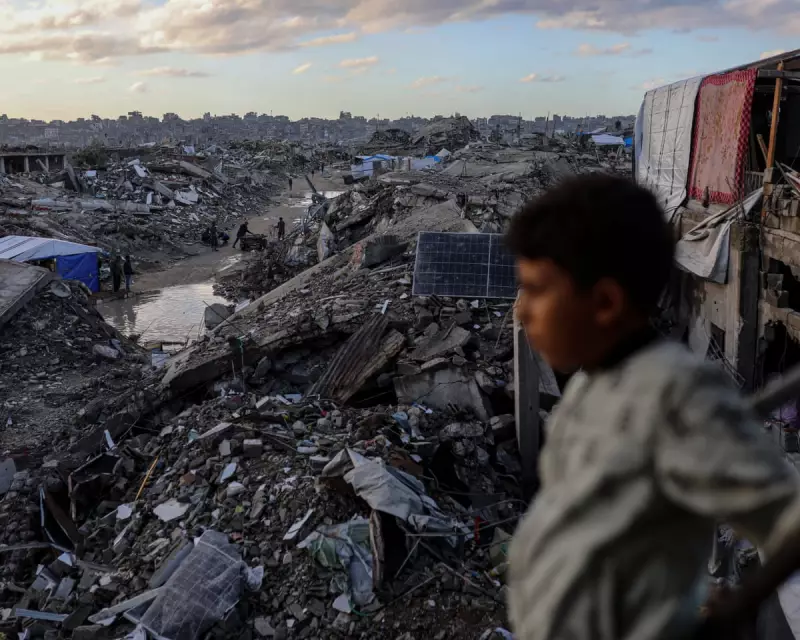
Thousands of homes and buildings have been destroyed, while Israel continues to block sufficient humanitarian aid from reaching the besieged population. The situation on the ground contradicts the political narrative of conflict resolution.

Genocidal Rhetoric and Ideological Warfare
Disturbingly, genocidal rhetoric from Israeli officials has not diminished. Simcha Rothman, a member of the Knesset for the Religious Zionist Party, articulated a chilling perspective at an international summit in Hungary on 28 October. He described Gaza as representing 'the idea of a genocide' against Jews and Western civilization.
This framing echoes historical patterns where perpetrators of genocide position themselves as defenders of civilization against perceived barbarians. Israeli President Isaac Herzog admitted in December 2023 that the conflict represents a broader struggle 'to save western civilization'.
The language used by Israeli soldiers on social media reveals a disturbing mindset. One officer described their mission as 'a real war of the people of Israel' where 'every Arab is a suspect' and moral action involves 'executing all terrorists' and settling 'all of the Land of Israel'.
From War to Nakba: The Unmasking of Intent
Israeli officials have increasingly dropped the pretense of this being a conventional war. Cabinet member Avi Dichter referred to the situation as a 'Gaza Nakba' in November 2023, while former military intelligence chief Aharon Haliva coldly stated in summer 2025 that 'the fact that there are already 50,000 dead in Gaza is necessary and required for future generations'.
This current Nakba connects directly to the 1948 displacement of Palestinians, challenging Israel's self-image as a unique state born from Holocaust survival. The simultaneous emergence of the genocide concept in international law and the Nakba in 1948 created a framework where Israel enjoyed impunity while denying Palestinian suffering.
Israeli Prime Minister Benjamin Netanyahu responded to South Africa's genocide case at the International Court of Justice by equating Palestinians with Nazis, claiming Israeli forces found copies of Hitler's Mein Kampf in Gaza. More recently, Israeli Heritage Minister Amihai Eliyahu stated explicitly that 'all Gaza will be Jewish' and acknowledged that 'the government is pushing to wipe out Gaza'.
International Complicity and Failed Prevention
The International Court of Justice determined in March 2024 that Israel was plausibly perpetrating genocide in Gaza, with Judge Abdulqawi Ahmed Yusuf noting that 'all the indicators of genocidal activities are flashing red in Gaza'. This finding should have triggered obligations under the UN Genocide Convention for signatory states to prevent and punish genocide.
Instead, Western nations continued providing Israel with weapons, ammunition, and diplomatic cover. The United States repeatedly vetoed Gaza ceasefire resolutions in the UN Security Council, while European governments maintained arms exports and political support.
The human cost has been catastrophic. By mid-March 2024, official figures indicated:

- Over 32,000 Palestinians killed, including at least 13,000 children
- More than 70,000 injured
- Over 60% of housing units damaged or destroyed
- Numerous hospitals and healthcare facilities rendered inoperable
- One million Palestinians facing catastrophic food insecurity
Historical Parallels and Systemic Failures
The current situation reflects deeper systemic issues within the international order. The post-World War II settlement preserved white supremacy and exclusionary nationalism rather than fundamentally challenging them. Israel emerged as a self-proclaimed exclusionary nation-state and settler colony, what Zionist leader Ze'ev Jabotinsky described as requiring an 'Iron Wall'.
This context explains why accountability mechanisms like the International Criminal Court have proven inadequate. Even if Israeli leaders face prosecution for war crimes, the underlying structures enabling genocide remain intact, much as Nuremberg trials failed to address the ideological foundations that produced Nazism.
We now inhabit a world with nearly 120 million forcibly displaced people, including over 9 million Palestinians. Climate change threatens to displace hundreds of millions more by mid-century, creating conditions where the Gaza genocide could become a model for dealing with displaced populations.
Grassroots Resistance and Hope
Despite governmental complicity and institutional failure, ordinary people worldwide continue to resist. Millions have taken to the streets, risking arrest, job loss, and stigmatization as antisemites to protest the genocide.
Most people recognize that day is not night, and they refuse to say otherwise. This basic commitment to truth, despite political pressure and propaganda, represents the foundation for meaningful change. The struggle continues for Gaza, for Palestine, and for a world where genocide prevention becomes reality rather than empty rhetoric.