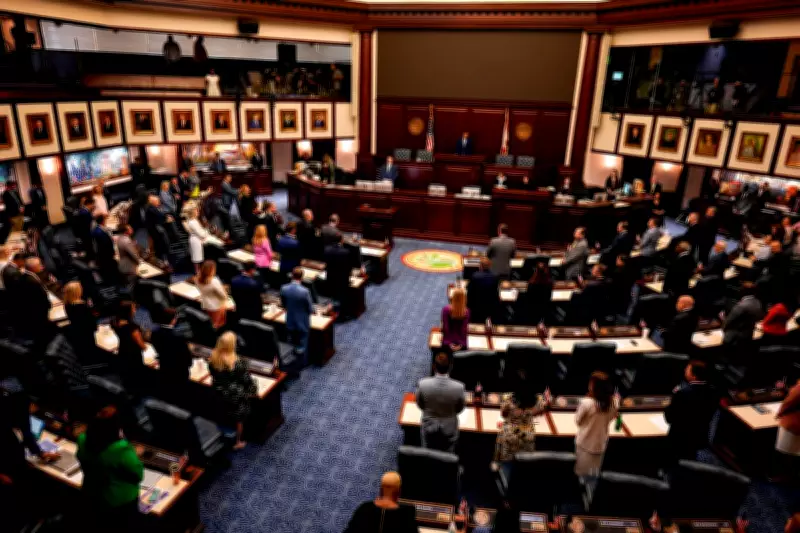
The Florida legislature has approved a new congressional map designed to maximize Republicans' advantage in the state, as part of the national redistricting battle initiated by former President Donald Trump ahead of the midterm elections. The vote came just two days after Governor Ron DeSantis unveiled his proposal and on the same day the US Supreme Court rolled back a key provision of the Voting Rights Act, potentially making it harder for Democrats to challenge Republican efforts to redraw districts that limit the influence of voters of color.
DeSantis's Map and Its Potential Impact
DeSantis's map could increase Republicans' advantage in Florida's House delegation from the current 20-8 split to 24-4. This potential four-seat gain mirrors what Virginia Democrats expect from a recent redistricting referendum, which is currently being challenged in state court. The new districts are certain to face lawsuits, especially because the state constitution prohibits redistricting for explicitly partisan purposes. However, DeSantis and his aides believe those provisions will not be a legal barrier, as they have been weakened previously by the Florida Supreme Court and again by Wednesday's US Supreme Court ruling.
Changes in Key Democratic Areas
The new map reshapes districts in Democratic areas around Orlando, the Tampa-St. Petersburg area, and in South Florida around Palm Beach, Fort Lauderdale, and Miami. These changes could cost US Representatives Jared Moskowitz and Debbie Wasserman Schultz, among others, their seats. DeSantis and his aides have argued that the new map is necessary to account for population growth in suburban and ex-urban areas since the 2020 census and to ensure Florida has a "race-neutral" congressional plan.

Supreme Court Ruling and Its Implications
The proposal presumed the outcome of the US Supreme Court's Wednesday decision, which specifically struck down a Louisiana congressional district drawn to have a majority Black electorate. Historically, Black voters have aligned more with Democrats, while a majority of white voters lean toward Republicans. The changes in Florida include the effective elimination of one nearly majority Black South Florida district that was represented by Sheila Cherfilus-McCormick, a Black Democrat, until her resignation earlier this month.
Uncertainties and Republican Concerns
There is no guarantee that new maps across the country will play out as the two parties hope. For example, Texas based its revised lines largely on Trump's performance in 2024, redistributing his voters across more districts to pull them into the Republican column. But Trump's popularity has waned since his re-election, including among Latino voters, who figure prominently in the state. Florida could face a similar conundrum: creating more majority-Republican districts could leave margins thin enough to allow for Democratic victories, especially if there is an anti-Trump backlash at the polls this year. Some Republicans have expressed worry about that possibility, and a handful voted against the measure in the Florida legislature.