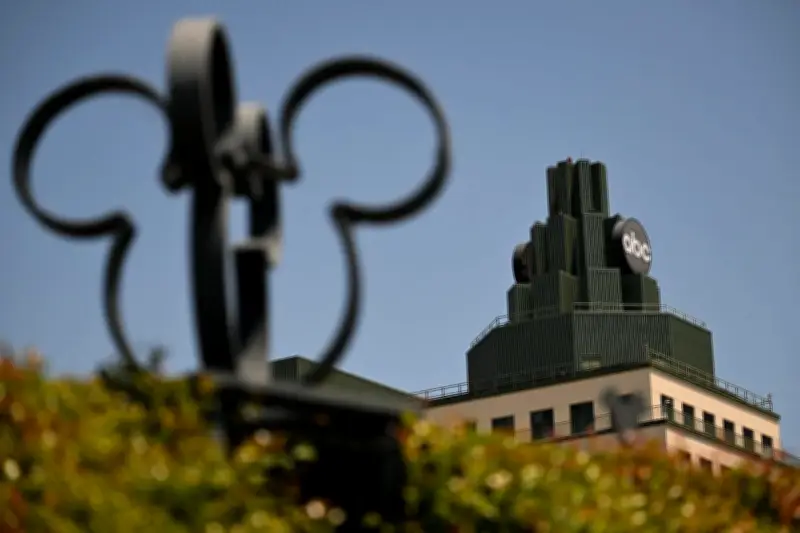
The Walt Disney Studios in Burbank, California, on 2 June 2025. Photograph: Patrick T Fallon/AFP/Getty Images
‘Open season’ on ABC as FCC moves up public comment process for renewals
Order represents one of the most significant actions the Trump administration has taken against a media company.
Over the next few weeks, anyone in the US can plead their case that Disney’s ABC should not be permitted to renew its broadcast licenses for the eight local television stations they own.

After the Federal Communications Commission’s stunning decision in late April to force ABC to apply early to renew its licenses – a move widely seen as retaliation against critics of Donald Trump – the nation’s top media regulator opened up the pleading cycle process to critics and supporters until 29 June.
The early renewal order represents one of the most significant actions the Trump administration has taken against a media company, a potential regulatory death-blow to go alongside the myriad legal actions taken against the press and access restrictions placed upon journalists.
The FCC’s order came one day after Trump and his wife, Melania, lobbied for ABC to cancel the late-night show starring Jimmy Kimmel, prompting some to claim it was politically motivated. But chair Brendan Carr has said that the decision was based solely on the early findings of an investigation into Disney’s diversity, equity and inclusion (DEI) practices.
ABC is extremely skeptical of the FCC’s stated rationale for the early renewal order, arguing in an 18-page memo in late May that the DEI investigation was simply a pretext for retaliating against a disfavored broadcaster and chilling its speech.
Either way, now that the FCC has begun the process of reviewing ABC’s licenses, critics of the network have a golden opportunity to land their blows.
Petitioners who want to deny the network’s license renewals are not limited to focusing on the company’s hiring practices – they can challenge any aspect of ABC’s fitness for broadcasting and contest whether the networks truly serve the public interest. ABC will then get a month to respond to the petitions to deny their renewals, and petitioners will get a few days to reply.
“Is this open season on ABC? Without a doubt,” said Gigi Sohn, who served as counselor to former FCC chair Tom Wheeler during Barack Obama’s administration.
Daniel Suhr, the president of the conservative legal group Center for American Rights, confirmed that his organization will file a petition to deny ABC’s license renewals on multiple grounds, including several issues the group has raised in the past. “It’s a license renewal, and so any issues dealing with the license are fair game, and we’ve had a number of pending complaints and concerns about ABC,” he said.
Over the past two years, the group has filed complaints about ABC’s moderation of a 2024 presidential election debate; about late-night host Jimmy Kimmel, and its belief that Kimmel “utilizes his show – and therefore the public airwaves – to advance his own political interests”; and has supported an inquiry into the ABC talkshow The View.
While several petitions to deny are expected to come from established organizations like Suhr’s, the public can also write in with comments. “I am concerned this proceeding reflects a broader effort to discourage corporate diversity initiatives and may create pressure on broadcasters based on political disagreements rather than established communications-law standards,” wrote one dissenting individual on 5 June.
After a 5 August deadline for replies to petitions to deny ABC’S licenses, the matter would likely be handed off to an administrative law judge to hold what is essentially a full trial over the license process, one that would involve discovery and depositions and witnesses – or the FCC’s commissioners could choose to hold hearings themselves, telecommunications policy experts said. Any adverse ruling could be appealed, and the case would go to the US court of appeals for the DC circuit, which could then choose to send it back to the commission.

Andrew Schwartzman, a veteran telecommunications lawyer, described a labyrinthian renewal review and appeals process that could take two to three years, likely running past Trump’s presidency. Meanwhile, ABC can continue operating their stations as usual.
ABC has hired experienced supreme court litigator Paul Clement to represent the network in its dealings with the FCC, a sign that the network is preparing for its day in court. Sohn speculated that any license revocation would be swiftly overturned.
“This is entirely about attacking ABC,” she said. “Is it about taking away their licenses? Brendan Carr is not a dummy. He knows that if he tried to take away ABC’s licenses that he would lose so badly in court. I mean, he would get spanked by a court, but it doesn’t need to get that far to make things very, very painful for ABC.”
Either way, the process could take a very long time, leaving the proverbial “sword of Damocles” hanging over ABC’s head throughout the process – which the network has said is the point.
ABC, in its filing, argued that this process can only end badly for the stations, considering that licenses can only be renewed 30 days prior to their expiration, and some of the network’s licenses don’t expire until 2031. “In sum, there is no procedural path for this proceeding to terminate favorably for the Station, which demonstrates the unlawful Order’s punitive intent and the harms flowing directly from it,” the network argued.
The FCC also has an enforcement action pending against ABC’s powerhouse daytime talkshow The View, for a potential violation of equal-time rules that require non-news programs to provide comparable air-time opportunities to the political rivals of candidates they host for interviews. The commission is accepting public comments on that investigation until 22 June, and it could play into the broader license-renewal process.
Thousands of commenters have already weighed in on whether The View should be considered a “bonafide news program” exempt from the equal time rules. Some of those comments, like a 9 June submission, have been short and to the point: “‘The View’, a News Program?! You’re kidding, right?”
The dual-track processes – the license-renewal challenge and The View enforcement action – put ABC directly in the center of Carr’s crosshairs, a very uncomfortable place to be for a network that is trying to stay out of the political limelight.
But Schwartzman, the telecommunications lawyer, said he been heartened that ABC has “drawn a line in the sand” and challenged both the expediting of the license renewal process and the investigation into The View.
“Instead of sucking up and paying off, they’ve reached their limit and they’re going to take a stand,” he said.