
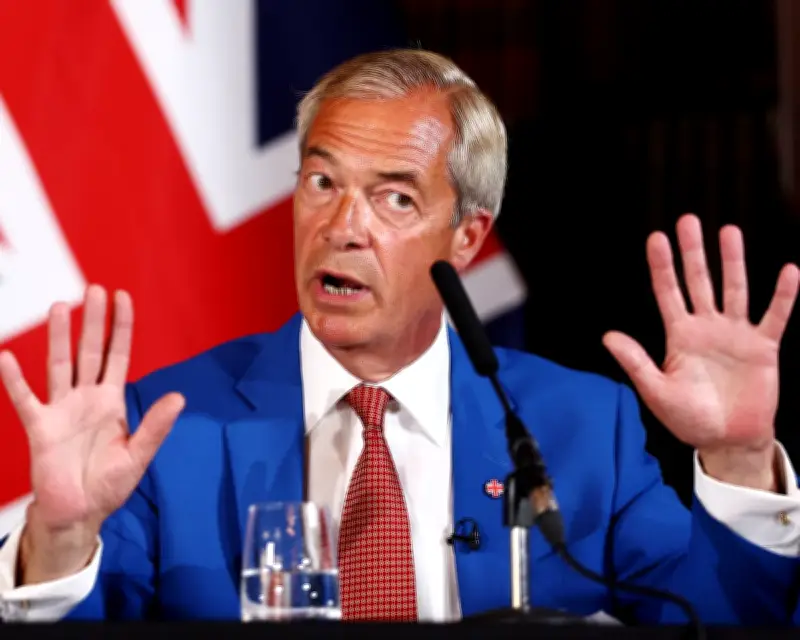
Nigel Farage, the leader of Reform UK, is facing mounting pressure over his party's finances, with questions swirling about the origins and purpose of millions of pounds in donations. In a week that saw the political landscape shift, Farage's celebratory mood over a recent byelection victory was overshadowed by revelations about his financial arrangements, leading to accusations of hypocrisy and confusion.
Farage's Financial Maze
According to reports from the Guardian and Sunday Times, Farage has been struggling to explain a series of financial transactions involving a £5m donation from Thai crypto-billionaire Christopher Harborne. Initially described as a gift for Ferraris, it was later said to cover security costs, and now appears to be a downpayment on the £1m per year Farage claimed he needed to return to full-time politics. Additional funds have been traced through offshore accounts linked to George Cottrell, a former aide who called Farage "Daddy," and his mother Fiona, eventually reaching Reform's bank accounts. Farage's inability to recall when he became politically active, despite owning a majority share in Reform, has only added to the confusion.
The timing is awkward for Farage, who is set to celebrate his byelection victory in Clacton against "the establishment," a phrase he used to describe his opponent, a comedian wearing a dustbin on his head. With a week to go before the celebration, Farage has yet to provide a coherent account of his finances, leaving voters and critics alike questioning his credibility.
Reform's Reckoning
This summer has been a turning point for Reform UK. Once dominating the polls and setting the news agenda with weekly press conferences, the party now appears to be in retreat. Even loyal supporters at the Spectator and the Telegraph have begun to express doubts, and political commentators suggest the game is up when GB News starts questioning Farage's actions. Farage has reportedly placed himself in a "witness protection programme," avoiding questions about his financial arrangements.
The party's decline is stark: a year ago, Reform was leading in opinion polls; now it struggles to maintain relevance. The investigative reporting by the Guardian and Sunday Times has exposed a web of financial dealings that have tarnished the party's image, leading to internal and external criticism.
Cambridge and the Arday Affair
In other news, the resignation of Jason Arday, a professor of sociology at the University of Cambridge, has sparked controversy over the university's hiring practices. Arday, who has been accused of fabricating parts of his CV, including claims of being a world-class athlete and appearing in the documentary series "Seven Up," resigned amid allegations of plagiarism in his PhD thesis. Critics argue that Cambridge failed to conduct due diligence, offering him a professorship without proper scrutiny.
The fallout has been significant, with rightwing commentators using the case to question the credentials of academics of colour. Arday's upcoming book, published by Simon & Schuster, now faces calls for its release to be delayed indefinitely. Cambridge's handling of the situation has been criticized for doing more harm than good, both to Arday and to the broader academic community.
Badenoch's Controversial Stance
Kemi Badenoch, the Conservative MP, has also made headlines this week for her defense of Joshua Bonehill-Paine, a former neo-Nazi who was jailed for harassing Jewish Labour MP Luciana Berger. Badenoch argued that Bonehill-Paine deserved a second chance, appointing him as a Tory special adviser after his candidacy for a council seat was withdrawn due to CV irregularities. Her stance has been criticized as inconsistent, particularly given her refusal to offer the same leniency to Labour minister Lou Haigh, who was convicted of phone fraud.
The controversy highlights a broader debate within the Conservative Party about what is acceptable. While Badenoch defends a man with a history of antisemitism, she has banned Grant Shapps from standing as a Tory MP for his belief in climate change. This double standard has not gone unnoticed, with commentators pointing out the party's shifting values.
Beckham's Silence on FIFA
David Beckham's silence amid the corruption scandals surrounding FIFA president Gianni Infantino has drawn criticism. Beckham, who was paid millions as a FIFA ambassador for the 2022 World Cup in Qatar, has remained mute as Infantino faced allegations of corruption, including awarding Donald Trump a peace prize and overturning a red card at Trump's request. Beckham's only notable comment during the Qatar World Cup was to say he hadn't seen any gay people being persecuted, a statement widely ridiculed.
As Infantino continues to face no-confidence votes from football bodies, Beckham's complicity has tarnished his once-beloved image. Observers note that Beckham could have used his platform to speak out against the commercialisation and corruption in football, but instead he appears focused on wealth and status, earning an additional £24m in endorsements during the US World Cup. The public wants "our Becks back," but his silence suggests he may be beyond redemption.




