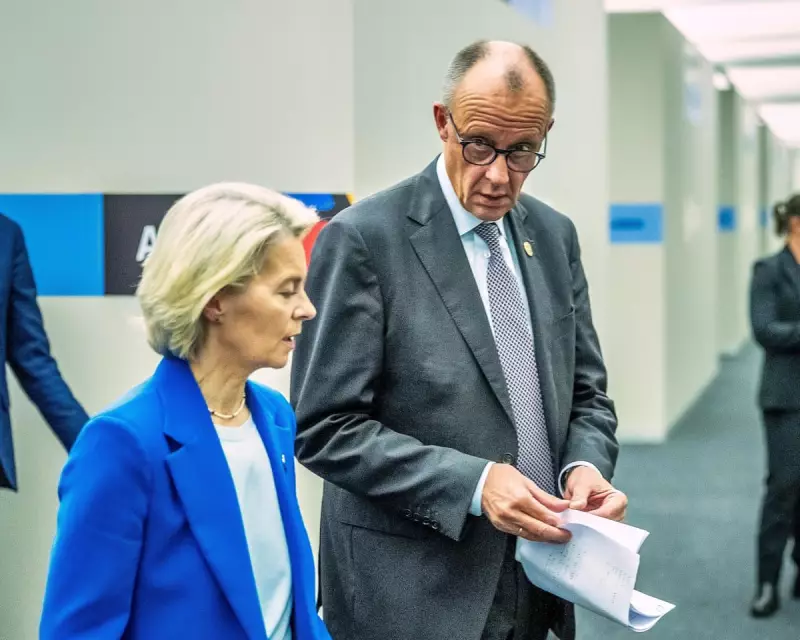
Top European Union leaders are scrambling to secure a vital financial lifeline for Ukraine, with emergency talks scheduled for Friday as Kyiv's cash reserves dwindle dangerously low.
High-Stakes Dinner in Brussels
German Chancellor Friedrich Merz, European Commission President Ursula von der Leyen, and Belgian Prime Minister Bart De Wever will hold a private dinner in Brussels in a last-ditch effort to salvage the bloc's funding plan. The meeting comes after Belgian officials have voiced strong and persistent opposition to the proposed scheme, which hinges on the unprecedented use of frozen Russian state assets.
The urgency is palpable. With Russia intensifying its attacks, Washington pushing for peace talks that could favour Moscow, and Kyiv fast running out of money, the EU faces a major credibility crisis. The bloc has pledged to support Ukraine through 2025 but must find a concrete way to fund this promise.

Two Controversial Paths to Billions
Ahead of a crucial EU summit on 18 December, von der Leyen outlined two primary options to raise the tens of billions Ukraine needs for its military and essential public services. The EU aims to secure approximately €90 billion (£80 billion) to cover around two-thirds of Kyiv's estimated requirements for 2026 and 2027.
The first option involves the EU borrowing against its shared budget on international markets. However, this faces significant hurdles, as many member states are reluctant to take on new common debt that would require repayment. Furthermore, it would need unanimous approval, a tall order given Hungary's past opposition to Ukraine aid packages.
The second, and more contentious, proposal is to issue a massive loan to Ukraine, using immobilised Russian assets as security. The bulk of these assets—roughly two-thirds of an estimated €290 billion frozen in the West—are held at the Euroclear securities depository in Brussels. The logic is that this would demonstrate to Moscow that Ukraine has the financial stamina to fight for years, strengthening Kyiv's hand in any future negotiations.
Belgium's Fear of Russian Retaliation
Prime Minister De Wever's government remains the plan's most formidable obstacle. Belgium fears catastrophic financial and legal repercussions if it acts alone. Officials worry that Russia could launch retaliatory lawsuits or demand its assets back if sanctions are ever lifted, potentially leaving Belgium solely liable for billions.
"We have the frustrating feeling of not having been heard. The texts the commission tabled do not address our concerns in a satisfactory manner," stated Belgian Foreign Minister Maxime Prévot on Wednesday, advocating for the joint borrowing alternative instead.
De Wever has been even more blunt, calling the asset plan a "fairytale" and warning that Moscow has threatened Belgium would "feel the effects for eternity" if the assets are seized. He has drawn a historical parallel, noting that even during the Second World War, Allied powers did not confiscate Germany's frozen sovereign assets during the conflict.
In a stark warning published on Thursday, Chancellor Merz framed the decision as existential for Europe. He argued that an "imperialist Russia" is preparing for conflict with the West and that using the frozen assets would send an unambiguous signal. Merz proposed that risks should be shared fairly across all EU member states, based on their economic performance, to alleviate Belgium's fears.
As diplomats acknowledge this is a defining moment for the bloc, the outcome of Friday's high-pressure talks will determine not only Ukraine's immediate future but also the EU's ability to act as a unified geopolitical force.