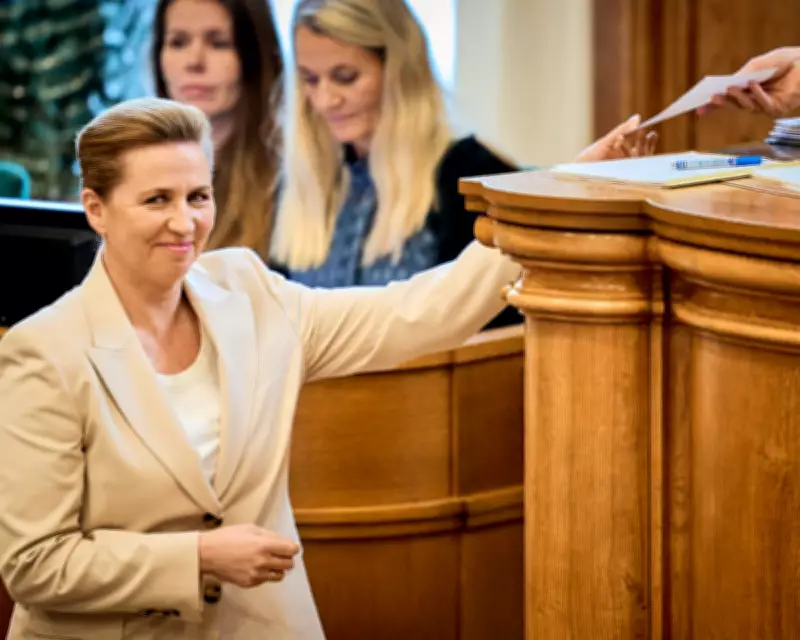
Danish Prime Minister Announces Early Election, Banking on 'Greenland Bounce'
In a strategic political move, Denmark's Prime Minister Mette Frederiksen has called an early general election for March 24, seeking to leverage what analysts term a "Greenland bounce" following heightened tensions with former US President Donald Trump over Arctic territory claims.
Timing and Political Calculations
Frederiksen, who has led Denmark since 2019, is legally required to call an election by October 31. By setting the date eight months early, she appears to be capitalizing on improved poll numbers after her Social Democrats suffered significant losses in November's local elections, including losing control of Copenhagen for the first time in a century.
Recent polling indicates her party and coalition partners are gaining momentum, partly attributed to their firm stance during the Greenland crisis. Frederiksen announced the election in parliament on Thursday, stating, "Winter has finally let go and the days are getting longer and brighter. It will soon be spring – and the Danes will soon be going to the polls."

International Crisis and Domestic Gains
The prime minister's international profile has risen substantially over the past two months as she rallied European leaders against what could have been an existential threat to NATO over Greenland. Donald Trump's threats to claim the Arctic territory created a diplomatic crisis that Frederiksen navigated with determination.
Peter Thisted Dinesen, a politics professor at the University of Copenhagen, noted, "The Greenland crisis has arguably aided her by conveying her ability to steer the country through an international crisis. The Social Democrats are faring better in the polls than after the local elections."
Policy Proposals and Coalition Dynamics
In her parliamentary address, Frederiksen declared this would be a "decisive" election for Denmark and Europe's future, pledging to redefine Denmark's relationship with the United States and strengthen European unity. She announced several key policy initiatives:
- A wealth tax expected to generate 6 billion kroner (approximately £700 million) for primary schools
- Abolition of property tax for homes valued under 1 million kroner
- Continued focus on Arctic security discussions with the United States
Frederiksen told parliament, "A wealth tax should take the edge off inequality and create a better balance in our country. This will be a decisive election because it will be in the next four years that we as Danes and as Europeans will really have to stand on our own feet."
Polling Shifts and Political Landscape
Recent surveys show significant movement in Danish politics. A Megafon poll for TV2 last month found Social Democrat support had risen to 22.7% of the vote, projecting 41 seats compared to 32 seats in early December. The broader left-wing bloc, including Frederiksen's party and smaller allies, now polls at 87 seats, surpassing the current government's 71 seats.
Professor Dinesen observed that new initiatives like the Fødevarechecken food support scheme appear to be resonating with voters, while the right-wing nationalist Danish People's Party has declined in the polls.
Coalition Considerations and Future Directions
While thanking current coalition partners in her speech, including Foreign Minister Lars Løkke Rasmussen and Defence Minister Troels Lund Poulsen, Frederiksen kept her options open for post-election alliances. She remarked, "When an elephant and a camel can become friends, so can political opponents," but added, "Could it be a choice over the political middle again? Yes."
The election will determine not only Denmark's domestic direction but also its position within Europe and its relationship with traditional allies. As Frederiksen told parliament, "We need to define our relationship with the United States, and we must rearm to ensure peace on our continent. We must stick together in Europe, and we must secure the future of the Danish commonwealth," which includes Greenland and the Faroe Islands.