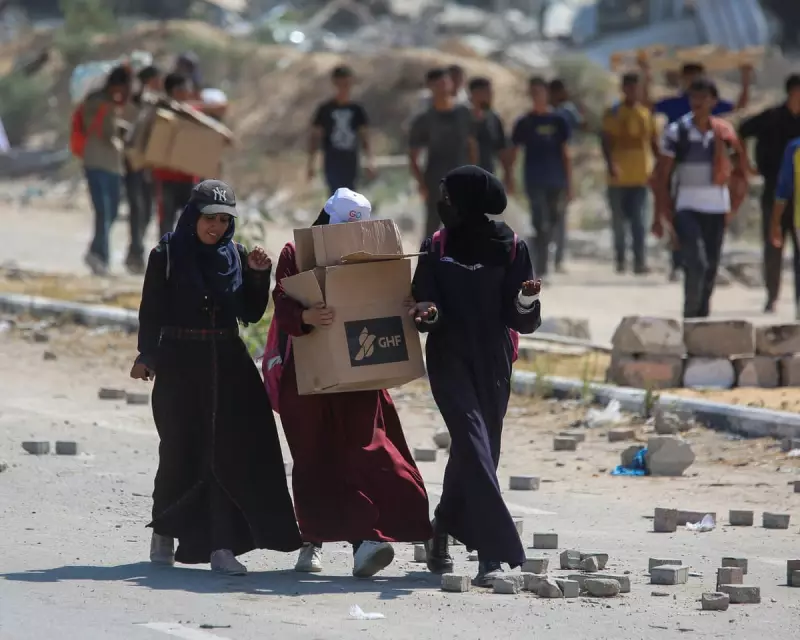
The controversial Gaza Humanitarian Foundation (GHF), a private company backed by the United States and Israel, has announced the permanent closure of its operations within the devastated Gaza territory. The organisation stated it had successfully completed its emergency mission to provide food aid.
Aid Distribution Sites Marred by Chaos and Violence
The GHF operated four main food distribution sites which, between May and October, became notorious flashpoints of chaos and deadly violence. According to witness accounts gathered by the Guardian, medical records, and social media videos, more than 1,000 Palestinians were killed or injured by Israeli military forces while seeking aid from these sites.
The Israeli military, which guarded the approaches to the company's distribution centres in central and southern Gaza, claimed it only fired warning shots for crowd control or when troops felt endangered. However, contractors on site, backed by video evidence, reported that US security guards fired live ammunition and stun grenades at desperate civilians scrambling for food.
The scale of the violence was starkly illustrated at the Red Cross clinic in Rafah, which treated 1,874 weapon-wounded patients between 25 May and 19 June. The vast majority reported being injured while trying to access aid from GHF locations.
International Scrutiny and a Controversial Model
The GHF was launched as famine loomed following Israel's total blockade on all supplies to Gaza imposed in March. It was viewed by Israeli and US officials as an alternative to the United Nations, which both countries accused of inefficient aid distribution and criticised over looting.
This opaque company faced significant international opposition. Major international aid organisations refused to work with the GHF. Furthermore, a UN-mandated expert panel alleged in August that under the GHF, aid was exploited for covert military and geopolitical agendas.
Throughout the conflict, the UN led a massive humanitarian effort with other aid groups, distributing supplies at more than 400 centres across Gaza despite immense logistical hurdles and tight Israeli restrictions.
Legacy and Transfer of Operations
John Acree, a former senior official at the United States Agency for International Development (USAID), revealed that the GHF would transfer its work to the Civil-Military Coordination Center (CMCC), a new US centre in Israel established to oversee the ceasefire and aid delivery.
In its closing statement, the GHF claimed it had delivered more than 187 million meals directly to civilians, calling it a record operation that ensured aid reached families without diversion to Hamas. Acree praised the model for working reliably and saving lives.
However, this view was not universal. Acree's predecessor resigned from the project, stating it was impossible to implement while adhering to the core humanitarian principles of humanity, neutrality, impartiality, and independence.
The US State Department publicly thanked the GHF for its work, with spokesperson Tommy Pigott writing on X that its model, which prevented Hamas from looting and profiting from stealing aid, played a huge role in achieving a ceasefire.
In stark contrast, a Hamas spokesperson, Hazem Qassem, called for the GHF to be held accountable for the death and injury of thousands of Gazans, accusing it of covering up a starvation policy practised by the Israeli government.
The GHF closed its distribution sites after a US-brokered ceasefire took effect last month. All sites were located in parts of Gaza under Israeli control, rendering them inaccessible to the Palestinian population.