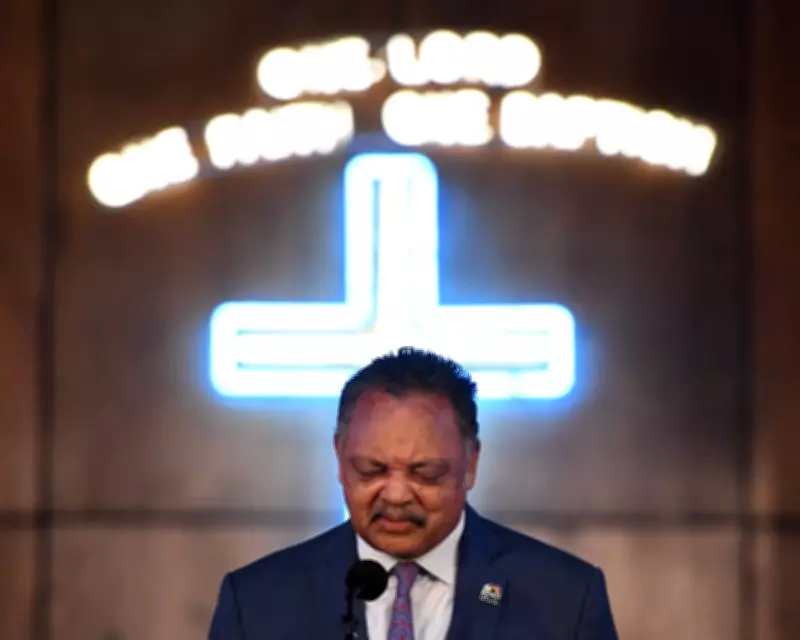
Civil Rights Pioneer Reverend Jesse Jackson Passes Away at 84
The Reverend Jesse Jackson, a monumental figure in the American civil rights movement and a fixture in Democratic politics for more than half a century, has died at the age of 84. His family confirmed his passing in a heartfelt statement that celebrated his lifelong dedication to justice and equality.
A Legacy of Service and Leadership
Jackson's family described him as "a servant leader" who devoted himself not only to his family but to oppressed and overlooked communities worldwide. "We shared him with the world, and in return, the world became part of our extended family," the statement read. They urged supporters to honor his memory by continuing the fight for the values he championed throughout his remarkable life.
While no specific cause of death was provided, Jackson had been living with progressive supranuclear palsy (PSP) for over a decade, having initially been diagnosed with Parkinson's disease. In recent years, he was hospitalized twice with Covid-19, highlighting his vulnerability during the pandemic.

From Segregated South to National Prominence
Born on October 8, 1941, in Greenville, South Carolina, Jackson experienced segregation firsthand during his formative years. His early activism began in 1960 when, as a college student, he participated in the Greenville Eight protest at the whites-only public library. This peaceful demonstration led to a federal lawsuit that successfully integrated the library system.
Jackson's athletic prowess earned him a football scholarship to the University of Illinois, and he later transferred to North Carolina Agricultural and Technical College, where he continued playing quarterback while deepening his involvement in civil rights activism through sit-ins and student leadership roles.
Mentored by Martin Luther King Jr.
Jackson's path intersected with Dr. Martin Luther King Jr. in the early 1960s, beginning a mentorship that would shape his life's work. After joining King's Southern Christian Leadership Conference (SCLC), Jackson took on leadership roles in Operation Breadbasket, an economic justice initiative that leveraged Black churches to pressure companies for fair employment practices.
Tragically, Jackson witnessed King's assassination on April 4, 1968, from the balcony of the Lorraine Motel in Memphis, Tennessee. This profound loss remained with him throughout his life, fueling his determination to continue the struggle for racial and economic justice.
Presidential Campaigns and Political Impact
In 1984, Jackson made history as the second Black candidate to mount a nationwide presidential campaign, following Shirley Chisholm. Though he lost the Democratic nomination to Walter Mondale, his campaign platform emphasized economic justice, peace, and human dignity. He ran again in 1988, performing strongly before ultimately losing to Michael Dukakis.
Jackson's political work extended beyond presidential bids. He founded People United to Save Humanity (PUSH) in 1971 and later established the National Rainbow Coalition, which eventually merged to form the Rainbow Push Coalition. These organizations focused on educational opportunities, economic empowerment, and voting rights, providing millions in college scholarships and assistance to families facing foreclosure.
Enduring Influence and Recognition
Throughout his career, Jackson remained a vocal advocate for racial equality and social justice. During the Covid-19 pandemic, he highlighted disparities in healthcare outcomes for African Americans, questioning why anyone would be surprised by disproportionate death rates given centuries of systemic inequality.
In 2000, President Bill Clinton awarded Jackson the Presidential Medal of Freedom, the nation's highest civilian honor, recognizing his decades of work to expand opportunities for people of color. Jackson's influence persisted through subsequent administrations, including his commentary on the Trump presidency and the rise of the Black Lives Matter movement.

Reflecting on King's legacy in 2018, Jackson emphasized the importance of multiracial coalitions and persistent activism. "The moral arc of the universe is long and it bends towards justice, but you have to pull it to bend," he said, echoing King's philosophy while acknowledging the ongoing challenges in the fight for equality.
Jackson is survived by his wife Jacqueline, whom he married in 1962, and their children. His passing marks the end of an era for the civil rights movement, but his legacy of courage, compassion, and unwavering commitment to justice will continue to inspire future generations.