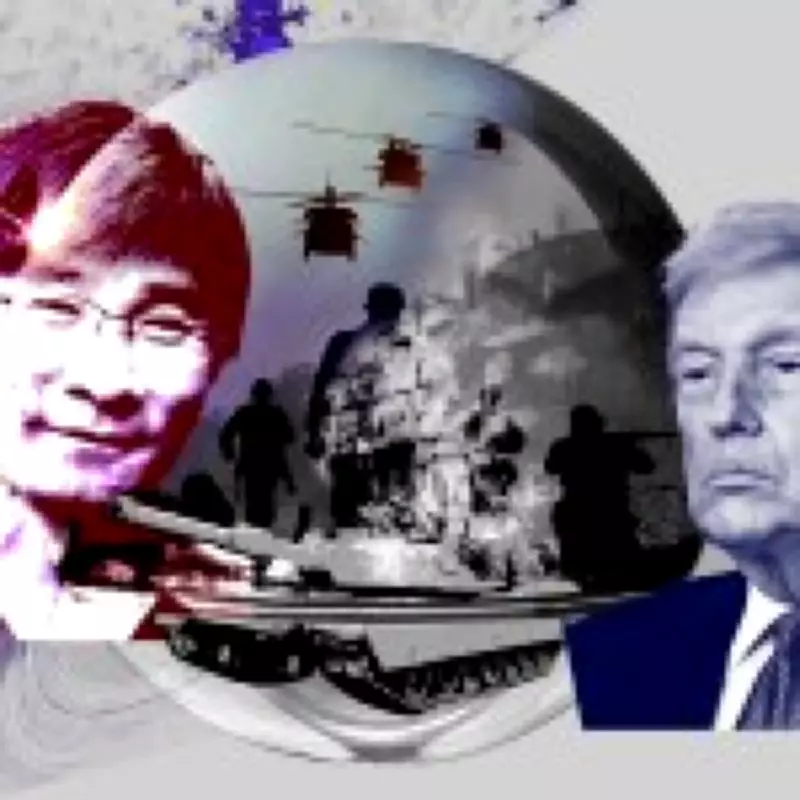
The Chinese Nostradamus: Viral Academic's Predictions on Trump and Iran War
Professor Xueqin Jiang, a Beijing-based educator and writer, has earned the nickname 'The Chinese Nostradamus' after several of his political forecasts appeared to align strikingly with real-world events. His online lectures, shared through YouTube and Substack under the project Predictive History, have gone viral, particularly as global tensions escalate.
Past Predictions Coming True
Jiang previously foresaw Donald Trump returning to the White House for a second term as President of the United States. He also predicted that tensions with Iran would likely escalate into an all-out war. As the Middle East crisis deepens, millions are revisiting his earlier lesson titled 'The Iran Trap,' searching for clues about future developments.
In his analysis, Jiang uses historic patterns to anticipate future events, inspired by the ancient philosopher Confucius' quote: 'study the past if you would divine the future.' His 2024 lesson on Iran gained renewed traction after military strikes in the region sparked fears of a wider conflict, drawing millions of views as social media users circulate clips of his discussions.
Current Crisis and Historical Parallels
The crisis escalated when Donald Trump and Israeli Prime Minister Benjamin Netanyahu launched a coordinated military strike targeting Iran's nuclear capabilities after diplomatic negotiations broke down. Iran retaliated with strikes on countries hosting US military bases across the Middle East, resulting in the death of Supreme Leader Ayatollah Ali Hosseini Khamenei.
Jiang had warned in 2024 that a second Trump presidency could lead to a direct invasion of Iran. He stated, 'If Trump were to win a second term, he would likely contemplate invading Iran. While an initial invasion would seem successful, American forces would quickly become bogged down in Iran's mountainous terrain.' He also predicted the conflict would be framed as a mission to destroy Iran's nuclear capabilities and bring democracy to the region.
After the first wave of strikes on February 28, Trump defended the decision in a video, echoing themes Jiang had suggested might justify military action. Trump said, 'It has always been the policy of the United States, in particular my administration, that this terrorist regime can never have a nuclear weapon. I'll say it again, they can never have a nuclear weapon.'
Three Forces Pushing Toward War
Jiang identified three key factors driving the US toward conflict with Iran. First, the influence of the Israel lobby, including the American Israel Public Affairs Committee. Second, America's reliance on global empire, with Jiang noting, 'America is now addicted to empire, because empire represents easy money. All money has to be channeled through the US.' Third, the long-running rivalry between Iran and Saudi Arabia, played out through proxy conflicts across the region.
Future Forecasts and Strategic Insights
Jiang has made further predictions about the conflict's future. He suggested a 'full-scale US invasion of Iran' could be launched in March 2027, with support from Israel, Saudi Arabia, and allies including the United Kingdom, Australia, the United Arab Emirates, and Poland. He argued that Iran holds strategic advantages in a prolonged war, stating, 'The United States military is not designed to fight a 21st century war.'
To illustrate potential outcomes, Jiang compared the conflict to ancient history, specifically Athens' invasion of Sicily in 415 BCE during the Peloponnesian War. He warned that the US, under Trump's leadership, could face similar challenges if drawn into a prolonged conflict in Iran's difficult terrain, akin to the Vietnam War in the 1960s and '70s.
Rising Fame and Comparisons
The renewed interest in Jiang's forecasts has drawn comparisons to famous prophetic figures like Nostradamus and Baba Vanga, whose predictions are often revisited when world events mirror their warnings. Jiang's background includes collaboration with Harvard's Global Education Innovation Initiative research team, authorship of a book on education reform, and organization of study abroad programs at prestigious Chinese schools.
As geopolitical tensions continue to unfold, Professor Xueqin Jiang's insights remain a focal point for those seeking to understand potential future scenarios based on historical analysis and pattern recognition.