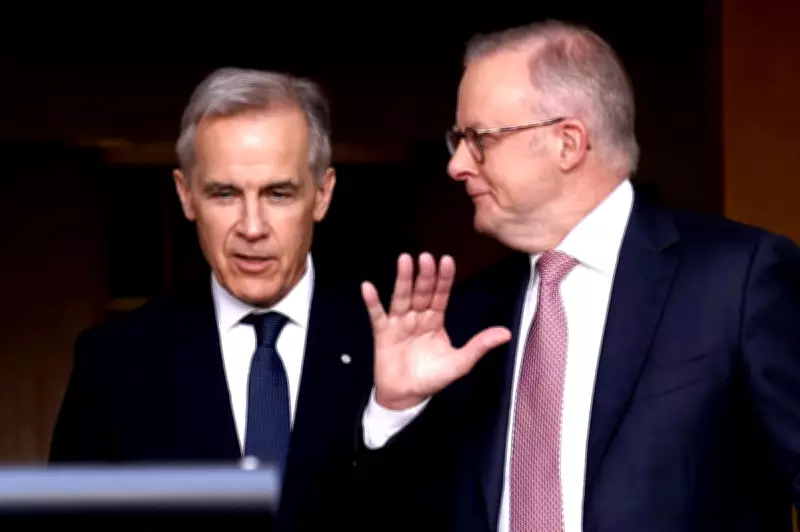
Mark Carney's Prescription for Global Rupture Meets Australian Resistance
In a striking series of addresses that captivated Canberra, Canadian Prime Minister Mark Carney delivered a powerful message on the demise of the post-World War II rules-based order. Speaking at the Lowy Institute in Sydney and before a packed House of Representatives, Carney argued that middle powers like Australia and Canada must forge new alliances to navigate an era dominated by US-China rivalry. However, despite the buzz surrounding his insights, Australia's political landscape appears stubbornly resistant to his call for change.
The Illusion of Business as Usual in Canberra
Carney's speeches, described as erudite and persuasive, highlighted a critical "rupture" in global affairs, urging nations to move beyond mourning the old system. He emphasized that trusted middle powers acting together could achieve greater security and prosperity. Yet, both the Labor Party and the Coalition seem to be ignoring this reality, maintaining a facade of normalcy while clinging to traditional alliances.
Prime Minister Anthony Albanese, who has met Carney ten times since their elections, shares a progressive vision with leaders like France's Emmanuel Macron and Britain's Keir Starmer. They position themselves as a bulwark against rising right-wing forces globally. Announcements on trade, defense, AI, and superannuation cooperation between Australia and Canada underscored this alignment, with Australia joining a top-tier democratic group on critical minerals.
Aukus and Iran: Stumbling Blocks to Independence
Where Carney's message falters in Australia is in the nation's unwavering commitment to the United States, exemplified by the Aukus nuclear agreement and support for US actions in Iran. Australia has committed over $1.6 billion to bolster US defense capabilities, with the Aukus deal potentially costing at least $370 billion. This agreement ties Australia's defense strategy closely to US interests, raising questions about autonomy in potential conflicts, such as over Taiwan.
Labor's defense of the rules-based order has been a cornerstone of its policy, yet recent events challenge this stance. The government's support for US and Israeli strikes on Iran, actions widely viewed as outside international law, has sparked controversy. When pressed on the legality, Albanese and Foreign Minister Penny Wong offered vague justifications, focusing on countering Iran's nuclear ambitions and terrorism.
The Hypocrisy of Political Posturing
The revelation that three Australian sailors were aboard a US submarine that sank an Iranian warship, resulting in significant casualties, further complicates Australia's position. After initially denying involvement, Labor faced scrutiny, highlighting a disconnect between its rhetoric and actions. This scenario invites comparisons to how the Albanese opposition might have criticized similar moves by the Coalition in the past, yet internal dissent within Labor remains minimal.
Carney, while expressing confidence in the Five Eyes intelligence alliance, subtly critiqued Australia's reluctance to pivot from US dependence. The political system's inertia suggests a deep-seated stubbornness, with leaders unable to envision a path away from American influence.
Conclusion: A Call for Clarity Amid Global Shifts
As the excitement from Carney's visit fades, Australia stands at a crossroads. The global rupture he identified demands a honest reassessment of foreign policy. Instead of pretending the old order persists, Australia must confront its reliance on the US and explore Carney's vision of middle-power collaboration. Without such clarity, the nation risks being left behind in a rapidly changing world, its prosperity and security hanging in the balance.