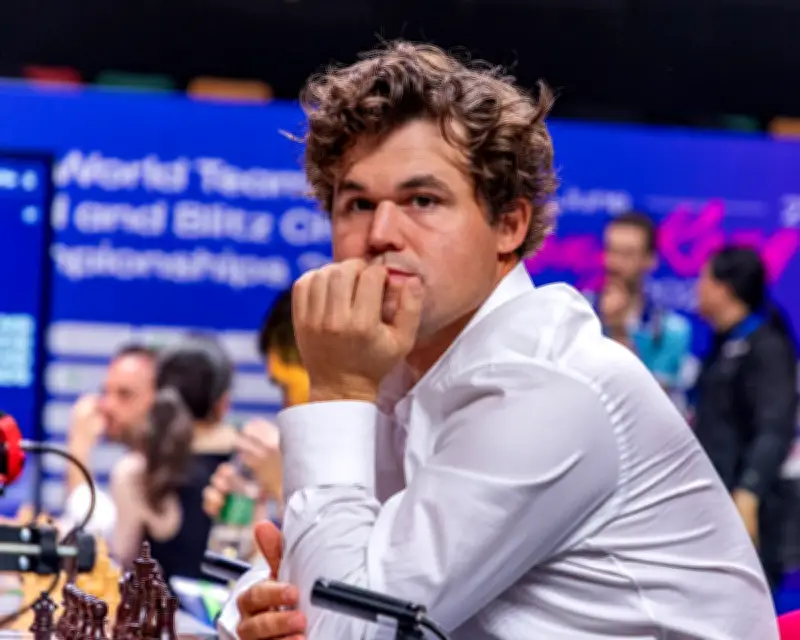
Magnus Carlsen suffered four consecutive defeats at the World Team Rapid in Hong Kong last week, a first since 2002 when he was 11 years old. This losing streak, combined with a fourth-place finish among six grandmasters in Oslo last month, has sparked debate about whether the 35-year-old Norwegian world No. 1, now a wealthy family man with a baby son, may be tempted to further reduce his chess activities and adopt a more relaxed lifestyle.
Carlsen's early success and sudden collapse
Carlsen began the tournament well, with a draw and two victories, including a win against historic rival Vasyl Ivanchuk. That game showcased Carlsen's signature style: a prolonged squeeze and grind maintained under acute time pressure. He also defeated China's Xu Xiangyu. However, the debacle began in the fourth round against India's Arjun Erigaisi, world No. 8, whom Carlsen had defeated in a playoff at Malmö weeks earlier. Erigaisi triumphed with a ferocious attack on Carlsen's king, culminating in a queen sacrifice.
In the next round, Carlsen chased a win in a drawn endgame against Armenia's Shant Sargsyan and blundered his rook in a single move. He sat out the final two rounds that day, but the following afternoon he lost to Candidates winner Javokhir Sindarov. In none of the four defeats was Carlsen able to establish positions favorable for his squeeze technique.

Carlsen's immediate future and scheduling conflicts
Despite the setbacks, Carlsen cannot realistically withdraw from top-level chess before the end of 2026. In early August, he will defend his title at the Esports World Cup in Paris, an event that conflicts with the Sinquefield Cup in St. Louis, the premier event of the Grand Chess Tour. This scheduling dilemma has divided leading US grandmasters: Hikaru Nakamura and Hans Niemann will compete in Paris, while Fabiano Caruana, Wesley So, and Levon Aronian will play in St. Louis.
At the end of 2026, Carlsen is expected to defend his double crown at the FIDE World Rapid and Blitz Championships. Only after that can he pause to consider his future, and his results in the second half of the year will likely influence his decision.
China's resurgence in chess
Meanwhile, China has re-emerged as a dominant force in global chess. The team Dragon Chilling, representing Beijing's national team under a different name, won both the Rapid and Blitz gold medals in Hong Kong. They attributed their success to team spirit and strong preparation. Ding Liren, world champion from 2023-24, returned on top board, but his role seemed to be a holding operation while teammates Wei Yi and Yu Yangyi scored heavily on the next boards.
China's performance signals intent for the 2026 Chess Olympiad in Samarkand, Uzbekistan, starting in September. Eight years ago, in 2018, China won double gold in the Open and Women's sections, outpacing the US, Russia, and India. After the Covid pandemic, which limited international events in China and possibly affected Ding with long Covid, Beijing is again expansionist and aims for double gold in Samarkand.
Individual achievements and rising stars
Among individual achievements in Hong Kong, the world's youngest grandmaster, Argentina's Faustino Oro, aged 12, performed strongly for the Chess United team led by former world champion Vishy Anand. Oro is potentially the greatest South American player since Miguel Najdorf half a century ago. Like Najdorf, he unleashes moves with physical intensity, as shown in his game against Poland's Jan-Krzysztof Duda, world No. 14, whom Oro defeated—the highest-ranked opponent he has beaten in major competition.