
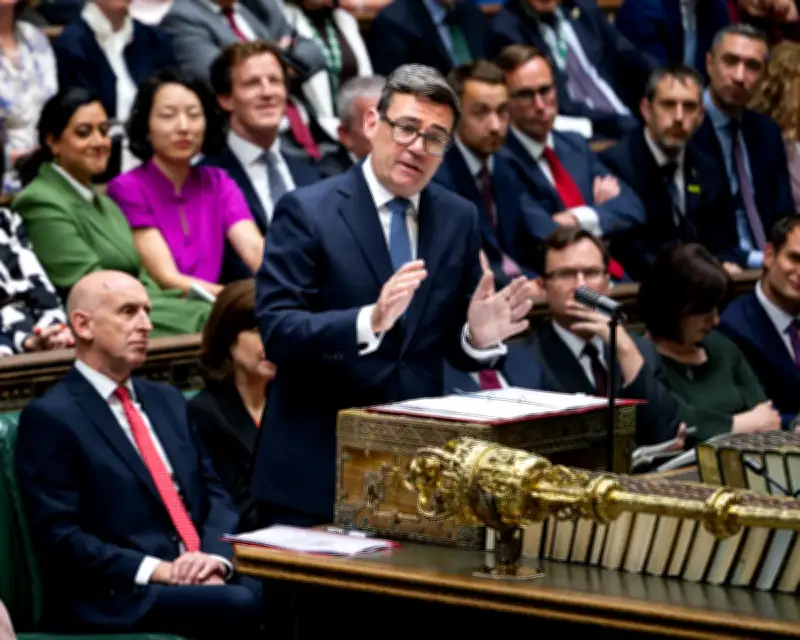
Andy Burnham's first Prime Minister's Questions as Prime Minister was a carefully watched event, and by most accounts, he emerged with a comfortable victory. The session, held in the House of Commons on Wednesday, was expected to usher in a new era of consensual politics, but that promise lasted only five minutes. Instead, it quickly reverted to the traditional cut and thrust of political point-scoring, with Burnham himself admitting he couldn't resist the temptation.
A Tense Start and an Early Triumph
Burnham began the session visibly nervous, twitchy, and not entirely in command, a state he himself acknowledged. He opened with, "It's good to be back at the dispatch box," and then listed some of the Labour government's achievements, including the number of small boat crossings being at their lowest for years. The Conservative benches barely reacted, showing little interest in crediting Labour for any progress.
The Tory leader, Kemi Badenoch, started with a flirtatious tone, congratulating Burnham on his stamina, to which he merely nodded. However, she quickly shifted to a more aggressive stance, accusing him of always promising the earth and never daring to say no to anyone. She challenged him to name anything he had ever cut.
Burnham's reply was simple and effective: "Tax." He detailed how he had removed VAT on electricity bills and cut business rates for pubs and hospitality venues. This direct answer caught Badenoch off guard, as she had anticipated a more evasive response. The exchange effectively ended the contest, with Burnham's backbenchers showing their support.
Bond Markets and Economic Blame
Badenoch then turned to the international bond markets, suggesting they had a particular grudge against Labour. Burnham responded calmly, explaining that the rising borrowing costs were a global issue, not a personal vendetta. He pointed out that other countries were also facing similar pressures and that the blame lay with the Conservative Party's 14 years of stagnant growth.
He could have also mentioned the Iran war and the spike in oil prices, a conflict for which Badenoch had initially shown enthusiasm. Burnham's implication was clear: the Tories had trashed the economy, and he was merely trying to pick up the pieces.
Badenoch sounded hurt, accusing Burnham of breaking his promise to avoid point-scoring. Unapologetic, Burnham admitted he couldn't help himself, enjoying the laughter and support from his own backbenchers, noting that PMQs was a team sport.
Shadow Chancellor as an Open Goal
Burnham also highlighted the vulnerability of Badenoch's appointment of Andrew Griffith as shadow chancellor. Griffith co-authored Liz Truss's mini-budget and was one of its most outspoken defenders. For Labour, this is an open goal, and they intend to exploit it relentlessly. Despite Badenoch's dismissal of history, the country has not forgotten the lasting damage of the 49 days of Tory chaos.
After failing to rule out further tax rises and spending commitments, Burnham returned to his positive message of good vibes, hope, and positivity. This was enough to secure a comfortable first PMQs, but he is aware that this is just a half-hour bubble, and the challenges outside will be far tougher.
Burnham seemed to relish the work, offering meetings to virtually every MP, including Samantha Niblett, whose stated mission is to have a summer of sex. Not everything went his way, though. Tan Dhesi, the Labour chair of the defence select committee, was visibly grumpy about the 3% promise, or possibly about not being made a minister. When the speaker called time, Burnham looked happy, having won the first PMQs 1-0, though no one was officially keeping score.




