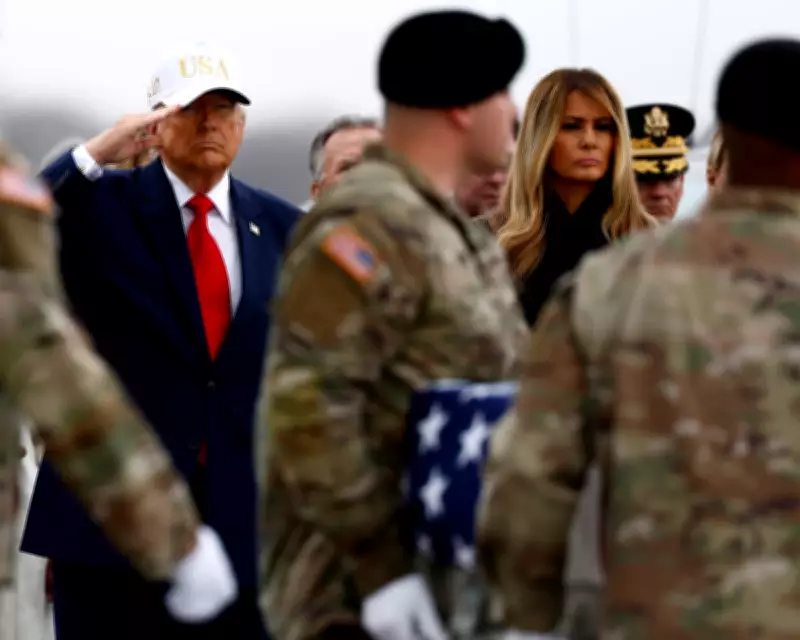
Trump's War Obsession Meets British Resistance
As Donald Trump salutes flag-draped coffins at Dover Air Force Base in Delaware, a stark divide emerges between American foreign policy ambitions and British public sentiment. The image from March 7, 2026, captures a moment that symbolizes what many Britons fear becoming entangled in once again: another US-led military conflict with devastating consequences.
Labour's Foreign Policy Dilemma
Prime Minister Keir Starmer faces mounting pressure from conservative voices to align Britain with Trump's aggressive stance toward Iran. Former Prime Minister Tony Blair has publicly declared that Starmer "should have backed America from the very beginning," echoing calls from Tory leader Kemi Badenoch, Nigel Farage, and right-wing media outlets. This coalition of voices urges Britain to follow Washington's lead despite the catastrophic outcomes of previous interventions.
The British public, however, tells a different story. Recent YouGov polling reveals that 49% of Britons oppose the war on Iran, with barely one-fifth expressing support. This represents a dramatic shift from previous conflicts where public opinion initially favored military action. The memory of Iraq, Afghanistan, and Libya has fundamentally altered British attitudes toward foreign military adventures.

The Human Cost of Intervention
The current conflict has already exacted a terrible human toll. According to the Human Rights Activists news agency, more than 1,000 civilians have been confirmed killed in Iran, with the actual number likely much higher. Among the casualties were 168 people, mostly young girls, killed in a school strike that US investigators reportedly attribute to American military forces.
Infrastructure attacks have compounded the humanitarian crisis, with medical facilities, water desalination plants, and oil refineries targeted. The refinery strikes have created an environmental catastrophe, blanketing Tehran in toxic black rain and severely degrading air quality. Trump has openly suggested that Iran's map will "probably not" look the same after the war, raising concerns about territorial dismemberment.
Historical Parallels and Failed Lessons
The current situation bears disturbing similarities to previous conflicts that Britain joined under American leadership. The Iraq war resulted in hundreds of thousands of deaths, sectarian violence, the rise of Islamic State, and ultimately an authoritarian government. Afghanistan saw two decades of occupation marred by war crimes, ending with the Taliban returning stronger than ever. Libya descended into civil war and became a failed state with rival governments.
"Our political and media elites appear incapable of learning a single lesson," observes columnist Owen Jones. Despite these disasters, the establishment continues to advocate for military alignment with Washington, ignoring both the moral implications and practical consequences for British security.
The British Price of Allegiance
Britain's subservience to American foreign policy has come at significant cost. Approximately £47 billion in today's money was spent on the Iraq, Afghanistan, and Libya interventions—funds that could have addressed genuine security threats like climate change. More tragically, 636 British soldiers lost their lives in these conflicts, predominantly working-class young men from communities like Wigan, Stoke-on-Trent, Blackpool, and Fife.
Security assessments have repeatedly shown how these wars increased terrorism risks. The Chilcot inquiry found that invading Iraq would heighten terrorist threats, while the Prevent program acknowledged that grievances over UK military operations in Afghanistan drove support for violent extremism. The Manchester Arena bombing inquiry identified the Libya conflict as a key factor in the perpetrator's radicalization.
Public Wisdom Versus Elite Folly
The British public has demonstrated greater wisdom than its political leadership. Where two-thirds once supported the Afghan war and half backed the Iraq invasion initially, now barely 20% support the Iran conflict. Ordinary citizens have drawn obvious conclusions from repeated disasters: these wars proved ruinous for attacked countries, for Britain itself, and for global stability.

This rational public consensus finds little representation in mainstream political discourse or media coverage. The disconnect helps explain the Green party's surge, as voters reject elites they perceive as extremists who "drag their country into one hideous crisis after another and learn nothing from the wreckage."
A Future at Crossroads
Britain stands at a critical juncture. Continued subservience to US foreign policy means repeated slaughters that devastate other societies, destabilize global order, squander national resources, sacrifice British lives, and ultimately reduce security. The establishment's immunity to public common sense suggests a fundamental failure of democratic accountability.
As the conflict escalates with Iran demonstrating greater capacity to retaliate than previous targets, oil prices soar, and economic impacts approach worst-case scenarios, the stakes could not be higher. The British public has learned hard lessons from past disasters. The question remains whether political leaders will finally heed their wisdom or repeat catastrophic mistakes.